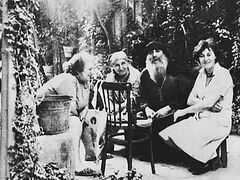
On December 24, 2012, by the decision of the Holy Synod of the Georgian Orthodox Church, Elder Gabriel (Urgebadze) was canonized as a venerable father, an uncommonly swift canonization occurring just seventeen years after his repose. On December 25, 2014, the Holy Synod of the Russian Orthodox Church resolved “to include the name of the Venerable Gabriel of Samtavro in the calendar of saints of the Russian Orthodox Church, fixing the celebration of his memory on November 2, as established in the Georgian Orthodox Church.”
Ketevan Bekauri, St. Gabriel’s spiritual daughter, has shared stories with us about what the elder was like in life, about his faith, simplicity, and even his sense of humor—and about the lessons that her holy spiritual father taught her.
 St. Gabriel (Urgebadze)
Having the Faith of Abraham
Fr. Gabriel was always feared. Why? He spoke the truth. And whoever speaks the truth is feared by everyone. When I read the Bible, young as I was, and reached the life of Abraham and his communion with God, it was absolutely incomprehensible to me. I did not accept Abraham, and Isaac did not appeal to me either, “What kind of nonsense is this? Abraham is a murderer. And why isn’t Isaac running away from him? What kind of father is that?” I did not understand this and, like a fairy tale, like a legend, I read the Bible. And when I looked at Fr. Gabriel, I immediately thought, “Abraham has arrived!” I recognized his spirit. Why Abraham? For his faith, which I felt deeply with my soul.
Whenever God comes to a person in the Holy Scriptures, He always says, I am the God of Abraham, and the God of Isaac, and the God of Jacob (Mt. 22:32). Because Abraham knew God and trusted Him to the very end. Abraham had a very strong faith; he was ready to sacrifice his only son to God and did not even hesitate… He trusted God and loved Him more than anything. Fr. Gabriel bore this kind of faith—a faith as strong as a rock. I have never in my life met a person like Fr. Gabriel.
Loving the Mother of God
 When I was reading the Gospel, I was still young and suffering a great deal; I wept for Christ, yet I could not accept the Mother of God. I just did not have it in me, and besides, there is hardly anything written about Her in the Gospel. I never told anyone about this. The serenity of the Mother of God was incomprehensible to me. I did not accept Her, I did not love Her, and never lit a candle before Her icon. Now, of course, I always light one wherever there is an icon of the Mother of God. But back then, I did not have that in me yet.
Once during a feast at Shavnabada,1 at a large banquet, I purposely sat in the corner so that Fr. Gabriel would not look at me. He was in another corner, far away. Then, a miracle occurred. He stood up, took a glass, and looked straight at me, weeping and saying, “Mother of God, Mother of God!” He was weeping and saying only these words. He said that She has forgiven everyone, that no greater love exists than the love of the Mother of God. He said that Christ was spat on, mocked, crucified, and betrayed—yet She forgave everyone everything. And there is no greater love.
Striving for Simplicity
Looking at Fr. Gabriel, you understand that there was no other monk or elder like him in the twentieth century. He belonged to the first century—he walked barefoot just like Christ. He always said that Christ was a simple Man Who walked barefoot and wore a tunic (also called a khiton). When the tunic would tear, the Mother of God would sew it, because they lived so poorly. The Mother of God sewed and then sold Her handiwork at the market. Well, what could they do? Everyone lived like that… And when the Mother of God sat at the market, people did not know Who they were sitting next to.
Fr. Gabriel especially loved the Kazan Icon of the Mother of God, and always loved to pray before it. And you know what he used to say? The greatest prayer is the Lord’s Prayer.
Always Choosing God
My most vivid memory is when I first felt the kind of freedom God gives us. Whichever path you step on becomes your road in life. God has nothing to do with it—you make a choice in life. “If you want to leave, leave; if you want to stay, stay. But if you stay, you will be the way I want you to be,” that’s what God tells you. He does not forbid you from doing anything; He simply tells you what is good and what is bad, but the choice is in your hands. And if you say, “I want to betray Thee like Judas,” He will reply, “Go ahead, betray Me.” “I want to leave Thee.” He will reply, “Yes, if you want to, leave.” But if you tell God that you want to be with Him, He will answer, “Yes, I desire that too. But since you want it, be the way I will make you.”
Living the Gospel
Fr. Gabriel lived by the Gospel. Aside from the Gospel, there was nothing else.
The holiest and purest time of my life was the four years when I often stayed with Fr. Gabriel. Not because I was pure myself or well-behaved—no. It’s just that whenever I sat with him, it was impossible to be any other way. Beside him, you were constantly in the Gospel and always mindful of hell. It is so good when you do not forget that hell exists. You become fearful that God may turn away from you.
Defending Your Church
We must become true soldiers of Christ, just as Fr. Gabriel was, just as our saints were. And even today, such great, holy people still walk the earth. We should cherish our priests; everyone is good everywhere…
 Nowadays is very fashionable to criticize—people even turn on the Patriarch; it is a nightmare. Is that even allowed? If Fr. Gabriel were alive right now, do you know what he would do in response to this? We must always defend our Church, we must fight; an Orthodox Christian must always be a true warrior. And if you are an Orthodox Christian, you have nothing to fear at all. Fr. Gabriel was not afraid of anything in life, absolutely nothing, because he walked with God. If you walk with God, what is there to fear?
Loving Everyone
Fr. Gabriel taught us that we must love everyone, that every single person is close to us, very special, and that bad people do not exist in this world at all. Yet, each one of us has a very small circle of people we love because we cannot contain the rest in our hearts. We love our neighbors, but not all of them; we love our relatives, but not all of them; and we love our friends, too, but again, not all of them.
One day, I walked into Fr. Gabriel’s room. He was lying down, weeping and shaking his head. As I waited for him to speak, he suddenly began, “A Chukchi2 man is my brother. I went to visit him, and he fed me fish—how kind he is! He is a shepherd.” He said that the Chukchi people are our brothers, too, and we must love them as well. And he was not acting—he was speaking straight from the heart, “I came to him, and he fed me fish, the Chukchi is so kind! Sister, look how kind he is—he fed me fish; he is a respected shepherd, you see, a shepherd.”
That is how we should treat our neighbors! This is what is needed in Orthodoxy—this kind of love. We must learn from one another, because human beings are the most important for God.
Giving Everything to God
What does God require of us? He needs nothing from us, except for the correction of our sins. How easy it is with God, and how difficult it is for us! How easy it is to walk with Him, and yet how hard! It is pride that destroys us. We have lost our sight through pride, we have lost our hearing. God speaks to us every single minute, but we do not hear. We cannot hear the voice of God because we do not want to, because we are proud, because we do not follow Him. He says, “Leave everything behind, and I will help you. Come with Me.” But we answer, “No-o-o.” We cannot do it, we simply do not trust Him. He is a Stranger to us, a Stranger—and that is what we should fear. He says, “Let it go,” and we reply, “No, how can I let it go?” We need the money, and the comfortable life, and our sins. That is the whole point.
Being Alive
He was sick, but he never felt it: he was always cheerful and full of life because he was with God; and with God, everyone is alive, so he was just as alive. He was dead to this world, but alive in Christ.
 Fr. Gabriel never used “I” or “you” in conversation; it was always “we”. “We” meant everyone together—that is, the Orthodox. He would say, “Now we are going to cook such a soup that the Pope will ask for a taste,” his humor was incomparable!
And there was another incident. Once, I was sitting with him, thinking to myself, “I just hope he doesn’t levitate,” sitting there in fear. And he said to me, “Ketevan, I have been living as an elder for forty years, yet some people think I am a magician.”
Once, when I was sitting by his side, I was reading something. As I read, I realized there was not enough light, and I could not quite make out the words. Suddenly, a light appeared from somewhere. I looked at the lamp—no, it was not coming from there; I looked at Fr. Gabriel, and this light was emanating from him. Later, Fr. Gabriel said, “Yes, sometimes I shine like a searchlight.” He had a wonderful sense of humor! He was so full of life, because he had a truly living faith. And at the end of our conversation, he would say, “A thousand thanks to God, and five hundred to you.”
Loving Russia
Once, he rushed out of his cell with his hands raised high, running and shouting, “Russia has recognized me! Russia! Russia!” Back then, I did not understand and thought to myself, “I have been staying here since morning; perhaps someone from Russia came to visit him, and to him, this one person represents all of Russia.” But he kept running right toward me, “Russia has recognized me! Russia, Russia, Russia has recognized me!” He ran past again, “Russia has recognized me! Russia! Russia!” I asked him, “At what time, Father Gabriel? I’ve been sitting here since morning and haven’t seen anyone.” Back then, no one knew him, and at that moment, I was deeply worried for him. And then, a miracle occurred: it later turned out that he truly did become famous in Russia. Look how many people come from Russia even now! How deeply he is venerated and loved! And to this day, I still remember him saying, “Russia has recognized me!”