Autumn for me is not only a time to remember my favorite poets, to whom these October days belong by right of birth—the days of Mikhail Lermontov, Sergei Esenin, and Alexander Pushkin through his classic verses—but also days of remembrance for my spiritual mentor, whose radiant face I see through time, through the blazing foliage of maples, birches, and ash.
Indeed, the longer I gaze at the trees standing near my house—at the leaves trembling in the wind that tears them away and carries them through the cooling air—the more clearly the faces of people dear to me come into view.
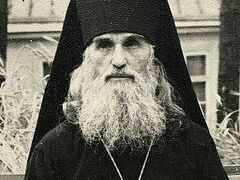
And most often, I see the face of Metropolitan John (Snychev) of St. Petersburg and Ladoga—after all, he served for thirty years here in Samara,1 and spent only the final five years of his earthly life in the northern capital.
It is the story of my meeting with this man who left an indelible mark on my soul that I wish to share.
 Metropolitan John (Snychev) I will begin these notes from May 1988.
At that time, joyful news swept across our vast country: The government of our “land of triumphant socialism”, which was “successfully building communism,” had decided to officially mark the millennium of the Baptism of Russia.
This news seemed improbable, almost fantastic. How could a country whose leader had only recently promised to show everyone “the last priest” on television2 suddenly decide to celebrate a date that shows even the poorly educated that Russia, Rus’, was from its very beginnings a deeply religious, Orthodox country?
Yet, the chief architect of Perestroika, Gorbachev himself, confirmed that we would indeed mark this historic anniversary—and not just anywhere, but at the Bolshoi Theater.
More than 1,000 foreign journalists arrived in Moscow, along with nearly all the hierarchs of the Local Orthodox Churches, and the celebration did indeed take place—to the amazement of the entire world.
Following these events in Moscow, permission had to be granted to celebrate this historic date across all dioceses of the USSR. Soon, the joyful news reached Samara (then Kuibyshev), and I received an invitation to a solemn assembly to be held at the Opera and Ballet Theater.
Now, I must explain why I received an invitation signed by Archbishop John of Kuibyshev and Syzran.
At that time, I had only just started going to church, but I did so secretly so that none of my acquaintances would notice me. I had the right not to hold a regular job and could focus on literature instead, since I was a member of the Union of Writers and Filmmakers. This meant I could not be persecuted for “social parasitism.”
To make a living, I took on assignments at a newsreel studio—especially those that aligned with my spiritual aspirations. They were also reflected in what I was writing back then.
My book, I Thirst, which came out that very year, summed up these pursuits. It included a novella about the final days of Dostoevsky’s life, which I titled exactly that. A thirst for life in Christ was, it seemed to me, the central theme of Fyodor Mikhailovich’s destiny. And the thirst to be a prophet, as expressed in Pushkin’s brilliant poem,3 was also a central theme.
I too felt a thirst, though a different one, of course, than that of my favorite writer. It was a thirst to write, freed from the daily grind, from random topics and “newspaper trash.” And at the same time, it was a thirst to find myself spiritually—that is, to resolve to openly profess my faith in Christ the Savior.
And so, in those days, I was agonizingly searching for ways to merge, to the best of my ability, into this joyful stream of the Orthodox people, and to find a “safe, passable topic” tied to some historical date so that I could bring it to life on television or in film. At last, I found one.
The topic took shape as: “Culture and the Church.” Yet even this “neutral” topic was rejected by the bosses, no matter how hard I tried to convince them that everything began right there in the Church—painting and music, to say nothing of the word, of literary monuments that were officially called “Old Russian literature”, when in reality were “hagiographic” literature.
Nothing helped, neither my arguments nor my eloquence.
I had already given up hope when, out of nowhere, help arrived. A radio correspondent, having heard about my endless rounds to publishing offices, called me and suggested putting together a broadcast.
She was a strong-willed, commanding lady—the kind who could break through brick walls. Large and determined, she had already managed to arrange the broadcast with both the diocese and her own bosses.
And so, here we were, strolling down an old Samara street, passing wooden houses and stone mansions. Lilacs were bursting over the fences, and the air smelled of freshness, spring, joy, and anxiety. It was an old, deeply familiar street; I grew up in a wooden house just like any of those. Granted, not here but in Saratov, my mother’s home city. But that doesn’t matter—the streets are so similar that I feel exactly as I did back then, walking to school to take my exams.
Here we were, walking up the wooden stairs to the second floor. The archbishop’s secretary opened wide the door to a small room.
A short, thin man stood up from behind an ordinary office desk. He smiled and held out his hand to me.
A fringe of white hair, a white beard and mustache, and a light–colored cassock—he seemed somehow weightless and welcoming, completely different from how I had imagined the head of the local diocese. I had expected to see someone imposing, authoritative, and for some reason even formidable, with a booming voice like our cathedral deacon’s.
But here stood a radiant man, asking us to make ourselves comfortable.
Radiant is the exact word—that is how he entered my memory, instantly and forever.
As I realized later, he entered my heart as well.
The correspondent—her name was Natalia—was setting up a microphone and a bulky tape recorder on the table.
And so, we sat opposite each other to begin our conversation.
When we walked in, a stately young woman was standing behind Vladyka. This was Nadezhda Mikhailovna Yakimkina, his spiritual daughter, with whom I later became close friends. She worked as the chief accountant for the diocese, and she had come to Vladyka’s office just in case he needed protection—you never know what to expect from these journalists. This was, after all, one of the very first interviews Vladyka had ever given for the radio, or for the mass media in general.
To my questions on the chosen topic, Vladyka gave only monosyllabic answers. To keep the conversation going, I began to talk up a storm, showing off my erudition in iconography and church architecture—everything I had managed to learn. I had already read quite a few books on the architecture of Ancient Russia and iconography, and had amassed a fairly decent library, which even included atheistic books (it was precisely through them that I learned about the essence and meaning of the Orthodox feasts).
“He’s read too many prefaces,” as Vasily Shukshin aptly put it in one of his short stories.4
 This is what Metropolitan John looked like before passing from earthly life into life eternal Vladyka smiled quietly, nodding in agreement in response to my escapades, while continuing to look at me intently with his bright eyes. Later I realized that he was studying me, giving me the chance to speak my mind, and only occasionally correcting me while adding substantial remarks to what I had said.
Little did I know that I was conversing with a doctor of church history and the author of a multi-volume work on Russian Orthodox hierarchs, which he had written together with his teacher, Metropolitan Manuel (Lemeshevsky; 1884–1968), who had passed these traits on to his own disciple, the then Archbishop of Samara and Syzran.
“You did so well!” the editor praised me as we were driving from Vladyka to the radio committee. “You completely drowned him out!”
And I genuinely felt like a hero who had managed to talk to a hierarch and put together a broadcast for a historic anniversary.
Only a few days passed before I realized what had really happened to me on that memorable day. But that realization came only after an equally memorable solemn assembly at our Opera and Ballet Theater, to which I had been invited by Vladyka.
My wife and I set off for the celebration together.
Everything was proceeding as usual. One after another, the speakers took the podium—first government officials, then a doctor of history from the university, followed by another well–known historian from Samara. They all spoke generic, well-known words. The only new element was that the meeting was presided over by a church hierarch, and that the audience included people in cassocks with crosses on their chests. And for the first time, Orthodoxy was spoken of with respect.
Just as the solemn assembly was smoothly drawing to a close, Vladyka announced that the floor was being given to me!
“If he is here, of course,” the archbishop added.
I flinched in surprise, completely caught off guard. He hadn’t given me any warning, and I was utterly unprepared to speak!
My wife nudged me in the side.
“Go!” she said with a demanding tone, and I had to stand up and head toward the podium. Usually, whenever I had an unplanned speech, I still managed to piece something together on the way there—at least how to start. Working in television and documentary film had taught me to react quickly to whatever was happening. Yet this time, not a single thought crossed my mind.
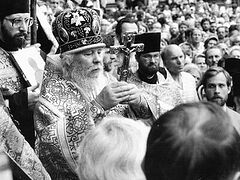
 Archbishop John of Samara and Syzran with the cathedral choir that sang at the celebrations dedicated to the millennium of the Baptism of Russia, at the Samara Opera and Ballet Theater
“What will I talk about? Where do I begin?” I stood at the podium in silence. Finally, I caught Vladyka’s demanding gaze. He nodded to me, which meant, “Speak!” And so I started.
Suddenly, from the very depths of my soul, something burst forth:
With spiritual thirst tormented,
I dragged myself through dark deserts
I hadn’t thought of Pushkin’s Prophet since my student days. In fact, I didn’t even know if I remembered it. Yet I went on reciting as if I had been preparing to read this exact masterpiece all along. I read it, as my wife, an actress, later told me, expressively and with deep feeling.
 In the courtyard of the diocesan administration, during one of the days celebrating the millennium of the Baptism of Russia. I am on the far left; next to Vladyka John is his secretary, Andrei Andreyevich Savin And then I began to speak about Pushkin—about how he journeyed from the irreverence of The Gabrieliad5 to the spiritual heights found in Orthodoxy. I also recalled Pyotr Ilyich Tchaikovsky, who used to visit Samara and conduct the choir at the Cathedral of the Kazan Icon, which stood back then not far from the Philharmonic Hall. “Now, a low-end eatery stands in the cathedral’s place,” I added. Yet it was in that very Cathedral that Tchaikovsky’s sacred works used to be performed.
And as I mentioned the Philharmonic, I was immediately reminded of Fyodor Chaliapin, who came to visit us and sang not only Nochenka (The Sweet Night), but also “Lord, Now Lettest Thou Thy Servant Depart”, and the Cherubic Hymn.
Right then, I also remembered how crowds of people used to pack the same Philharmonic just to hear Mozart’s Requiem. “So why is it that we never hear Rachmaninov’s All-Night Vigil or his Divine Liturgy of St. John Chrysostom performed either here or in the capitals?”
And catching Vladyka’s gaze, I grew even more inspired. I recalled how Chaliapin used to visit the All Saints’ Cemetery in Samara, where his mother is buried. He took a handful of earth from her grave and sewed it into an amulet pouch, which he wore on his chest for the rest of his life. “But today, a park named after Shchors6 stands in place of this cemetery. And it is quite possible that a dance floor now sits right where Chaliapin’s mother found her final rest.”
I kept speaking—never once faltering—after reciting The Prophet and remembering everything that needed to be said, so that we might awaken from our spiritual slumber and root out, once and for all, that “loose and sly”7 tongue.
During the intermission, many people—both friends and strangers—came up to me to express their gratitude.
Later, at the festive meal to which Vladyka had invited me, he called me over and presented me with gifts: a beautifully published anniversary edition of the Bible, a vinyl record of sacred hymns—the first of its kind released under Soviet rule—and a large-format church calendar featuring icons for each month.
He congratulated me, looked at me with his radiant eyes, and said nothing more, simply seating me at the table.
I was happy as rarely before in my life, being the only layman among the clergy at that celebratory meal.
It was only years later, recalling those days in detail, that I realized Vladyka had deliberately chosen not to warn me that I would have to speak at the solemn assembly. He wanted me to deliver the right words coming straight from the depths of my soul.
He had studied me during our conversation, which was recorded for the radio.
And, of course, he prayed for me and blessed me so that I would effortlessly recall Pushkin, Tchaikovsky, and Chaliapin, delivering the finest speech of my life.