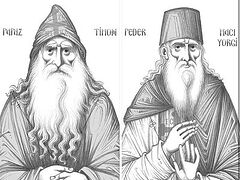
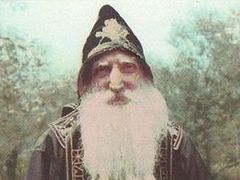
Elder Tikhon (Golenkov), affectionately known on the Holy Mountain as Papa Tikhon the Russian, reposed in the Lord on September 10/23, 1968, and was canonized by the Patriarchate of Constantinople on February 11, 2026. While he is perhaps best known as the spiritual father of St. Paisios the Athonite, St. Tikhon is a great saint in his own right, whose life and teachings deserve attention.
 Hieromonk Tikhon The future elder was born in 1884 in the village of Novaya Mikhailovka (now in the Volgograd Province). His pious parents baptized him with the name Timothy. He inherited a love for God from them and desired from childhood to dedicate his life to Him. He was distinguished by a lively character and grew tall and strong. He learned to read and write, had a beautiful voice, and sang in the church choir. When he turned seventeen, his parents sent him on a long pilgrimage, during which he visited more than a hundred monasteries of the Russian land. At one of them, when he was faint with hunger, a beautiful maiden appeared to him and handed him a piece of white bread. He was astonished. Later, he recognized her on an icon of the Mother of God.
After that, with his parents’ blessing, Timothy decided to visit Jerusalem and the Holy Mountain. Along the way, in Constantinople, he met the steward of the Russian cell of Bourazeri, who asked him if he wanted to become a monk. “I do,” replied the future elder. “Make a prostration, and from this day you are a novice of our community of St. Nicholas,” the steward said. The young man couldn’t hold back his tears of joy.
After visiting the Holy Land, he arrived on the Holy Mountain, at the age of twenty-four. There, according to St. Paisios the Athonite (his faithful disciple), “he grew and flourished like an innocent flower in the garden of the Mother of God and began to exude the fragrance of virtues,” acquiring many gifts from God.
The novice Timothy lived at Bourazeri Skete for five years. Under the guidance of experienced mentors, he gradually mastered the fundamentals of monastic life and the art of noetic prayer. He was tonsured there with the name Tikhon (in honor of St. Tikhon of Zadonsk). However, because of the many pilgrims and his desire for more intense asceticism, he withdrew to a more secluded place—Karoulia, known as “Terrible Karoulia” on Athos due to its harsh natural conditions and extreme inaccessibility (it can only be reached by climbing sheer cliffs with the help of chains). There, according to St. Paisios, he “labored zealously to become an angel inwardly, not simply bearing the angelic image outwardly.”
Monk Tikhon lived in a cave, where he made more than six hundred prostrations a night. His livelihood was painting icons, which he bartered for rusks (he learned iconography while living at Bourazeri Skete). In his free time, he meticulously studied the works of the Holy Fathers. He ate once every three days, and often only once a week. The ascetic spent fifteen years in this place, in severe asceticism and meager outward conditions. When the mobilization of Russian monks began in 1917, he went to the Russian Thebaid Skete to fulfill his duty. But when they beheld this incorporeal angel, the officials released him, and he returned to his cave.
After Karoulia, Monk Tikhon moved to the cape of Kapsala. As St. Paisios writes: “Divine grace revealed him to men, and many who were suffering began to flock to him for advice and comfort.”
He was asked to accept the priesthood so he could help people more. He heeded their entreaties and became a hieromonk. Fr. Tikhon’s cell had no church, but now he needed one. In his poverty, he didn’t have a penny to build a church, but he relied on God’s providence and prayed fervently. Soon he met a man who said to him: “I was given some money to donate to someone who could use it to build a church. You don’t have a church, so take this money for yourself.” The Elder tearfully thanked God, found builders, and a church in honor of the Holy Cross was built. Fr. Tikhon was known for his incessant praise of God, like the Prophet David: And my mouth shall declare Thy praise (Ps. 50:15). St. Paisios writes: “From his lips was constantly heard: ‘Glory to Thee, O God; glory to Thee, O God.’”
The liturgical rites are always filled with mystery. How Elder Tikhon served is partly revealed by his faithful disciple, St. Paisios the Athonite. During the proskomedia,1 the Elder would spend a long time commemorating submitted names. He served with utmost reverence, deep compunction, and tears. He knew the text of the Divine Liturgy by heart. During the Cherubic Hymn, he would sink into deep silence, and sometimes these moments of silence were quite long. When asked what he saw then, he would answer: “The cherubim and seraphim glorifying God.”
St. Paisios also testified:
During the Liturgy, Fr. Tikhon would lock the door leading to the church, so as not to be distracted, while I recited “Lord, have mercy” and sang various hymns, standing in the hallway outside the church. Once, during the Anaphora, at the moment of the consecration of the Precious Gifts, the Elder suddenly fell silent. I waited for him to continue the Liturgy for almost five hours. I waited in silence. I didn’t call out to him or summon him, because I didn’t have a blessing to do so. After five hours, he continued the Divine Liturgy with the exclamation, “Especially for our Most Holy, Most Pure…” Where had he been all that time? Presumably, he was caught up in contemplation. We didn’t finish the Divine Liturgy until evening that day.
The Elder loved to serve and would say: “If the Lord has mercy on me, I’ll serve in Paradise.”
“He lived, as we’ve seen, in the divine Heavenly world, participating in Heavenly praise with the angels during the Divine Liturgy,” St. Paisios added.
Elder Tikhon had absolutely no interest in earthly things. His cell was small and simple, with just a few icons, a crucifix (which is now at Iveron Monastery), a lampada, and a censer. Three planks served as his bed, and his clothing was shabby and patched. Outwardly, everything may have seemed unkempt and squalid, but, in the words of St. Paisios, “Fr. Tikhon placed importance not on cleaning his cell, but on cleansing his soul, and thus he was vouchsafed to become a vessel for the grace of God.” Even the wild beasts that came to his kalyva felt this grace. The Elder never drove anyone away, receiving them as part of God’s creation, and saying: “I love him. He’s not mean. He’s a friend who comes to take what he wants and then goes on his way.”
Sometimes pilgrims would bring Fr. Tikhon food and money, wanting to thank him for his spiritual counsel and prayers. But he never kept a crumb or a coin for himself; he immediately gave everything to those in need, for he lived by the Apostle’s words: It is more blessed to give than to receive (Acts 20:35).
Another Athonite elder, Archimandrite Gregory (Zumis) (the recently reposed abbot of Dochariou Monastery) would visit Elder Tikhon’s kalyva and left the following recollections:
The door opened, and before us stood a man as if from some bygone era. He let us in, constantly repeating: “Glory to Thee, O God!” and showing no sign of irritation that we had disturbed his silence and interrupted his prayer… Fr. Tikhon was quite tall, with a long beard that he always tied up to make his work easier, and bushy eyebrows that half obscured his large eyes… Elder Tikhon possessed the greatest of virtues—discernment. The Elder lived in extreme poverty. His life had none of the comforts or conveniences of modern civilization. In the evening, he would take his prayer rope and take endless walks through his garden, saying the Jesus Prayer.
 Elder Tikhon (center) receives monks from the Joasaph brotherhood
Metropolitan Nikodim (Rotov) of Leningrad also visited Elder Tikhon. When he saw the Elder, he knelt before him to receive his blessing. But the Athonite humbly said to him: “Stand up. You’re a bishop!” When he noticed people treating him with reverence, he would say with heartfelt simplicity: “I’m not an ascetic—I’m a false ascetic.” As a Russian, Elder Tikhon deeply grieved the fate of Russia, which was suffering under the godless regime. He fervently prayed every day for Russia’s salvation, commemorating the names of suffering Russians and new martyrs. He told his disciple St. Paisios: “My child, Russia is still doing penance from God, but it will survive everything.”
Despite his strict asceticism, Elder Tikhon was a cheerful man with a subtle sense of humor. He always had rakia—a common treat on the Holy Mountain. Knowing how precious a cool sip is to a weary traveler trudging along hot mountain trails, the Elder didn’t keep the bottle in his cell, but hid it in the hollow of an old olive tree, securely tied with a rope. When guests came, Fr. Tikhon would ceremoniously draw the bottle from the hollow. It’s notable that he treated only Russian pilgrims. They seldom visited his Holy Cross Cell, and for them this was a special sign of his attention and paternal care.
Fr. Tikhon’s fasting was marked by extreme austerity. Archimandrite Gregory (Zumis) recalls how the Elder instructed visitors: “Humble your flesh to enter beautiful Paradise.” St. Paisios said of his mentor:
He ate little and was very unpretentious in his diet. He would cut one fig in half and eat it in two sittings. He would say to me: “Oh, oh, oh, my child, it’s too big for me!” While I needed a pound of these figs to be satisfied… Every Christmas, the Elder would buy himself a single herring so he could eat fish on all the joyful days of Christmastide with the dispensation for fish. He wouldn’t throw away the skeleton, but would hang it on a string. When a feast of the Lord or the Theotokos would come and fish was permitted, he would boil a little water in an empty tin can, dip the herring skeleton in the water two or three times until it smelled slightly, and then add a little rice. Thus he observed the allowance for fish and condemned himself for eating fish soup in the desert! Then he would hang the skeleton on a nail until the next feast.
In his conversations with pilgrims, Hieromonk Tikhon always spoke about what mattered most—questions of the spiritual life and the path to salvation. Tears would flow from his eyes when he spoke of the sweetness of Paradise.
His spiritual teachings include:
“There (in Paradise) there will be no resentment, no fatigue, no fear—only the love of God. Let us endure a little here for the sake of this love.”
“Don’t look for great asceticism, my child, but seek humility: In humility, prayer is sweet, labor is easy, and the heart is calm.”
“One humble man has more grace than many people. Every morning, God blesses the world with one hand, but when He sees a humble person, He blesses them with both hands. Yes, my child, he who has the most humility is greater than all!”
“Let us say, ‘Glory to Thee, O God,’ not only when things are good, but also when trials come upon us, for the Lord allows them as medicine for the soul.”
“My child, Christ loves you; He has forgiven you. Christ especially loves sinners who repent and live in humility.”
Elder Tikhon was a man of unceasing prayer. He kept the Lord’s Day strictly, saying work was forbidden on Sundays. As St. Paisios writes: “His prayer was self-acting, heartfelt. People felt this when they approached him, for they left strengthened. And the Elder would bless them until they disappeared from his sight.”
Sometimes he would send letters from the Holy Mountain to the world. In one, he wrote:
Let us have love for Christ. Paradise is sweet, but it requires much labor. You have a great fear of hell, but you have to have Jesus Christ in your heart, and the fear will gradually begin to fade, because where Christ is, there is joy. Christ is sweet… All the Holy Fathers had fear. That’s why they labored in asceticism. Some made thousands of prostrations, others ate grass, others were stylites, others lived in caves, still others fasted for forty days. Absolutely all of them feared Him. And we today labor as we can. You have to pray to Christ and the Theotokos both day and night. You have to have tears. Christ is merciful. He will have mercy. You have to have fervent tears.
St. Paisios noted that Fr. Tikhon “attained such a state of holiness because he deeply loved Christ, humility, and poverty.” And he added: “From Fr. Tikhon, I received a noble blend of Athonite asceticism and the tradition of Russian eldership. He taught me true prayer, humility and love for neighbor.”
The Elder was known as “Papa Tikhon the Russian” on the Holy Mountain and was venerated as a saint even during his lifetime. Metropolitan Amfilohije (Radović) of Montenegro said of him:
This Elder, who spent sixty years there in the desert, had so much humility! His language was a mixture of Church Slavonic, Russian, and Greek—a kind of Esperanto that only he spoke—but his soul… I’ll never forget his eyes! Such infinite humility, such love, such purity of soul! Such joy I have in my soul from my encounter with Elder Tikhon!
 St. Paisios recalls that toward the end of his life, Elder Tikhon “was in a state of intoxication from Divine love.” In early 1968, he sensed his approaching death. He told his disciples of his imminent departure, gave them his final spiritual instructions, and prepared to meet the Lord. At that time, the young hieromonk Ippolit (Khalin) (the future elder of Rylsk), who had arrived to restore St. Panteleimon’s Monastery, went to him for advice. After the feast of the Dormition of the Mother of God in 1968, Elder Tikhon fell ill, took to his bed, and never got up again. He peacefully reposed on September 10 that year.
Before his repose, the Mother of God appeared to him, accompanied by Sts. Sergius of Radonezh and Seraphim of Sarov. Having foreseen his repose, the Elder prepared his own grave with a cross, on which he wrote: “Sinful Tikhon, hieromonk, sixty years on the Holy Mountain. Glory to Thee, O God.” There he was reverently buried to await the glorious and dread Second Coming of the Lord.