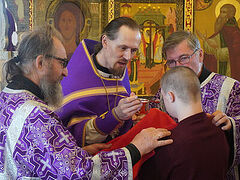
Fr. Seraphim was born in Herkimer, in the north of New York State, near Jordanville and its Holy Trinity Monastery. There, the nature, the weather, and the Russian pronunciation are just like in central Russia. His father, the future Archpriest Nikita Chemodakov, was then graduating from the Holy Trinity Seminary.
Fr. Seraphim’s father and mother were born in China. Their family has a holy martyr—his great‑great‑grandfather, Fr. Gavriil Luchinin. He served in the Trinity Church in the village of Sorvizhi, Vyatka Diocese. Fr. Gavriil did not accept the declaration of Metropolitan Sergius (Stragorodsky), for which he was sent to a labor camp and died of starvation in 1931. In his honor, Fr. Seraphim’s uncle received the monastic name of Archbishop Gavriil of Montreal and Canada.
 Archpriest Seraphim Chemodakov
The cousins of the wife of the holy martyr Gabriel were bishops. Pakhomiy, Averkiy, and Mikhail Kedrov. Pakhomiy and Averkiy were ranked with the holy new martyrs.
Archbishop Pakhomiy (Kedrov) of Chernigov was arrested in October 1922 and exiled for three years outside the Chernigov Governorate. He criticized the activities of Metropolitan Sergius (Stragorodsky), the deputy of the patriarchal locum tenens.
On October 16, 1930, he was arrested and sentenced to six years in prison “as an enemy of the revolution and Soviet power.” He served his sentence in the Solovetsky Special Purpose Camp. He was seriously ill. He died on November 11, 1937. In 1981, he was glorified as a new martyr by the Russian Orthodox Church Outside of Russia.
Archbishop Averky (Kedrov) of Volyn and Zhytomyr, according to Metropolitan Manuel (Lemeshevsky), “was an exceptionally kind, friendly, and deeply religious man; as a bishop, he was approachable and sociable, and this earned him the general and most sincere love of the people of Zhytomyr… He liked to serve often.”
On July 25, 1937, the prelate was arrested in Birsk and transported to the NKVD prison in the city of Ufa. Numerous charges were brought against him. On November 27, 1937, Archbishop Averky was executed by firing squad. In 1981, by decision of the Bishops’ Council of the ROCOR, he was canonized as a hieromartyr and included in the Synaxis of New Martyrs and Confessors of Russia.
The third brother, Bishop Mikhail (Kedrov), was the Bishop of Wrocław in the Polish Orthodox Church.
“Fr. Gabriel’s daughter, my great-grandmother Zoya,” says Fr. Seraphim—married Nikolai Chemodakov. They had a son, Leo, the father of my father and Vladyka Gabriel.
My paternal grandfather, Lev Nikolaevich Chemodakov, received his education in Harbin and became an engineer. He was also a reader in the church, where his deep, velvety bass made a special impression on the clergy and parishioners. When Lev Nikolaevich read the Epistle, many said that “the lion was roaring.” [Lev means “lion” in Russian —Trans.]
 Archpriest Nikita Chemodakov and his wife, Ekaterina Alekseevna.
Fr. Nikita entered the seminary in 1972 and lived to see Archbishop Averky (Taushev) and the founders of the Holy Trinity Monastery—Archimandrites Panteleimon (Nizhnik) and Joseph (Kolos), the iconographer Cyprian (Pyzhov), Fr. Mikhail Pomazansky, the Church historian Nikolai Dmitrievich Talberg, and other professors of that time.
He decided to go to the seminary from Australia after his late father, Rostislav Gan, appeared to him in a dream and said: “Go to the seminary, study.”
“When Fr. Nikita became a priest,” Fr. Seraphim continues, “he received invitations to serve from various parts of America (at that time, Orthodox churches were short of priests), but Fr. Rostislav appeared to him in a dream and said: ‘You are needed in Australia. Go there.’”
Since then, Fr. Nikita has been serving for 52 years in Australia, at St. Nicholas Church in Sydney and at the Kazan Women’s Monastery in the suburbs of Sydney.
 With his mother in Australia It was there, in Australia, that the future Fr. Seraphim grew up and received his higher education in biology and microbiology.
From childhood, he wanted to follow in his father’s footsteps and entered the seminary in Jordanville. After graduating in 2002, he was ordained as a deacon, and at the same time he worked in a laboratory in a secular profession. In 2005, he was ordained as a priest and went to serve at his first parish—St. Alexander Nevsky Cathedral in Lakewood, New Jersey, where he served for 15 years and gained valuable experience.
Many years later, the questions that Fr. Seraphim encountered while working with parishioners led him to get an education as a psychotherapist. Now, like most priests in places without a long Orthodox history, he works outside of the Church as a psychotherapist, both in his own office and in a prison.
What do you need this for?
—When I started studying to become a psychologist, my loved ones, priests, and parishioners all asked me: “What do you need this for?” And by that time, in our large parish, I had already seen how people came to me with problems, and I didn’t always know exactly what advice to give them.
People came to me with problems, and I didn’t always know exactly what advice to give them. And then I started reading books on psychology
Usually, like other priests, I would say: let’s pray. We prayed, we held a supplicatory service—that’s good, but inside I felt that something was missing, that I needed to take a deeper look at the problem and give them sensible and practical advice. And then I started reading books on psychology.
In the city of Lakewood, New Jersey, close to St. Alexander Nevsky Cathedral, where I served at the time, is Georgian Court University. I enrolled there in the department of psychological counseling, specializing in working with families and couples. I obtained a master’s degree and am now working on my dissertation for a doctoral degree.
I work in a prison
—After some time, I was offered a job at the Monmouth County Prison. It holds about 400 prisoners. Of these, 350 are men, and the rest are women. Professionals work at this prison—both correctional service staff and civilian specialists, including doctors.
—What is your profession called?
—Psychotherapist, or, as the profession is specifically called in this prison, a mental health counselor. I conduct interviews with newly admitted inmates, determine whether they have mental health issues, including fear, anxiety, depression, whether they are prone to suicide, and whether they need medication.
 Monmouth County Jail, New Jersey
—And who are the inmates of this prison?
—These include repeat offenders, rapists, and murderers. Some are seriously mentally ill, and my job upon their admission is to determine the extent of their mental disorder (if any), and then to observe and talk to them.
The part of the prison where they will be held depends on their mental illnesses and their severity; prisoners are assigned to blocks with a minimum, medium, or maximum level of security. Prisoners with severe mental illnesses who are at risk of suicide are placed in blocks where people are kept even without clothing, and they are only given blankets.
In our prison, prisoners of two major gangs—the Crips and the Bloods—are kept in such blocks. Their “track record” is drug dealing, murder, street theft and reselling stolen cars. I first learned of their existence in prison. And sometimes it happens that they fight each other, and then you can really feel fear!
Other inmates receive sentences for minor offenses—some failed to pay child support, others behaved indecently in public…
Some people get scared when they first end up in prison. Sometimes they even want to take their own lives. So I need to notice the nuances of the inmates’ mental state that need to be reported to the director—the prison’s clinical psychologist, the lawyer, and the guards.
—Tell us about your path to this field of psychotherapy.
—I had been a priest for fifteen years before I started working as a psychotherapist in a prison. After obtaining a degree in clinical psychological counseling, I began working with families and couples. These are the people who most often came to me in the church as well. Now I could professionally help them resolve the current psychological difficulties of a particular person or a married couple and help them adapt to difficult life situations.
Furthermore, to become a licensed psychotherapist, I needed to accumulate 4,500 hours of work, which equaled three years. After obtaining a psychotherapist’s license in the state of New Jersey, I got my first job—at a rehabilitation center that worked with families. This center admitted drug addicts, alcoholics, and gamblers. I worked there for two years; in early 2022, a colleague advised me to apply for a job at a prison.
At first, this place seemed scary to me, but even then I had heard that many people turned to God there.
At first, this place seemed scary to me, but even then I had heard that many people had turned to God there
I’ve been working there for five years now, alongside my colleagues—psychologists, psychiatrists—and other healthcare professionals: therapists, dentists, and nurses—whose services are needed by the inmates.
—What percentage of prisoners have actual mental illnesses?
—In the prison where I work, between a quarter and a half of the inmates have serious mental health problems, including schizophrenia. For some, the condition is genetic; for others, the main cause is drug use.
—Do they often develop illnesses while in prison?
—Yes, we could be around many people and not suspect that they are sick or that they are beginning to suffer from an illness. Some of the prisoners are homeless, others suffer from psychoses or use drugs, some have lost their jobs or gone through a divorce. Often, their families don’t notice the illness, and we first identify it in prison.
—Is there a difference in how you communicate with male and female inmates?
—At the first meeting, I also ask women general medical questions, then find out if the woman has been subjected to emotional, sexual, or physical abuse in the past. Ninety-five percent of them had such abuse. Men don't talk so openly about this aspect of their lives, but in the course of our conversations, I have learned that more than fifty percent of the men have been subjected to abuse.
If they feel comfortable talking to me, they share the details.
“I was eight, twelve, seventeen years old… My uncle, my father, a strange man did something to me… And that was the reason I got into drugs. First you forget yourself, and then an addiction develops…”
And then families fall apart, people lose their jobs, and they become homeless.
I often ask myself: Why does God allow this? Does He allow criminal violence, and that people get sick from it, or suffer from psychoses and other diseases? I don’t have an answer, but we all carry our own cross in life; and I’ve also been told that we all have a cross to bear, and we carry a cross of a certain size, a certain weight. I tell them about Orthodoxy, about the cross—the main symbol of the Christian faith, the instrument of humanity’s salvation. They think about it, and for many, it makes sense. Then we continue our conversations about God; some people get released, and I don’t see them anymore.
—What percentage of them acknowledge the existence of God?
 With the Kursk Root Icon of the Mother of God —Approximately seventy-five percent. Most believers are African Americans and Mexicans, mostly Catholics and Protestants. I’ve met Orthodox Christians a few times.
Our prison employs a Catholic priest, a Protestant pastor, and an imam.
When I walk past the room where a Catholic priest is celebrating Mass, I, to be honest, envy him in a kindly way. How I wish I could serve too! But that depends on the number of inmates of a certain faith. There are almost no Orthodox Christians in our prison. They only occasionally end up there and spend only a short time.
Nevertheless, two‑thirds of the inmates start talking about God, about religion. And then, depending on the situation, in addition to providing psychotherapeutic assistance, I carry out my pastoral work with them.
I return to my office and, depending on the conversation and the person, I make copies for them from the Bible and the writings of the Church fathers. As I’ve noticed, this yields positive results. After talking about God, a person gains hope.
After talking about God, a person gains hope
I remind the inmates that man was created in the image and likeness of God. It goes like this: I say, that the first book of the Bible is the Book of Genesis. I often hear: “I know! And what does it say there?” —“That we were created in the image and likeness of God.”
Yes?—And they reflect. And then the conversation turns to Christ. Jesus Christ came to earth and interacted with sinners, ate with them, taught them, forgave them, healed them. And we are the same people who were with Christ. We condemned Him, we threw stones. And this also gives them a sense of reality, of tangibility. And I hope they feel better after hearing such words.
I often tell them stories from the lives of the saints; we also talk about Christ’s commandments, about what humility, self‑sacrifice, and love mean. They think about it, they agree. And some look at me with surprise, surprised that I know something about God and the Church.
I often tell them stories from the lives of the saints, and we also talk about Christ’s commandments, about what humility, self‑sacrifice, and love mean
—These conversations are like Confessions, aren’t they?”
—Yes, my most sincere and profound confessions take place in my office and in prison.
I won’t judge our churchgoers. Perhaps they’re embarrassed to be sincere during Confession, afraid that the priest will think badly of them. “I didn’t observe the fasting days, I sinned through excessive talk, I took money from my wife without asking,” they say.
“That’s all?” I probe, “Well, sometimes I swore…”
And then… Some sins will be confessed to one priest, others to another. So that no one will think badly of them.
I myself advise people to choose one spiritual father. There’s no need to run to a new priest every time. That would be detrimental to you and would bring no spiritual benefit.
I advise people to choose one spiritual father. There’s no need to run to a new priest every time. That won’t bring any spiritual benefit
In my work—both in the world and in prison—not much frightens me in confessions and conversations, little disturbs me, and little evokes a feeling of disgust. Already in prison, I came to realize more deeply how sinful we all are; but we are capable of returning to the better, of discovering the good qualities within ourselves.
And, of course, I leave all the confessions at the church; I don’t take anything home.
Of course, there are also deep confessions in the church; but overall, such instances are rare. And in my conversations with prisoners, I hear more repentance.
—Is this sincere repentance, or is it the path to repentance?
—I think it’s the path to repentance. I don’t tell them that I’m a priest. They realize it and start worrying… Sometimes I even talk to prostitutes. And I myself think that my work has opened my eyes to our fallen state in a deeper way.
But sometimes the opposite happens: A person is so evil that they don’t even think about repenting.
Recently, I had a conversation with a murderer who stabbed his wife. I’ll omit the details of how he did it. And in the conversation with me he asked: “Why am I sitting here?” He had a hostile look, his eyes were spiteful. I’m a bit afraid of people like that.
—Do you work outdoors?
—Usually in an open area, but there are also enclosed rooms, and the inmate services specialist watches through the glass, so no one can hear our conversation.
“Alarming signs” in those close to you
—How can we distinguish between psychology, psychotherapy, and psychiatry? In which cases should one turn to psychologists, who needs psychotherapists, and who needs psychiatrists?
 At work —Psychology studies the human psyche, its inner world and the state of the soul; human behavior, including memory, attention, speech; emotions and feelings, and communication between people in the family and in society.
There are child psychologists and family psychologists; talking about prisons, our facility employs clinical psychologists. They work with those who have suicidal thoughts or have attempted suicide. They try to determine whether it’s possible to return the inmate to his original place of residence or whether he should be kept away from other inmates.
Psychotherapy is a therapeutic psychological intervention aimed at addressing emotional, personal, and behavioral problems. This is what I do, trying to help the clients and patients in my office—couples and families—cope with depression, anxiety, and fears, and to build and improve their relationships with those around them.
If I see that a person is developing psychosis, if they have depression, split personality, if they hear voices, or say something incomprehensible, I send them to a psychiatrist. In prison, as a rule, the doctor prescribes medication, and it’s not hard for us to notice positive results over time, after which the psychiatrist discontinues the medication.
—What is the difference between despondency and depression? Where is sin, and where is a disease?
—The concept of “despondency” relates to spiritual life and is one of the passions, when a person loses hope. St. Evagrius associated despondency with the temptation of the “demon of noonday,” which is mentioned in prayers.
Thus, in Psalm 90 (“He who dwells in the shelter of the Most High…”)—one of the most famous protective prayers in Christianity, which people turn to in difficult and dangerous moments of life—we read: thou shalt not be afraid… for the mishap and demon of noonday.
“The demon of noonday”—in the patristic interpretation (for example, by St. Athanasius the Great)—is a spirit of despondency, a state of spiritual lassitude and melancholy.
When it comes to monastics, people experiencing despondency find it difficult to stay in one place; they constantly crave change. They find it hard to pray and work in the monastery on their obediences.
St. John Cassian says: “Despondency is expressed in irritability, spiritual lethargy, unwillingness to pray, aversion to obediences, and a desire to escape from current circumstances.” I have observed and see such passions—both among the clergy and among the laity.
Depression is a psychological and medical condition characterized by a dejected mood, loss of interest in life and family, and disturbances in sleep and appetite. A person experiences severe fatigue, hopelessness, and a sense of his own worthlessness; his sleep is disrupted, and he may have suicidal thoughts. Many of my patients say: “Why go on living? I know it’s wrong and sinful, but these thoughts come to me.”
Depression does not mean that a person is in a state of despondency, and vice versa. But I would say that in all these cases, a person needs, if he realizes it and wants it, both a psychologist and a psychotherapist—and a priest.
—If someone close to you shows signs of a mental illness, what are these signs, and what “red flags” should you pay attention to?
—Thoughts of suicide, depression, loss of interest in everyday life.
—What should you do if a priest says, “You shouldn’t go to a psychologist or psychiatrist, and you shouldn’t take medication” for depression, for example?
—The priest still needs to get to know a psychologist or psychotherapist, find out what they do, what kind of work they do, and then together they become such a powerful force! Both spiritual and psychological. Before COVID, I gave a lecture at the Holy Trinity Seminary in Jordanville, and many priests’ attitudes towards psychotherapists changed.
 In the Znamenie (Icon “of the Sign”) Synodal Cathedral in New York
Before ordination, there is an interview with a psychologist
—In the Church, do you notice any symptoms of illness among parishioners?
—I sometimes notice that something is wrong with a person. At the church where I serve, at the request of the administration, I had a conversation with a young man who was harassing girls. This man was asked not to come to the church because he was behaving inappropriately and disturbing the young parishioners. They threatened to call the police and file a complaint against him.
Another incident. Once, after the festive service on the eve of Lent, when the bishop and the clergy were already in the altar, a certain man almost completely undressed in the church. The police and psychiatrists had to be called, and they literally carried him out of the church.
Most often, I encounter people with depression. In church, if necessary, I tell them that I am a priest and also a psychotherapist, but in prison, only my colleagues know that I am a priest, because you never know how this might provoke the patient.
—During Confession or in a conversation, do you tell a person that they need to see a psychologist or psychiatrist?
—In the Russian Church, not everyone approves of a priest professionally engaging in psychological counseling. Many people have asked me: Why do you need to study psychology? You’re a priest! Other priests are more open to this practice, especially the younger generation of clergy and lay believers. Sometimes I advise a person to see a doctor, and for the doctor to prescribe medication, even if only for a short time. This mostly happens in cases of depression.
Over the past six years, I have given presentations at pastoral meetings, diocesan assemblies, and even at youth congresses, and now many priests refer their parishioners to me, and many come to me on their own.
—Which seminaries in America teach the basics of psychology? How is psychological counseling used in working with future priests?
—At the Holy Trinity Seminary (ROCOR) in Jordanville, a psychology program was introduced several years ago. This course is taught by a licensed psychotherapist. The online correspondence seminary based in Chicago also offers a psychology course. Psychology is also taught at the Holy Vladimir Seminary under the jurisdiction of the Orthodox Church in America and at the Greek Holy Cross Seminary in Brooklyn.
In the Orthodox Church in America, before being ordained, a candidate must undergo an interview with a psychologist—for the sake of preserving the Church and to ensure that a fully worthy candidate is ordained.
In the Orthodox Church in America, before being ordained, a candidate must undergo an interview with a psychologist
It is not always possible to recognize a mental illness before ordination, and even after ordination, a priest may display unusual behavior. A check by a specialist can reveal whether the candidate is ready to endure the priesthood—a blessed but not easy endeavor. How difficult it can be, especially for young priests, to go through the Sacrament of Confession and then carry everything that has been said with them! At some point, a person may break down, and it is not always possible to predict how this will affect their mental health.
—Has your view of people in the Church changed over the years you’ve been working in psychotherapy?
 With his uncle, Archbishop Gabriel of Montreal and Canada —Both my outlook and I myself have changed, but I don’t think it’s because of my job. I’ve grown older. I’ve seen a lot in life. I think that’s played a big role.
Do I look at other people differently? Sometimes it’s hard to figure a person out. In prison, you have to be prepared for the fact that you might constantly encounter lies. You don’t know who’s telling the truth and who isn’t. I know that during our conversations, inmates were being sly and dishonest on several occasions.
We are people broken by life, by our experiences. One has experienced divorce, another has experienced the death of a spouse or child, and yet another is dealing with a mental illness.
In general, most of those who come to me are believers, and parishioners are more open in the Church than outside its doors. I know that none of us lives without sin. And we usually don’t know why someone comes to the Church—whether it’s just for the sake of checking a box or to meet Christ, the saints, and the Sacraments.
—What would you, as a priest and psychotherapist, advise your parishioners and our readers?
—Live cautiously, knowing that God has given you yet another day; and I will repeat the words of the builder of the cathedral where I began my ministry—Protopresbyter Valery Lukyanov: “Life is given for good deeds.” Fr. Valery had a small box that was given to him in Gethsemane. If you opened it, you could read: “Life is given for good deeds.” That is, to live in a good way, for the sake of God, recognizing your own sinfulness, and knowing that every day gives us the opportunity to repent.
Live cautiously, because every person you meet has been through a lot in life
Live cautiously, because every person you meet has probably been through a lot in life, and you don’t know about it. If you say a harsh word to one person, it might hurt him deeply or make him angry, but it may not make another person angry, because he’s heard a lot and is used to it.
One more thing. With a word, you can give a person hope precisely where they have already lost hope. He may be thinking about suicide, but we don’t know about it. What kind of person is he? What is he going through? Therefore, at any time, you need to behave carefully—in word, deed, and thought.