On ten years of episcopal ministry, the Orthodox community of Menton, and the faith that brings people together.

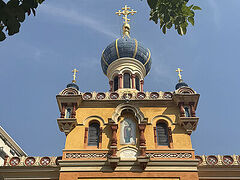
On the French Riviera, where the Mediterranean Sea meets the foothills of the Alps, there is a corner of the world where time seems to slow down. Amid the gardens and historic streets of Menton stands a Russian Orthodox church, a witness to the lives of generations for whom faith, far from their homeland, remained a spiritual home.
Here, the past is quietly present in the life of today—in the singing of the church choir, the flickering of candles, and the prayers of people who speak different languages yet turn to the same God.
On 6 November 2026, the church celebrated its patronal feast in honour of the Icon of the Mother of God, “Joy of All Who Sorrow.” The very name of the icon carries a profound Christian meaning: even amid suffering and sorrow, faith opens the way to hope.
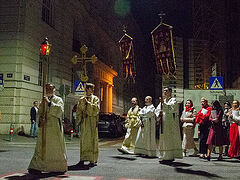
 Photo: Anna Nikitina On this occasion, Bishop Irenei of London and Western Europe, a hierarch of the Russian Orthodox Church Outside Russia, visited Menton. At the entrance to the church, he was welcomed with bread and salt, in accordance with an old Russian tradition.
Bishop Irenei presided over the festive Divine Liturgy, concelebrated by the parish rector, Father Evgeny Nikitin; Archpriest Dionisy Baikov from Sanremo; Father Antony Odaysky from Cannes; and Deacon Oleg Petrov.
For Father Evgeny Nikitin and the entire parish community, the occasion was a source of particular joy. Behind the solemn beauty of the patronal feast lies the rector’s daily pastoral work: caring for people, nurturing the liturgical life of the parish, and preserving the traditions that allow this historic church to remain a place of prayer and spiritual unity.
In his homily, Bishop Irenei spoke of war, human division, and the suffering of the modern world. Reflecting on the Icon of the Mother of God, “Joy of All Who Sorrow,” he reminded the faithful that sorrow does not have the final word in Christian life. Through faith and the maternal intercession of the Mother of God, we find consolation in Christ.
A particularly meaningful moment of the celebrations was the parish’s tribute to Bishop Irenei on the tenth anniversary of his episcopal ministry. He was presented with a commemorative gift associated with the Icon of the Mother of God “Derzhavnaya” (the Reigning Icon). In his response, the bishop warmly thanked those gathered for their love and prayers, which, as he acknowledged, sustain him in his ministry.
Following the service, we had the opportunity to speak with Bishop Irenei about his journey, Orthodox life in Europe, and what makes a parish a true spiritual family.
***
 Bishop Irenei (Steenberg)
“Never cease to be amazed by the works of God”
—Your Grace, you have now completed ten years of episcopal ministry. What has been the most important lesson you have learned during this time, both as a bishop and as a person?
—I have served in holy orders for nineteen years, ten of them as a bishop.
The most important thing I have learned is never to cease being amazed by the works of God.
We are merely His servants, with our own shortcomings and weaknesses. And yet the Lord works through us.
It is a great honour for me to serve God and His people. Throughout these years, I have continued to marvel at His love and at all that He accomplishes in the world.
If we remain faithful and patient, we begin to recognise the manifestations of God's grace in every day of our lives.
“This is not a museum, but a living parish”
—What does visiting the Orthodox parish in Menton mean to you personally?
 —It is a great joy for me.
This is a historic church, almost 145 years old. There is something very special about being able to pray in a place where so many generations of the faithful have prayed before us.
But what matters most is that this is a living community. It is not a museum or a monument to the past.
There are wonderful people here: local residents, those who have moved here from elsewhere, people who came to Orthodoxy later in life, young and old alike. There is a good priest, an active congregation, and a wonderful deacon.
When I come here, I try, as a bishop, to bring people comfort and support. But very often the opposite happens: it is I who receive spiritual consolation when I see such a beautiful parish life.
“A family should be a place of prayer”
—What qualities turn a parish into a true spiritual family?
—First and foremost, prayer. That is why we gather together.
A family, too, should be a place of prayer. Without it, something essential is missing from the spiritual foundation of family life.
In the parish, we learn to bear one another's burdens and to help our neighbours. The same should happen at home.
A true spiritual family is a place where people seek to support one another rather than cause pain. When we see someone's weaknesses, we should help that person rise again and move forward.
This experience does not remain within the walls of the church. It transforms our relationships with those closest to us and with the world around us.
“The liturgy remains the same, wherever it is celebrated”
—In Western Europe, Orthodox communities live alongside Catholics and Protestants. Sometimes Orthodox services are held in churches belonging to other Christian denominations. How is fidelity to Orthodox tradition maintained in these circumstances?
—For example, in neighbouring Monaco, there has been an active Orthodox community for many years, but it does not have a church building of its own.
We use an Anglican church, setting up an iconostasis, icons, and everything necessary for Orthodox worship.
This is one of the particular features of life in the diaspora.
Here in Menton, we have the great blessing of a beautiful Orthodox church. As soon as you enter, you immediately know where you are.
But not having a building of our own does not make our faith any less authentic.
If we celebrate the Divine Liturgy in a barn, a shop, or another suitable place, it remains the same Liturgy, the same faith, and worship of the same God.
We are grateful to members of other Christian communities for their kindness and for allowing us to use their premises. At the same time, we remain faithful to Orthodox doctrine and liturgical tradition.
Good relations with our neighbours do not mean abandoning our own faith.
During our conversation, Bishop Irenei also spoke about the development of Orthodox communities in Gibraltar, Liechtenstein, Switzerland, and Wales. In his experience, increasing numbers of people are turning to the Church in search of spiritual grounding in the modern world.

“Be strict with yourselves, but full of love towards others”
—What spiritual message would you like to leave with the parishioners of Menton?
—Preserve the traditions of our fathers. Remain faithful to what the Orthodox Church and the Russian Orthodox Church Outside Russia have always upheld.
Be demanding of yourselves above all. Strive to follow God without fear, but do so with love.
Strictness and love are not contradictory. On the contrary, the more seriously we approach our own spiritual lives, the more gentleness and compassion we should show towards others.
Continue along this path, and your community will grow.
***
Following the Divine Liturgy, the celebrations continued with a festive meal, bringing clergy and parishioners together around one table.
Bishop Irenei described the parish in Menton as a living community. Behind those words lies the daily dedication of its rector, clergy, and faithful, through whom the church's history continues to unfold in the present.
And therein lies a beautiful connection with the feast of the Mother of God, “Joy of All Who Sorrow”—where faith meets compassion, sorrow finds consolation, and love gives rise to hope.