In the name of the Father, and of the Son, and of the Holy Spirit!
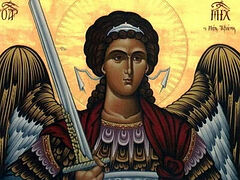
 Archangel Michael.14th century, Patriarchate of Pec (Serbia). Photo: Pinterest Dear brothers and sisters, in the Holy Scriptures, the Lord left us a promise that God will have all men to be saved (1 Tim. 2:4). These most essential words should tell us that no one should harbor even a shadow of a doubt that God has forgotten him, that God does not hear his prayers, that everything is hopeless, that no one sees him, knows him, or wants to know him—or perhaps cannot forgive him for what he has done. All of that is demonic falsehood. For God desires every single person on earth to be saved. We ask, “Why do people of different faiths live the way they do? Why this? Why that?”
That is not what should concern Orthodox Christians—why someone, somewhere, is doing something for themselves. What should concern them is what they are doing for their own souls. Their entire care should be directed toward this. Each one of us is given only one soul. I was not given many souls to oversee, only my own. And every Christian should think like this: “Will I be saved if I am there? Will I be saved if I turn left or right? What will become of me?”
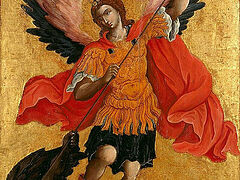
And today is the feast of the holy Archangel Michael and All the Bodiless Heavenly Powers, who in their very nature reflect the Divine Light, which radiates from them and comes to us. At Baptism, all of us received a guardian angel from the Lord. And were it not for this Divine Light that he radiates—this Divine grace—none of us would be able to withstand this battle against the evil spirits of the air. Indeed, it is thanks to this Divine grace within each one of us, and because our guardian angels never depart from us for a single hour or minute. Yes, of course, there are occasions—such as the one told in the Life of St. Basil the Great—when he approached a house and saw a guardian angel standing outside, weeping. The saint asked,
“Why are you weeping?”
And the angel replied,
“I cannot enter the house where my charge has gone to sin. He is in there sinning while I stand outside praying to God, imploring Him not to forsake the man. Because he entered of his own free will, I cannot follow him. I can do nothing but pray and hope that God will not leave him there.”
Well, some immediately wonder:
“How can that be? People keep on sinning and doing evil deeds.”
That is just how it happens: angels weep, worry, and grieve, yet they never leave our side, for they are sent by God; they are messengers of God’s grace, messengers of God’s Word. They never abandon us.
In the Life of Blessed Andrew the Fool-for-Christ,1 there is an incident related by the Holy Fathers. As he was walking along, he would strike the corners of the houses. Afterwards, people asked him,
“Father, what are you doing? Why do you strike the houses? You kiss some corners of the houses, and yet you strike others.”
And he explained to them,
“I strike those houses where fine, God-fearing people live. But why do I strike them? Because the demons who used to dwell inside can no longer stay there, so they linger nearby—coming out of the houses to settle around the corners. Therefore, I go up to them and strike them. As for the houses where I kiss the corners, there stand angels who cannot remain inside a home where wicked people reside. I approach them and offer them a brotherly kiss.”
That is, we cannot see angels. Yet among us, there are those who have seen angels since childhood, since infancy—those whose souls are as pure as the sky. That is why on the feast of the holy Bodiless Heavenly Powers, all the priests wear white vestments. For all of us, this serves as an image of their purity and what we must strive for. When a person receives the grace of God in Holy Baptism, and throughout his life abides in the word of the Gospel, he becomes a saint—like St. Seraphim of Sarov, like the Optina Elders, and many, many millions of saints who were able to preserve this Divine purity, this clarity, this beauty, and the majesty of God. How is the name of the Archangel Michael translated from Hebrew? “There is no one like God.”2 That is, he bore witness with his own words. He did not offer the explanations people demand today: “Give us a mathematical formula, give us a physical formula for why things happen.” The Archangel spoke simply. He did not merely testify; he declared what he knew: “There is no one like God.” Such a truth is difficult to understand. To comprehend it, you need a pure heart. Blessed are the pure in heart: for they shall see God (Mt. 5:8).
Children see God, yet later, when they become teenagers and young adults, unfortunately, this pure-hearted way of being often comes to an end. A person becomes entangled in the snares of sin, passions, and vices, and an impure heart cannot see God. Yet God never forsakes him, and the angels sent to serve humanity never leave either. Therefore, nothing stops us from starting all over again on any day of our lives, as if with a clean slate: “Lord, yesterday I sinned, today I went to confession and received forgiveness, and with a pure heart I want to live differently from now on.”
These are the exact thoughts we should bring with us to church—not merely to fulfill a routine or do what we feel obligated to do. The nineteenth homily of the Teachings on the Angels tells us to pray through our angel: “Lord, grant me from my guardian angel that spark of self-transformation, that spark of grace which they (the angels) possess, so that the angel might share just a little of what he has, awakening within me this desire, this resolve, and this steadfastness to change my life.” At any given moment, anyone can radically transform his life. The Lives of the Saints bear witness to this. How many examples exist of people who sinned and lived as robbers! Take the thief hanging on the Cross. Just one word—and he was in the Heavenly Kingdom. Think of how many sins he had committed and how much evil he had brought on others, yet it was simply his sincere desire to change that moved the Lord to forgive all his sins in a single instant, and he immediately inherited the Kingdom of God.
So here is an example for all of us—no matter how much we sin, how far we stray from God, or how much it may seem that all hope is lost and we can no longer see a single good deed to our name, repentance is always possible. A person says to himself, “There is nothing left.” He comes to confession and says, “Father, I don’t know how to go on living—I have lost hope.” And what must be said to him is: “Your guardian angel has not lost hope. You did not come to me alone. Your guardian angel brought you here by the hand.”
Many people wonder, “Father, how should we talk to our children? How should we praise them for good deeds or scold them?” You can, as long as you do it the right way. You should give thanks by saying, “I am grateful to God, my child, that you did a good deed today by following the words that your guardian angel spoke to you.” Children usually come up and say, “Look, Mother, I did this well, and I did that well.” And the mother or father should reply, “I see the hand of the angel who is with you. Look how he is helping you!”
Many years ago, I witnessed a touching moment. A little three-year-old girl ran up to a priest and said,
“Father, I fell down—please make the sign of the cross over my knee.”
“What happened?” he asked.
“Well, I didn’t listen to my mommy, so my guardian angel stepped away from me. Then the demon who follows me around came up, tripped me, and I fell and got a boo-boo. Please bless my leg.”
The priest made the sign of the cross over her leg, and she started to run off. Then the girl turned back and added,
“Oh, I forgot—please tell God that I’m sorry for how I acted toward my mommy.”
In other words, from early childhood, this cause-and-effect relationship grows within a young child. First comes sin, then punishment. And so the child clearly understands that there is sin, there is wrongdoing, there is punishment—but there is also forgiveness. And, having received forgiveness, the child runs off to continue living his grace-filled, angelic life. That little girl and her friends used to play with angels in church; the whole parish talked about it. That is, they see angels because they have pure hearts. Yet later, very sadly, all of this fades away somewhere. The reason is understandable—because the whole world is entangled in the web of passions, endless cares, and daily bustle—worrying about this, worrying about that. As children become immersed in all this vanity, they forget what is most important. We, as parents, must constantly remind them that everything that happens in the world is either according to God’s will or against it. Yet we have helpers whom we must turn to for aid, and who will always help us live according to God’s will. That is why in our morning and evening prayers, we pray to our holy guardian angels. We must make sure to read these prayers—meaning we begin the day by venerating our holy angels and our guardian angels, and we end the day the exact same way, asking that there be no temptations during the night either.
Today, just as in the nineteenth century, a great many temptations have emerged. People believe in superstitions and summon spirits. During confession, our priests constantly hear the words: “I told fortunes, turned to spirits, and called upon them.” St. Ambrose of Optina used to say that this delusion was new, yet terrible. One must never engage in such practices—neither believe in omens and superstitions nor dabble in them. It starts in childhood. Children gather together and begin summoning spirits, and later they wonder why terrible things happen in their lives.
We, as parents, must earn our children’s trust so that they can tell us everything that is happening in their lives. Yet this is impossible when a child’s heart has already become impure. Therefore, mothers and fathers must pray: “Lord, grant my child a pure heart. Perhaps there are things I cannot do for him; I may lack the words or the wisdom to give him this. Yet, Lord, through my prayer, please do not forsake my child, so that with a pure heart he may behold God and all the holy angels who help him.” Therefore, through the prayers of the holy Archangel Michael and All the Bodiless Heavenly Powers, grant us, O Lord, steadfastness in faith, the resolve to guard this faith, to keep our hearts from evil spirits, and always to live in complete obedience, humility, and friendship with our guardian angels. Amen.