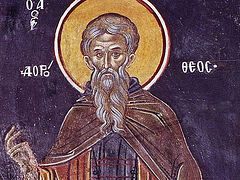
On November 11/24, the Orthodox Church honors the memory of St. Theodore the Studite (759–826). During his lifetime, the saint was an outstanding orator and philosopher, an author of dogmatic writings and liturgical canons, and a defender against the heresy of iconoclasm. He headed the Studion Monastery of St. John the Baptist, where around 1,000 monks struggled. For this monastery, the saint wrote a rule of monastic life that became known as the Studite Rule. He set an example of a true pastor and genuine ascetic. On this day, let us explore some of his spiritual teachings.
 St. Theodore the Studite. Eleventh-century mosaic, Nea Moni Monastery, Chios
God brought us into the world so that, by pleasing Him through good works, we might become heirs of the Heavenly Kingdom.
*
From the living, God requires labor according to their strength. Let us therefore labor, striving above all to avoid robbing ourselves through vainglory before others and self-conceit before ourselves, as though we were accomplishing something great.
*
Flee evil thoughts as you would the deeds themselves. Count talkativeness as much sinning, laughter as fornication, and gluttony and overindulgence as bondage to lust; thoughts lifted up, eyes cast down; be pure in body and soul; be inspired by good hope; become attached to nothing on the earth; and fear God alone. If we conduct ourselves in this way, and if we are thus rightly disposed, we shall rejoice with the angels and be glad with all the saints unto the ages.
*
Evil thoughts sting like serpents, pouring poison into the soul, which must be expelled with all diligence as soon as this happens, lest through delay the wound be made hard to heal.
*
We ought to perform the church services with all good order, reverence, and warmth of heart.
*
Keep your lips pure, always speaking only what is pleasing to God. Allow neither flattery nor unjust reproaches.
*
I beseech you, while shunning great sins, let us also shun those that are called small—I mean idle talk and jesting. Treat everyone quietly and meekly; and when you engage in conversation merely to dispel weariness, even then let your speech be edifying.
*
Do you see the vanity of this present life? Do you see how unstable and fleeting human life is? There is but one good portion, one blessed life, and one insatiable grace: to acquire God through keeping His commandments. Yet it demands labor and strenuous compulsion of self.
*
Do not stop, and do not give yourselves over to sloth in the service of God; nor, looking at the hardship of the present time, deprive yourselves of the delight that awaits in the age to come. Rather, endure all things—both words and deeds—with a noble spirit, and so order your lives as to receive each other in the love of God and mutually aid one another in difficult tasks.
*
Like good soil watered by rain from the grace-giving streams of the Holy Spirit, bring forth fruit and sprout virtues like ears of grain full of life.

Sow, according to the apostolic commandment, not to the flesh, lest from the flesh you reap corruption; but sow to the spirit, so that from the spirit you may reap spiritual fruits—learning patience, constancy, magnanimity, lowliness of mind, and mutual love for one another, while hating envy, guile, delusion, reviling, and slander.
*
Acquire also temperance. For temperance is when the body is given food according to its need.
*
God loves a heartfelt word, a submissive answer, a gentle disposition, and humble conversation.
*
Do not seek rest here, but regard present affliction as a surety of eternal rest in the age to come.
*
Keep far from pride and clothe yourselves in lowliness of mind… and joy and gladness shall abide upon your heads.
*
Let us do all things with humility, and we shall see how sweet, how lovely, and how radiant is the fruit of this virtue, which makes us imitators of God.
*
Be saved, all of you; to this end, strive and be zealous to present yourselves pure before God, just as you were created in the beginning, bearing the likeness of the Divine image.
*
It is no great praise to keep silence in the desert and preserve stillness in solitude; it is quite another thing to live in the city as in solitude, and to be in the midst of a noisy crowd as in the desert.
*
Why, then, do we so pamper this wretched body, which after a little while we shall commit to the earth and to worms? Let us not indulge the flesh, which the saints regarded as an enemy and humbled in every way through abstinence.
*
What is the ascetic life, if not the bridling of the passions, mastery over thoughts, and unceasing warfare against unseen enemies? Let there be among you neither unseemly laughter, nor distracting and self-indulgent amusements, nor long, idle conversations.
*
Where there is remembrance of death, there are repentance, compunction, tears, detachment from all earthly things, delight in what is Heavenly, enlightenment, and longing for what is better and above the heavens.
*
Narrow and afflicted is the path of God, yet wide and spacious is the rest that awaits us. There is no insurmountable obstacle to salvation for one who sincerely desires it.
*
Enrich your souls with virtues as a pledge of the Heavenly Kingdom.
*
Let no one remain without a spiritual steed, which is a living readiness for every good work.
*
Press forward toward the commandments of God, and sow the seeds of virtues in your hearts so that, in due time, you may reap the fruits of righteousness.

We must always be vigilant and, in every circumstance, keep ourselves within the Law of God, turning aside from the commandments neither to the right hand nor to the left, but walking the royal middle way, where salvation, unerringness, and good success abide.
*
Words cannot express, nor can the mind measure the boundless love and mercy of God toward us. A bridegroom does not so love his bride, nor do parents so care for their children, as God—the Master of all—loves and cares for us.
*
Do not act according to the passions, for those who do so die an eternal death.
*
Train your lips to sing only what is pleasing to God and to remain free from falsehood.
*
God brought us into the world so that, by pleasing Him with good works, we might become heirs of the Heavenly Kingdom.
*
Let each one do his work as before the Face of God, and not before men; and his work shall be pure.
*
We ought to look on high, for there is our Head—Christ the Lord; there is our treasure and eternal life.
Bibliography:
Alexios (Mandziris), Archimandrite. “Venerable Theodore the Studite—Abbot of a Cenobitic Monastery.” Paper presented at the Holy Dormition Zhirovichi Stavropegic Monastery, June 23, 2017.
Philokalia, In Russian Translation, Supplemented. 2nd ed. Vol. 4. Published through the efforts of the Russian Monastery of St. Panteleimon on Mount Athos (Moscow: I. Efimov Lithographic Printing House, 1901).