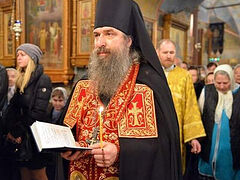
On October 31, the Church commemorated the uncovering of the relics of St. Joseph of Volokolamsk, celebrated as the patronal feast of St. Joseph of Volokolamsk-Holy Dormition Monastery. For more than twenty years, the monastery has been led by its abbot Archimandrite Sergei (Boronkov). Fr. Sergei kindly answered questions about his path to monasticism, about the Holy Mountain, about the monastic life, and the hermits of the Caucasus.
 St. Joseph of Volokolamsk Monastery
—Could you please share what it means to you to be the abbot of the St. Joseph of Volokolamsk Monastery? What about it brings you joy?
—The Lord called me to this position. As they say: “In for a penny, in for a pound.” Of course there’s joy. Even as a child, before I ever even thought about monasticism, I didn’t want to have to work from morning till night like my parents. I wanted some kind of creativity. But I don’t have any artistic or musical gifts—nothing like that—and then you realize perhaps the Lord gave you a different kind of creativity. Because, of course, it’s a creative life when you see your brothers gradually ascending from strength to strength, and you can help.
It’s a joy to see one of the brothers prospering. He’s left something bad behind, moved towards something better, become more stable, or changed his way of thinking. You see how a layman comes in as a nobody, but over time he starts to understand what’s what in the monastic life. He gradually outgrows his shallow state and becomes more patient, more attentive, more conscious. Such creativity brings both joy and inspiration to follow this path—that you’re not wasting your time here.
And of course, it’s also my job to restore the monastery, because it’d be shameful before St. Joseph of Volokolamsk if I came and didn’t do anything for the external splendor of the monastery, for its internal spiritual strengthening, or for the spiritual growth of the brethren. We shouldn’t just be whiling away the hours. Of course, we have to labor so as not to be ashamed before God, the Mother of God, and St. Joseph. This is my calling; it’s my creative obedience.
 A service at the monastery’s affiliated church in the village of Teryaevo
—Fr. Sergei, what does serving Liturgy at the throne of God mean to you?
—It’s the foundation of our entire monastic life. Serving the Divine Liturgy is a must. Mt. Athos has sketes, hesychasm, and the Jesus Prayer said on the prayer rope. That’s their single focus. Ours is a cenobitic monastery, so it’s more about services in the church. We also have a required rule on the prayer rope, but it doesn’t compare with Mt. Athos. The foundation of our life is the Church services and celebrating the Liturgy. If you can’t serve for some reason, you feel like something’s missing.
I remember when everything was just starting in the ’90s, the Solovki Paterikon was published. I read everything back then. I had such spiritual hunger when I first came to the faith. This book talks about one monk from Solovki. The brothers led a hesychastic life there, but he was a hieromonk, and he was despondent because he just had to celebrate the services all the time. The elder told him that he gained even more by standing before the altar of God and contemplating God in the Holy Mysteries.
Yes, silence is a very important monastic practice, which has been lost to some extent today. Perhaps some still try to live a life of silence. And when you feel the grace of silence, of course, you feel unity with God. When you lose this because of external things, you feel like you’ve lost your connection with God. But we also unite with Him in the liturgical services. Therefore, our whole life is built around the Liturgy.
What was it like in ancient monasteries? There were almost no priests among the brethren; it was quite rare. The monks lived like hermits and would go to church on Saturdays and Sundays. It was nonsense to somehow connect monasticism with the priesthood. That happened later. For example, St. Theodore the Sanctified. Why is he called “sanctified?” Because he was the first from his brotherhood to be ordained a priest. He was a disciple of St. Pachomios the Great. Or, for example, St. Sabbas the Sanctified.
It used to be that monasticism was primarily associated with silence. Then monastic life became liturgical. Our life is built through the services. They sustain us, because we’re weak. We don’t even have the conditions for silence now. Although our monastics sometimes take trips to Egypt, to Coptic monasteries where they still have hermits. There are also some in the sketes on Mt. Athos. To be a hesychast, you have to have great fortitude. You’re entering into direct confrontation with the evil one—it’s a serious and difficult battle. But we’re weak, so we usually can’t endure such battles. The Lord saves us, as a weak generation, through the Liturgy. Fr. Nikon (Vorobiev) said that we’re saved today not through ascetic struggle, but through patience. So we endure all sorrows and cling to the Liturgy as best we can.
—Presumably this also applies to laymen, that they should cling to the Liturgy?
—Of course. All Christians need this. Yes, conditions are different in the world and in a monastery, but either way, we all have to cleave to the services, to the Liturgy. The Lord has given it to us for life. Thus He gradually leads us to salvation.
—Fr. Sergei, perhaps you’ve met other people like Archimandrite Naum who were endowed with spiritual gifts?
—I had the chance to talk to Elder Kirill (Pavlov). It’s a shame I didn’t get to see Fr. John (Krestiankin). I didn’t visit any spiritual fathers on Mt. Athos. By the time I got there, Elder Paisios the Athonite had already died, unfortunately.
I once visited the hermits in Abkhazia. These were amazing monks who labored in remote reaches of the Caucasus Mountains. Their secluded communities were hidden, in particular, within the high mountains surrounding Lake Amtkel. Of course, these were very different people, with their own unique characters and life experiences, but they were united by one thing: an unwavering, ardent desire for authentic monastic life.
When the persecution of the faithful began in the ’60s, the monasteries were all closed, and some monks moved there from Pochaev and the Holy Trinity-St. Sergius Lavra. There were nuns in the mountains too. There were still some who remembered the Glinsk Elders. Fr. Naum sent us there. We spent some time with the hermits.
Life is harsh there. There are bears constantly lurking about. I remember, you could leave the nearest village in the morning and not arrive where the monks live until evening. It was physically very difficult. You’re walking through pristine nature and you wind up in the boonies, wild animals all around, with fresh bear tracks in front of you. There were bandits in those places then. The locals asked us: “What did you come here for?” “What else? To pray, to see the monks.” They just stared at us wide-eyed. There were a bunch of abandoned villages with gardens where bears came to feed. And you hear this crackling sound everywhere that really gives you this creeping dread. This pristine wilderness, this wildness, the mountains all around—it all starts to weigh on you.
The nuns there know Fr. Vitaly (Sidorenko). Their names were Rachel and Euphemia. They’d been living in the mountains for forty years by then. St. John Climacus writes that the spirit of despondency attacks hesychasts and hermits differently than in a cenobitic monastery. The passions are different in a communal monastery. But hesychasts are particularly attacked by the spirit of despondency. One brother came to help them chop wood and just collapsed. He lay there in despondency for several days. The nuns took care of him. Their lives are completely different there. It’s pretty difficult if you’re not used to it. The mountain hermits there settle near springs or streams, because they can’t live without water. You could walk for hours without finding any water. Bears often come up to the streams, and the nuns have to bang on something iron to scare them and drive them away.
—Is it easy to pray in such deserted places?
—The labor of prayer is the labor of prayer everywhere. There’s more silence in the mountains, but there’s more physical work there, of course. You have to chop wood, and the soil is poor for gardening. Whatever they need to survive, they have to carry up there. In the winter, snow comes and covers everything, and then you can’t go anywhere. You just sit and pray in your cell. You work all summer to stock up on food for six months. If anyone’s elderly, you carry food for them too. I remember a place called Paseka, where nuns from Chuvashia lived. They were such ascetics…
Of course, you feel a special stillness and silence when there’s no one around for miles. But the work of prayer is the same everywhere. Some of the Holy Fathers write about how you can even pray in the marketplace. But you have to have already made some kind of progress for this. Prayer requires silence, which is why people shut themselves up in their cells in monasteries. And some go into seclusion where there’s a spring or a stream, a clearing where they can plant a garden. In Soviet times, they’d go as far as possible so as not to be found. The police patrolled there, tracking them down, catching them and putting them in prison. They were raided, so they hid in places like that. That’s one side of it.
But the other side is that prayer is given to those who pray. A man labors in prayer, so the Lord gives him prayer. It’s always the result of long, persistent, patient labor. It requires desire and diligence. And it needs silence too. And over time, quantity turns into quality. It’s very important to have someone who’s already walked this path and can guide you down it. We have to read books about prayer; we have to cultivate a desire for prayer and have a sense of repentance. This also requires caution and discernment.
The main aim of our entire spiritual life, including prayer, should be to acquire the fruits of the Holy Spirit and to ever walk in the presence of God.
—Thank you, Fr. Sergei!