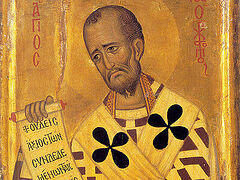
Photo: St. John Chrysostom In the name of the Father, and of the Son, and of the Holy Spirit!
Dear brothers and sisters in the Lord, congratulations to all of you on today’s feast! On this day, we commemorate one of the greatest saints, whom the Church venerates as a pillar and an Ecumenical Teacher. Only three men have been deemed worthy of this highest title: St. John Chrysostom, whom we honor today, along with Sts. Gregory the Theologian and Basil the Great.
You know, brothers and sisters, when you read and reflect on the Lives of such saints, you notice one interesting thing: that the holiness of these people, their spiritual beauty, and their spiritual greatness begin in the family. Take St. John Chrysostom, for example: he came from a noble family. His father was a military commander in Antioch, Syria, but he passed away shortly after John was born. St. John was raised solely by his mother, a devout Christian woman. Though she was very young—only twenty years old—she never remarried. Instead, she poured all her strength, her health, and her talents into raising a pious Christian. She sent him to school, where he studied under the finest and wisest teachers of his time and region.
And here is an interesting detail—of course, his mother was praying for him. It reminds me of a moment in the Life of the Optina Elder Leonid/Leo (Nagolkin). Once, a general—a veteran of the Patriotic War of 1812—came to see him. The general was an orphan and had no parents. Suddenly, Fr. Leonid asked him, “How is your dear mother doing?”
The general replied dismissively, “What do I care? She abandoned me, and I want nothing to do with her at all!”
The holy elder answered,
“Fine son that you are! Do you know that she is like one giant candle reaching from earth to Heaven, praying for her child? Look at how many wealthy, noble parents have wayward children, while you—seemingly a poor orphan—have become a general. Know this: you have achieved everything solely because of how your mother prayed for you!”
Here is a very important point. You know, having experienced this in his own life, St. John Chrysostom said a very interesting thing: “Give me one generation of pious Christian women, and I will change this world.” He also emphasized that the first book children read—and the one from which they learn about life—is the deeds of their parents.
 St. John Chrysostom So, St. John grew up. He was a very talented man; God had given him a great deal. That is why he was called Chrysostom (the Golden-Mouthed), though that was not his only name; he was also called “the Mouth of Christ” and “the Mouth of God.” What he said and how he spoke was an expression of the profound and inspired mind he possessed, having received an extensive education.
You know, when we look at people’s lives—both in ancient times and today—we see that talent has always been a great temptation. How will you use it? Talent is always a test, in the sense that it pulls you toward conceit, arrogance, and feeling superior to others. If you go down that path—seeking human praise and exalting yourself—you will perish, and in your life, you will simply become an ugly, unattractive person. As it is written in the Holy Scriptures: For that which is highly esteemed among men is abomination in the sight of God (Lk. 16:15).
And one of the greatest virtues of St. John Chrysostom was that he lived very modestly and humbly. You would think, with so many talents—being a philosopher, a rhetorician, a remarkably educated man—he could have easily become a renowned, highly capable politician, or a military commander like his father. Yet he chose a completely different path and withdrew into the desert. It would seem, what talents can you possibly use in the desert? But this man simply felt God in his heart and strove to serve Him.
Later, he was ordained priest and began to preach. That is actually how he earned the name “Chrysostom”. And eventually, he became a bishop—and not just any hierarch, but the bishop of the imperial city, Constantinople.
St. John Chrysostom drew nourishment for his soul, strength, and all this spiritual power from one particular practice—one he deeply experienced and always spoke about. He gave alms abundantly. And he used to say: “Suppose you feel down, you are in a bad mood, someone has offended you, and there is a heavy weight on your soul. Go and bring joy to someone by giving them alms, feeding them, and gladdening their heart. You will immediately see how light your own soul becomes.”
And it would seem that such a pious man and wonderworker—so gifted a preacher, held in such immense esteem by the people—ought to have spent his old age in peace, honor, and glory. Yet he ended his life in exile, condemned, having suffered for the truth in an Orthodox Empire at the hands of an Orthodox Emperor. He died in banishment from malaria and starvation. Yet, in truth, it was precisely through this that the full measure of his immense spiritual strength was revealed. It shone forth not only in his words, nor merely in the homilies he delivered; for, as we all know, our faith, our virtues, and our true selves are always revealed in times of tribulation. This man endured his afflictions with dignity and ended his days as a confessor, uttering at the very close of his days: “Glory to God for all things!” Those words of his became a timeless saying precisely because they were his dying breath, spoken in agony.
That is why this man holds such immense significance in the life of the Church and has great boldness before God. And truly, if we pray to him and ask for his help, we will certainly receive this help and support.
And finally, brothers and sisters, I want to share three quotes that I specifically wrote down for today. Listen to them, so that we may honor the memory of St. John Chrysostom and reflect upon the words he spoke.
The first quote. St. John Chrysostom said: “There would be no more pagans if we were true Christians.”
The second quote: “You did not read, so you did not know; you did not know, so you did not practice; you did not practice, so you perished—and all because you did not read.”
And the third quote, which is also very powerful: “Offenses come not from the malice of those who offend, but from the weakness of those who are offended.” I even want to repeat that last one again: “Offenses come not from the malice of those who offend, but from the weakness of those who are offended.”
Therefore, brothers and sisters, may God help you all! Just a little food for thought for today. Let us pray to St. John Chrysostom, that through his prayers, strengthened by his teachings, we may walk the path of salvation. May God save you! Amen.