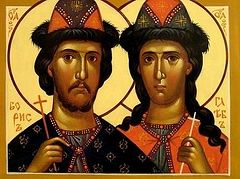
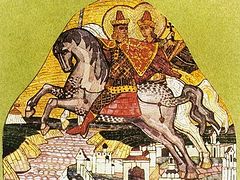
May 2/15 is the feast of the Translation of the Relics of the Holy Passion-Bearers Princes Boris and Gleb—Roman and David in Holy Baptism.
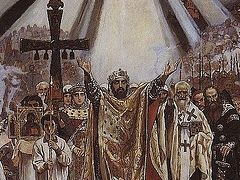
 Holy Prince Vladimir, Equal-to-the-Apostles When in 1010 Grand Prince Vladimir Equal-to-the-Apostles, the Baptizer of Russia, lost his son Vysheslav of Novgorod, he sent his other son Yaroslav the Wise1 there, and sent his younger sons to the lands where Yaroslav had previously ruled. St. Boris was sent to Rostov, and St. Gleb was sent to Murom. Prince Vladimir’s sons viewed this more as missionary work than state rule of the Russian lands, since the people there were still in the grip of paganism. Prince Yaroslav had already established order in Rostov, and Prince Boris was recognized there as its ruler. As for the young St. Gleb, he came to Murom with several monks and founded the Holy Transfiguration Monastery there—the first monastery on Russian soil. However, the pagans of Murom never recognized Gleb as their prince and did not want to be baptized.
At that time, Boris and Gleb’s father, Grand Prince Vladimir, was solving the important tasks of defending Russian lands from constant invaders. Prince Vladimir defeated the army of the Swedes who had attacked Russia and carried out several retaliatory attacks on them. When a peace treaty with the Swedes was concluded, Prince Vladimir married his son Yaroslav the Wise to the Scandinavian Princess Irina (her name was Ingegerd before Orthodox Baptism).
In 1013, King Boleslav I the Brave of Poland went to war against Russia. His army was crushed as well. A peace treaty was concluded, sealed by the marriage of Boleslav’s daughter and the infamous Prince Svyatopolk the “Accursed.” Svyatopolk’s father was Grand Prince Yaropolk Svyatoslavich of Kiev (972–978), who had constantly feuded with St. Vladimir. When Yaropolk died in an internecine battle, Prince Vladimir, according to pagan custom (this was before his Baptism), married Yaropolk’s widow, who was pregnant at the time, and treated her son, Svyatopolk, as his own, never offending him. When Svyatopolk grew up, Prince Vladimir gave him the Principality of Turov in what is now Belarus, which was much better organized than the Principalities of Rostov and Murom. But Svyatopolk’s mother had been turning her son against his stepfather since his childhood, telling him that he was “the only legitimate heir to the Kievan throne”.
King Boleslav of Poland was aware of Svyatopolk’s hostility towards his stepfather Prince Vladimir and sent along with his daughter her father-confessor, the Catholic Bishop Reinbern, to Russia. On behalf of Boleslav, Reinbern proposed that Svyatopolk, along with the Principality of Turov, come under the rule of his father-in-law, the Polish King. But, on hearing this, Prince Vladimir suddenly came to Turov and imprisoned the conspirators—his stepson and Bishop Reinbern, and took King Boleslav’s daughter to his court in Kiev. The bishop died from the shock.
Meanwhile, in 1014, Prince Yaroslav, who ruled in Novgorod in the North, and the Novgorodians, who felt their power after the defeat of the Swedes, announced that from now on they were not going to pay tribute to Kiev. Prince Vladimir raised his army, but did not hurry to Novgorod, realizing that the Novgorodians, who did not want to have their city and lands ruined, would begin negotiations. Several months passed in waiting.
 Yaroslav the Wise But the misdeeds of his son Yaroslav and stepson Svyatopolk made Prince Vladimir wonder to whom to transfer power. There was no law on the succession of power in Russia at that time. In the Byzantine Empire, Bulgaria, and Germany the rulers decided themselves which of the heirs to crown. Grand Prince Vladimir chose to do the same; he invited Prince Boris to Kiev, and he came from Rostov. It should be noted that St. Boris refused to fight with Yaroslav, because his Christian conscience did not allow him to use weapons against his brother. So Prince Vladimir did not have time to appoint a successor, as we will see later.
At that time, a conspiracy arose against Prince Vladimir in Kiev. The boyars of the capital, who had become rich and gained political weight, did not want to resign themselves to the Grand Prince’s strong power. They started supporting Svyatopolk, who was in prison. The arrival of Prince Boris in Kiev and talk that he would be the next Grand Prince provoked the traitors.
 Holy Prince Boris. Sketch of the painting at St. Vladimir’s Cathedral in Kiev. Artist: Mikhail Nesterov, 1891 Grand Prince Vladimir was just over fifty at the time and enjoyed good health, but in the summer of 1015 he suddenly fell ill. The combination of such circumstances looked suspicious. The conspirators demanded that the army assembled for the march on Novgorod be withdrawn from Kiev. Prince Vladimir was immediately misinformed about a “new Pecheneg raid.”2 Prince Vladimir ordered his son Boris to lead the army and go to fight the Pechenegs. St. Boris set out on his journey, and a few days later—on July 15/28, 1015—Grand Prince Vladimir departed to the Lord.
The boyars did not hurry to inform anyone about St. Vladimir’s death. But they immediately brought Svyatopolk out of prison and declared him the Grand Prince. Svyatopolk distributed Prince Vladimir’s treasury, paying the boyar conspirators for their “services”.
Having met no Pechenegs on the way, Prince Boris turned the army back. On the Alta River (now in the Kiev region) he received the news that Grand Prince Vladimir was dead and Svyatopolk was on the throne in Kiev. The troops suggested going to Kiev and overthrowing Svyatopolk right away. But Prince Boris could not even imagine fighting with his kinsmen and fellow countrymen. So he sacrificed the Kievan throne, declaring to his troops that since Svyatopolk was his elder brother, he (Boris) should obey him as a father. St. Boris stopped at the Alta River, sent messengers to Kiev, and stood down the army.
Soon Svyatopolk sent his brother an affectionate sounding reply with kind words, while secretly sending assassins. Having learned about this, Predslava, Prince Vladimir’s daughter, at once warned her brothers Boris and Gleb about the impending assasination. Prince Boris, with only a few servants left, did not have time to do anything to save his life. The assassins were already close, but they feared to attack the prince during the day, waiting for the night. Meanwhile, St. Boris prayed for a long time in the tent, primarily for the soul of his stepbrother Svyatopolk. When Boris went to sleep, the assassins assaulted him and his servants who were next to the prince.
Prince Boris received multiple wounds and bled profusely. He was taken, barely alive, to Svyatopolk in Kiev. Svyatopolk ordered Prince Boris to be killed. The holy Prince Boris commended his soul to the Lord on July 24/August 6, 1015.
 Holy Prince Gleb. Sketch of the painting at St. Vladimir’s Cathedral in Kiev. Artist: Mikhail Nesterov, 1891 Then Svyatopolk sent his forces to the sons of Prince Vladimir—Princes Svyatoslav and Gleb. Soon Prince Svyatoslav Vladimirovich of the Drevlyans3 was killed.
In Murom Prince Gleb received a false message that his father was ill and ordered him to come to Kiev. The young Prince Gleb hurried to Kiev. On the way, his horse stumbled and fell, injuring its leg. At the Dnieper River, he boarded his boat, leaving his main cavalry on the bank.
Near the city of Smolensk St. Gleb received a message from his brother Prince Yaroslav. He informed Gleb about the death of their father, Prince Vladimir, the seizure of power in Kiev by Svyatopolk, and the murders of their brothers Boris and Svyatoslav, offering him his protection from Svyatopolk.
St. Gleb was devastated by the death of his father, Grand Prince Vladimir, and the murders of his brothers Boris and Svyatoslav at the hands of Svyatopolk. He stopped at the small Smyadyn River near Smolensk (a small tributary of the Dnieper) and prayed there for a long time. Then he was overtaken by the assassins—first spotted by Gleb’s servants, who turned out to be very unreliable. Prince Gleb’s body was buried in the brushwood. Prince Gleb was martyred on September 5/18, 1015.
However, the joy of Svyatopolk and the boyars was brief. In the autumn of 1016, Prince Yaroslav the Wise of Novgorod defeated Svyatopolk’s army near Lyubech (now in the Chernigov region), and Svyatopolk fled from the Russian lands. But afterwards he tried to regain power twice, returning to Russia first with the Polish army, then with the Pecheneg army. Both attempts ended in complete failure, and Svyatopolk became known as the “Accursed”.
In 1019, Prince Yaroslav the Wise confronted a huge horde of Pechenegs allied with Svyatopolk on the Alta River. In a difficult battle, the Russians crushed the Pechenegs, and Svyatopolk fled westwards again. After experiencing all these catastrophic events, Svyatoslav suffered a physical and mental breakdown. Even while bedridden, he was gripped with a feeling of being pursued. He died in 1019 in the Czech lands.
 The holy Right-Believing Princes and Passion-Bearers Boris and Gleb Prince Boris was initially buried by St. Basil’s Church in Vyshgorod (on the right bank of the Dnieper in the Kiev region). When Yaroslav the Wise became the Grand Prince of Kiev, he transferred the remains of Boris, who had been killed by evildoers, into the church and had them enshrined.
Prince Yaroslav sent people to search for the body of Prince Gleb. His remains were uncovered thanks to the fact that a pillar of unearthly light, resembling a candle flame, was seen above them. Prince Gleb’s body was moved to Vyshgorod as well. When the tombs of Princes Boris and Gleb were opened following a fire in the church, their relics were shown to be incorrupt. Thus the veneration of Boris and Gleb as saints of God began.
In 1021, Grand Prince Yaroslav the Wise built the first wooden Orthodox church in honor of Sts. Boris and Gleb, and their relics were translated here.
Prince Yaroslav ordered the first icons of the Holy Passion-Bearers to be painted, and the Church of Sts. Boris and Gleb was built on the Alta River. The Monastery of Sts. Boris and Gleb was built in the town of Torzhok.4 Christians started flocking from everywhere to the relics of Sts. Boris and Gleb, the sick were healed there, and the righteous brothers became famous as healers.
In the second half of the eleventh century, Princes Izyaslav, Svyatoslav and Vsevolod, sons of Yaroslav the Wise, requested the canonization of their martyred relatives from Byzantium,5 and Boris and Gleb became the first officially glorified Russian saints.
In 1072, a new church was built in the city of Vyshgorod, into which the shrine with the relics of Sts. Boris and Gleb was moved.
 Kideksha. Church of Sts. Boris and Gleb. Photo: pravoslavie.ru Many Grand Princes of Russia deeply venerated Sts. Boris and Gleb, who became the Heavenly patrons of the Russian land. Grand Prince Yuri Dolgoruky (†1157), the founder of Moscow, also regarded them as his patron-saints, and in about 1152, when he ruled the Rostov-Suzdal Principality, he founded a stone church in Kideksha6 in honor of the Passion-Bearers Boris and Gleb.
Prince Yuri Dolgoruky’s son, the holy Right-Believing Prince Andrei Bogolyubsky (†1174), always carried with him a precious relic—the sword of Prince Boris. Grand Prince Rurik Rostislavich of Kiev (†1212) publicly thanked Sts. Boris and Gleb for his victory over the Polovtsian Khan Könchek who made destructive raids on the Russian Principalities of Kiev, Chernigov and Pereyaslavl in the 1170s and 1180s. Sts. Boris and Gleb appeared to the holy Right-Believing Prince Alexander Nevsky before his decisive battle with the Swedes in July 1240 and helped him defeat a strong enemy.
The first Russian saints, brothers Boris and Gleb, who were deeply humble and peace-loving in an era of internecine wars, received their martyrs’ crowns together. Their Christian act had a profound and lasting influence on the entire history of Russia. The image of Sts. Boris and Gleb has shaped the worldview of many of our country’s rulers, right up to the holy martyred Tsar Nicholas II.
 Eugene Demakov. Holy Princes Boris and Gleb