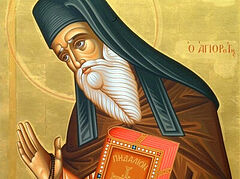
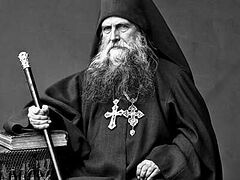
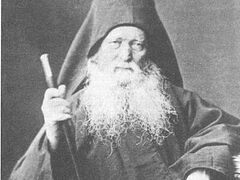
How many faithful followers does God have—diligent laborers in the great work of the divine economy of the salvation of mankind, how many have already been glorified in the heavens, and how many remain unknown to the world! It pleased God, wondrous in His saints, to glorify one such laborer in Christ’s field, Venerable Gabriel of Mount Athos, through the revelation of his incorrupt relics in the Holy Elijah Cathedral of the city of Odessa on July 9 (22), 1994.
The venerable and God-bearing father Gabriel was born on January 8, 1849, in the Kiev province, to a family of modest means. His birthday coincided with the Church’s commemoration of St. George of Choziba, and at baptism the child was named George. It is likely that George received his initial Christian upbringing from his parents. At the age of twelve, he became an orphan. With the help of caregivers, he received an education at a village school, where he especially excelled in studying the Word of God. He quickly learned Church Slavonic, loved reading the Holy Scriptures and spiritually edifying books, and displayed a bright mind and clear memory, adorning himself with virtues.
As a youth, during a serious illness, he vowed that if he recovered, he would visit the holy places of the Kiev region. He soon fulfilled this vow. Visiting the sacred sites of the Lavra and other monasteries left a deep impression on him. George saw with his own eyes the places of the ascetic feats of the venerable fathers, about whom he had heard and read much, and reverently kissed their incorrupt relics, asking for their prayers.
In the soul of this pious young man, a desire was born to follow in the footsteps of the saints, to imitate their ascetic labors, to renounce the world, and to devote his life to monastic struggle. After spending some time in his homeland, he returned again to Kiev and asked the brethren of the Theophania Hermitage to receive him as a member of the community. With love, George was received as a novice and placed under the instruction of the humble Fr. Boniface. Imitating the elders of the hermitage, the young novice regularly attended services, stood through the long monastic vigils, loved prayer, and diligently fulfilled the obediences assigned to him.
In 1867, a favorable opportunity arose to visit Jerusalem and Mount Athos. With a blessing from his elder, the novice George traveled to Jerusalem, where he venerated the Life-Giving Tomb of the Lord and other holy sites. The following year, he arrived at Mount Athos.
And so Athos opened before him—the domain of the Theotokos, with its sacred treasures, wonderworking icons, and strict monastic way of life; an island of prayer and spiritual life, a millennial monastic kingdom serving the Creator of the ages day and night. George looked with awe upon the inhabitants of Athos—holy fathers and venerable desert-dwellers, monks living not in a world distorted by sin, but in a transfigured world, where the ascetic, having cleansed himself from passions, contemplates God. George became personally convinced that the monks of Athos were martyrs for Christ, “separated from the world in their senses and dead to it in their minds,” who truly fulfilled all the Beatitudes of the Lord, having fervently embraced triple poverty: material, spiritual, and bodily. For in becoming poor in spirit, they were made rich; becoming meek, they inherited the earth; weeping, they were comforted; thirsting for righteousness, they were filled; being merciful, they obtained mercy; purifying their hearts, they saw the Invisible One; attaining peace of soul, they were called sons of God.
The silent bearing of the monks, their eyes turned to the ground, the caves of hermits praying for the human race, the splendid monasteries, the strict rule of monastic life, and the very nature of the Holy Mountain made an irresistible impression on the novice George. “A burning love for Thee and a fervent desire for Thee, O Lord, seized these angels,” says St. John Chrysostom, “and an even greater longing and love flamed up in them. For contemplation of deeds kindles even more than words.” George beheld the virtuous, truly monastic and ascetic life of the inhabitants of the Holy Mountain. His heart was inflamed with the fire of divine love. Having utterly rejected all worldly things, he remained on Mount Athos and dedicated himself there to the service of God.
Among the Russian monastic settlements, he was most drawn to the Skete of the Holy Prophet Elias, where the brethren lived a strict monastic life. The abbot, Fr. Paisius P., a loving and gentle elder, subjected the young novice to the customary testing, as he accepted brethren into the skete only after becoming fully convinced of their sincere desire to become true monks. Archimandrite Paisius and the brethren grew to love George, who faithfully and joyfully fulfilled various obediences in the skete, and was distinguished by meekness and humility. The young man grew to love the skete’s night services, the holy prayer that lifts the soul to the Lord, solitude, and silence. His desire for the monastic life deepened.
As a tried novice, in 1869 he was tonsured a monk with the name Gabriel, in honor of the Archangel Gabriel, the heavenly messenger who brought the joyous news to the Most Holy Theotokos. The name “Gabriel” means “God is my strength.” Bearing the name of the Archangel, Venerable Gabriel acquired in his life that divine strength which is made perfect in weakness—bearing illnesses and labors, fulfilling the obediences entrusted to him by the spiritual authorities of the St. Elias Skete. Having firmly renounced the world with its passions and temptations, the holy man, in deep faith, sought the heavenly City, belonging to it with his heart, soul, and every thought. Imitating the labors and prayers of the Athonite fathers, the young monk Gabriel became a man of spiritual maturity. Advancing in asceticism, in 1874 he was ordained to the diaconate, and in 1876 to the priesthood, becoming a hieromonk graced with “the great honor of the priesthood,” called “to minister on behalf of the people and to offer the sacrifice of righteousness for his own sins and the ignorance of the people” (cf. Hebrews 5:1–3). Hieromonk Gabriel strove to use all his strength to live a holy life and to please the Lord, abiding in prayer and keeping his mind and heart pure.
Through constant labors and obedience, and with the vigilant guidance of his elder, Fr. Gabriel advanced in his inner spiritual life. Attentive to himself, he learned clearly that man is nothing of himself, and in the struggle against his sins and passions, he could be victorious only to the extent that he humbled himself and called upon the help of the Lord. Enlightened by divine grace, his spirit reached toward union with the Sweetest Jesus. In his ascetic life, Fr. Gabriel often encountered sorrows and temptations, but he endured all with humility and patience, lifting his mind to heaven and firmly believing in the help of God and the intercession of the Most Holy Virgin. “A monk is a depth of humility,” teaches St. John Climacus, “in which he has cast down and drowned every evil spirit.” Gabriel overcame the tricks and snares of the demons with humility, obedience, prayer, and fasting. More and more he became confirmed in the salvific nature of monasticism and loved it with all his heart.

In the spring of 1876, Fr. Gabriel was appointed steward of the sailing vessel belonging to the Skete, which annually sailed to Russia to deliver all that was necessary for life in the St. Elias Skete. The monastic brig Holy Prophet Elias made voyages between Mount Athos, Constantinople, Odessa, and Mariupol, where it was loaded with grain, flour, fish from the Volga, and other provisions. The ship’s captain was a hieromonk, and the crew consisted of monks and novices—natives of Kherson, Kursk, and other provinces. The ship’s watch alternated with the prescribed divine services in the chapel on deck. During the Russo-Turkish War, the steward Hieromonk Gabriel, along with his ship, stayed in Taganrog and Rostov-on-Don; in 1878, after peace was concluded with Turkey, he returned to Mount Athos.
At the monastery, Fr. Gabriel was entrusted with important obediences: as treasurer, steward, and also as head of the St. Elias metochion (representation church) in Constantinople. The duties were so numerous that he barely had time to reach his cell, give his weary body a bit of rest and peace, and then proceed to the church service, only to resume his tasks for the skete. Even while carrying out his obediences for the improvement of the skete, Fr. Gabriel did not cease to live an intense spiritual life. Constant prayer, spiritual wisdom, fatherly care for the brethren, heartfelt kindness toward outsiders, and practical competence in administration—all these qualities were wondrously combined in him.
 After the transfer in 1887 of the abbot of the skete, Hieroschemamonk Tovia, to the Akhtyrsky Monastery, it pleased God to entrust Fr. Gabriel with the leadership of the St. Elias Skete. In 1891, he was elevated to the rank of archimandrite by Patriarch Joachim III of Constantinople. The new superior, endowed by God with lofty spiritual gifts, skillfully governed the life of the monastery. He taught the brethren the necessity of strict observance of the monastic rule and of inner spiritual growth. Under the influence of his fatherly counsel, some monks, in addition to fulfilling the three usual monastic vows—of poverty, chastity, and obedience—also undertook additional vows aimed at strengthening their spiritual will and elevating the Christian spirit.
Concerning Father Gabriel and his brotherhood, one might well apply the words of St. John Chrysostom: “Monks are like choirs of angels in human flesh; their life is hard and burdensome, yet sweeter and more desirable than the life of the world. Their lips are filled with fragrance; in their dwellings are silence and stillness. They keep strict fasts and rise before dawn, striving in thanksgivings to God, in prayer, and in psalmody. Dwelling as in a harbor, they lead lives shielded from every tumult. They sing before the birds awaken. They overcome the passions more easily than those in the world. The monastic life is more blessed than the royal life. Prayer to a monk is as a sword to a hunter; death for a monk is untroubled. The monk heals the sufferings of others; his ascetic struggle is great. Though monks live in poverty, they possess the spiritual treasures of the whole universe. Monks are holy in life and in faith...”
Archimandrite Gabriel labored greatly for the improvement and prosperity of the monastery, both inwardly and outwardly. From the time a new church was laid in the skete by Grand Duchess Alexandra Petrovna—who had taken monastic vows under the name Schemanun Anastasia and sent the first foundation stone with an inscription for the cathedral—a strong opposition arose from the Greeks against the Russian monks on Mount Athos in general, and against the St. Elias Skete in particular. But Venerable Gabriel, a true peacemaker who had acquired the grace-filled peace of God, was able to bring the conflict to a peaceful resolution in favor of the Elias Skete.
Ahead lay the construction of a new cathedral, yet there were not enough funds. At the request of the skete’s abbot, Archimandrite Gabriel, and by the highest imperial permission and the blessing of the Holy Synod, the Russian Skete of the Holy Prophet Elias was granted permission to collect alms throughout the Russian Empire. At the end of 1893, Archimandrite Gabriel, accompanied by brethren, arrived in Russia with the sacred relics of the St. Elias Skete: the wonderworking icon of the Mother of God, the “Milk-Giver,” a fragment of the Life-Giving Cross of the Lord, and the left foot of the holy relics of the Apostle Andrew the First-Called. With the blessing of Metropolitans Palladius of St. Petersburg and Sergius of Moscow, as well as various archbishops and bishops across Russia, these relics were placed in churches in the capital and other cities for veneration by pious Christians and for the collection of donations according to their means.
By God’s providence, good people responded to this holy cause and, through their offerings, made possible the start of new construction at the skete. The holiness of Fr. Gabriel’s life and his spiritual strength attracted both monastics and laypeople. Material means, necessary for the skete, began to appear.
While caring for the brotherhood and attending to the beauty and dignity of the Athonite St. Elias Skete, the venerable one did not forget to show concern for Russian pilgrims traveling from their homeland to the Holy Land and to Mount Athos. For this purpose, between 1894 and 1896, he built a magnificent three-altar church in the Byzantine style at the St. Elias metochion in the city of Odessa. On December 22, 1896, the main altar, dedicated to the icon of the Mother of God, the “Milk-Giver,” was consecrated by Archbishop Justin of Kherson and Odessa. On December 23, the right altar was consecrated in honor of the Holy Prophet Elias, and on December 28, the left altar in honor of the Archangel Gabriel. Accommodations with all necessary conveniences for pilgrims were also constructed.
In 1894, Archimandrite Gabriel laid the foundation for a new communal residence at the St. Elias Skete on Mount Athos, which was completed in 1898. The following year, he began the construction of the new cathedral. He managed to complete the foundation and the basement portion of the church. Responsibilities once again called him to travel, and in 1901, despite poor health, Archimandrite Gabriel was compelled to journey to Russia to visit the skete’s metochia in Odessa, Taganrog, and Novonikolaevsk, to oversee administrative affairs and offer spiritual instruction to the brethren.
The years passed one after another, and the elder, who had labored much, was drawing near the end of his earthly journey. The lamp of life was visibly fading within him. Before his departure from Mount Athos, Elder Gabriel, sensing his approaching end, addressed the brethren with words of farewell:
“Peace I leave with you, my peace I give unto you... If we live in the spirit of true monastics, if we bear one another’s burdens, if we preserve among ourselves that peace which Jesus Christ has commanded us, then our compassionate benefactors—the true children of the Holy Orthodox Church, the prayerfully unforgettable sons of our beloved homeland, Holy Russia—shall not cease to support us with their generous aid, by which our monastery exists, through the mercy of the Queen of Heaven.”
Visiting along the way the metochia in Constantinople, Odessa, and Taganrog, Archimandrite Gabriel arrived in Novonikolaevsk in October. On October 14, after the Divine Liturgy, he began to feel unwell. The next day, his condition worsened. On October 18, he received the Holy Mysteries of Christ, and on October 19, he departed into eternal life—to that place toward which all his thoughts and desires had always been directed.
Precious in the sight of the Lord is the death of His saints (Psalm 116:15).
These words were fulfilled in the Venerable Gabriel, whom the Lord deemed worthy to pass away in piety after a life of pastoral labor and church-building. Bodily death for the righteous is not terror and dread, but a gateway to the heavenly mansions prepared by Christ for His faithful followers. Having borne the good yoke in this earthly life with patience and hope, the holy servant of God could firmly say:
I have fought a good fight, I have finished my course, I have kept the faith: henceforth there is laid up for me a crown of righteousness, which the Lord, the righteous Judge, shall give me at that day”(2 Timothy 4:7–8).
The venerable elder’s remains were transferred to Odessa and, on November 2, were buried in the crypt of the metochion church.
A city that is set on a hill cannot be hid (Matthew 5:14).
The All-merciful Lord does not abandon the human race, but in His love for mankind, cares for it and saves it from evil and destruction through His chosen ones—the saints of God—revealing even the hidden places of their repose.
The clergy of the St. Elias Cathedral in the city of Odessa would at times hear unexplained knocks in the basement of the church. According to the testimony of elderly parishioners and the local pious tradition, it was known that the relics of the church’s founder rested beneath the church. With the blessing of His Eminence Metropolitan Agathangel of Odessa and Izmail, the clergy decided to examine the suspected burial site, located beneath the baptistery. This took place on Friday, July 9 (22), 1994.
A sign of the discovery of the holy relics occurred that day: A young man about nineteen years old, possessed by an evil spirit, was brought into the church. Like the demoniac of Gadara, he screamed and struggled in the hands of his parents. With difficulty, he was brought into the baptistery for a prayer. During the prayer, he collapsed unconscious onto the floor. After being sprinkled with holy water, the young man rose to his feet—to the astonishment of his relatives—exhausted but in a normal state, and walked out of the baptistery. This clearly indicated that the evil spirit that had left the young man could not remain near the place where the saint’s relics lay.
That evening, the priests and church workers, after examining the walls and removing some partitions, discovered a coffin in a niche, covered with a monastic mantle. Those present sensed what felt like a breeze of fresh air. Thus were revealed the relics of Elder Archimandrite Gabriel. His venerable relics were then placed in a tomb within the church.
 Healings from the relics were recorded from the very first days. Thus, on July 13 (26), on the feast day of the Archangel Gabriel, a gravely ill woman possessed by an evil spirit—handmaiden of God, N.—received significant relief during prayer before the newly uncovered relics.
On July 14 (27), during the evening service and prayer at the relics, a disabled man, Z., who had a diseased leg, was completely healed. He left the church neither limping nor leaning on his cane.
On July 16 (29), a paralyzed man was brought into the cathedral on a stretcher. While in the presence of the relics, the sufferer felt himself surrounded by a bright light and experienced relief from his affliction.
From childhood, God’s servant A-ko had suffered from spastic paralysis (a condition of the central nervous system known as Little’s disease), enduring excruciating pain. After multiple visits to the Holy Elias Cathedral and prayer at the relics of Venerable Gabriel of Athos, she experienced significant relief—her pain nearly vanished, she began to sleep normally, and was able to move around without assistance.
Miracles at the honorable relics take place sometimes in the presence of many witnesses, and at other times in the secret depths of the heart, according to the faith of those who come to the holy treasure.
“We give thanks unto Thee, O Lord, though we are unworthy servants, for Thy great mercies bestowed upon us…”
The Almighty God has granted the Orthodox faithful a new intercessor and prayerful protector.
Today, the faithful come to Venerable Gabriel, asking for his prayers on their behalf and for their loved ones. Simple people come, as do bishops, priests, and monks. He prays for all; he prays for our Church and for our land.
The Orthodox come to the holy relics of Gabriel, that this venerable intercessor, comforter, and father might help us to accept all things from God with faith and patience, in a Christian manner—that the Lord may teach us humility and grant us strength in the struggle against despondency, temptation, and sin.
His venerable relics pour forth healings upon all who draw near to them with faith, for there, in the dwellings of heaven, the Venerable Gabriel prays to the Lord for those who honor his holy memory—those who honor him with loving hearts, who honor him by their lives, and who in prayer cry out with hope:
O our holy father Gabriel, pray to God for us!