The First Encounter
A pilgrimage always leaves a deeply personal impression. My first encounter with the Pochaev Lavra took place back in Soviet times, when at the foot of the Lavra, in a two-story pre-revolutionary building that now houses the theological seminary, there was a Museum of Atheism. All tourists—including foreigners—were brought there, as though to a godless purgatory, so that the citizens of “the freest country in the world” might be spared from being “poisoned” by the “opium of the people” on Pochaev Hill.
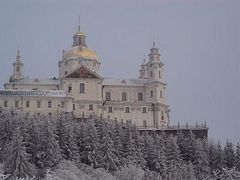
I don’t recall at all the content of the museum’s atheist propaganda, but I vividly remember how deeply I was impressed by the Lavra’s Trinity Cathedral, built in the early twentieth century (1906–1912). At that time, on the eve of revolution, the cultural elite was beginning to rediscover the genius of ancient Russian architecture, and the academician Alexey Shchusev decided to recreate—over a thousand kilometers to the west, on the frontier of the Catholic world—the Trinity Cathedral of the St. Sergius Lavra near Moscow, where the relics of St. Sergius of Radonezh lie, only enlarged exactly fourfold.

At that time, I was still a young Soviet journalist, far from faith and the Church. It was as though I beheld with my own eyes this very “Holy Russia”: waves of humanity swaying between the blue and sky-blue walls adorned with the solemn faces of saints. The Divine Liturgy had just ended, and the people—many of whom were “the poor and the afflicted,” in makeshift wheelchairs and carts, with satchels on their backs—were streaming toward the golden cross gleaming in the morning light, held aloft by a hieromonk…
I knew nothing then about the scale of persecution against the Church, about the sea of blood shed by the confessors of the twentieth century. Nor did I know about the harsh Khrushchev era, when the Ternopil Party officials carried out the secret atheist directives of the Central Committee, and the local police staged raids on the Pochaev Lavra. Cells were flooded with water from fire hydrants, monks were herded into trucks… Many were imprisoned “for violating passport regulations.”
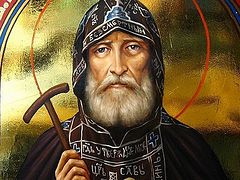
I saw people with satchels and prayer books in hand, resting in the stone niches of the long staircase leading to the cave church of St. Job, lined with icons of all the saints “who shone forth in the Russian land.” From the icons gazed Equal-to-the-Apostles Prince Vladimir and Princess Olga, the martyred children of the Baptizer of Rus’—the young princes Boris and Gleb—followed by the saints of the Kiev Caves, and then the saints of the eras of Sts. Alexander Nevsky and Sergius of Radonezh, Job of Pochaev, and beyond. It was a great multitude of the venerable, the martyrs, the fools-for-Christ, up to St. Demetrius of Rostov and Seraphim of Sarov. (Later, the faces of the new martyrs and confessors of the twentieth—the bloodiest—century would appear here, along with the newly glorified contemporary, St. Amphilochius of Pochaev †1971.)
“There’s a mystery here,” I thought then, in wonder…
Early 1990s: The Last Persecutions
In the late 1980s and early 1990s, a terrifying political wave swept through the western regions of Ukraine: Greek Catholics, who had received official status thanks to Mikhail Gorbachev, but without any clear directives about church property or which churches they were to use, began seizing Orthodox churches on a massive scale. At the same time, from the shadows of the Nazi occupation era, there re-emerged the so-called “autocephalists,” led by maniacally obsessed nationalist deputies and new political demagogues. By that point, the cathedrals in Lvov and Ivano-Frankivsk had already been seized. In Lutsk, Ternopil, and Rivne, Orthodox believers would lock themselves inside the cathedrals to pray while enraged nationalist crowds were barely held back by police cordons.
 The Pochaev brotherhood writes a letter to the UN in defense of the Lavra, 1963
When Metropolitan Vladimir arrived at the Kiev cathedra in 1992, he asked us—a handful of journalists who had supported the canonical Church in the press—to travel to Western Ukraine. I remember how we huddled on the tiny landing of the steps before the cathedral in Lutsk, while below us raged a sea of furious people, corralled by riot police, waving sticks and signs that read, “Away with the Moscow Church!” I also remember the twenty-kilometer procession from Kremenets to Pochaev in support of the besieged Pochaev Lavra. I still recall the newspaper headline, which seemed to capture the entire moment: “The church is closed. There is blood on the steps…”
I remember the solemn faces of the monks deep in prayer in the Dormition and Trinity churches of the Lavra, the akathists and endless molebens, the cries of prayer: “Save and preserve us, O God, by Thy grace…”And the buses of the nationalist Rukh party, blocking the entrance to the Lavra.
Before my eyes would arise the panoramic image painted on the wall of the Dormition Cathedral: the Turkish-Tatar siege of Pochaev in the seventeenth century, when, through the prayers of the Theotokos and St. Job of Pochaev who appeared above the monastery, the enemy’s arrows miraculously turned back and struck the attackers themselves, stunned by the vision. And now, at the close of the twentieth century, the Lavra was again under attack. And to this day, in the pre-dawn hours, the monks of Pochaev process around the ancient monastery in prayer, with burning lanterns and banners.
Acquaintance with Monastic Life
In the early 1990s, the grounds of the Lavra looked quite different from today. There were no white stone-paved alleys, no small chapels, no elegant golden-domed gazebo sheltering the outdoor altar where the Divine Liturgy is served on great feast days when the faithful can no longer fit within the Lavra’s churches, and the entire vast territory becomes one open-air church. So it was during the most recent visit of Patriarch Kirill to Pochaev on August 5, 2009, the feast of the Wonderworking Pochaev Icon of the Mother of God—when some 50,000 people sang the Nicene Creed together in a single, mighty choir.
 The 1970s
The 1970s and Early 1990s: The Last Persecutions
Back in the early 1990s, instead of today’s graceful buildings for pilgrims, behind a tall wooden fence topped with barbed wire stood the peeling walls of a regional psychiatric hospital. Through its barred windows, one could glimpse the ashen faces of the mentally ill. At that time, by the blessing of the abbot, we were lodged in one of the monks’ cells, which allowed us to witness Lavra life from within. We saw, in the dim corridors of the monastery, the silent figures of monks in black klobuks moving swiftly toward midnight prayer in the Dormition Cathedral, connected to the brethren’s quarters by medieval passageways and secluded courtyards hidden from the outside world.
For the first time, I was able to hear the voices of white-haired elders who still remembered their spiritual guides—monks of Pochaev from Tsarist times—who had preserved for decades the ancient monastic tradition of Pochaev—the long Athonite-style services, the chanting, the multitude of obediences, even the way monastery bread and prosphora were baked. Not to mention the heart of monastic life—prayer. And since the Most Pure One Herself touched these rocks with Her foot and left Her wondrous footprint, from which a miraculous spring still flows, the monks pray here for the entire world, sheltered under Her wondrous intercession.
I remember a two-hour conversation in the cell of Schema-Archimandrite Dimitry (Shivkennik, †2005), a revered spiritual father, highly respected both by the brotherhood and the faithful.
We sat in the soft twilight, and Fr. Dimitry spoke of how, in his famine-stricken childhood, his mother had brought him to the monastery so he would not starve, how he would rise at night for the vigils, how he came to love God and the Most Holy Theotokos, how he nearly died from intestinal ulcers in adulthood after having taken no food for forty days during Great Lent, and yet survived, healed by grace. He spoke of many things: of God’s love for man, of humility and endurance. There was a sweetness in his quiet speech, and every time the large wall clock in his cell marked another half hour, he would cross himself and offer a short prayer.
I also managed to make some audio recordings and photograph (something monks, especially the elderly, usually dislike) some of the Lavra’s oldest residents, many of whom had endured war fronts, labor camps, and prison. They spoke unanimously of the evil of the Philaret schism and its leader,1 and those interviews were later published in one of Ukraine’s major political weeklies.
Some of the novices also left an impression—one of them a former tank officer, a veteran of the Afghan war, tormented by visions of the bloody conflict, by the screams and tears of slaughtered civilians. Here, he found peace, and the visions ceased. He told us how the Mother of God had healed him.
Grieving. A Revelation
 Confession. Schema-Archimandrite Dimitry (Shivkennik, †2005) Later there were other pilgrimages to Pochaev, one of them following the tragic death of our twenty-year-old son two years earlier. My wife and I brought our sorrow to the holy places, seeking spiritual consolation from the sacred treasures of Orthodoxy. At that time, I recorded this in my journalist’s notebook:
“The abbot gave us his blessing to stay in Room 182 of the Pochaev guesthouse, with its stunning panorama of green fields, groves, and hills stretching to the horizon, to the blue distance where the earth meets the sky in a pale azure haze far to the east. The air was fragrant with blooming summer grasses, birdsong filled the air, the Lavra’s bell tolled rhythmically, and in the corner of our room stood the icon of the ‘Inexhaustible Cup.’ Before it, we wept for our departed Alyosha. The weariness of the day, and all of this, was wrapped in the great grace of the Most Holy Theotokos. Most Holy Theotokos, save us!”
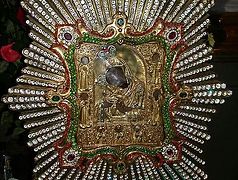
“I awoke at 5 after a deep, strong sleep, went to the open window, and saw a crimson sun rising over the blue hills. I gave thanks to the Lord, Creator of heaven and earth. Then I walked to the Holy Trinity Cathedral, built in the Old Russian style and painted as it was in the time of Sts. Sergius of Radonezh and Andrei Rublev. I confessed and stood before the wonderworking copy of the Pochaev Icon of the Mother of God, by the bronze railing and lit candle stand, on the steps leading to the raised icon in its case. I looked at Her darkened face through the white, red, and pink lilies placed in a ceramic vase beyond the railing, breathing in their nectar-like fragrance. And I prayed to the Queen of Heaven, pouring out my soul and sorrow. And She consoled me, the unworthy one, with the Body and Blood of Her Son, for the remission of sins and life eternal. And I understood in my soul that all are alive. And in response to my protest over Alyosha, the Most Holy One sent me a thought: ‘It had to be this way.’ And peace entered my aching heart. July 2, 2009. Pochaev Lavra.”
On the bright stairways and corridors of the now-comfortable modern guesthouse, there reigned an intangible purity—a grace shared among people of one heart, united in prayerful labor. The elderly and the young, children and teenagers, men and women… They had all come here, to the holy site, to pray. In their quiet unity, they resembled the community of early Christians, of whom the Apostle wrote, They had all things in common. I thought then: How many lives, how many prayers and hidden sighs are lifted here to the Mother of God! Truly, a holy place does not remain empty.
The Last Visit
It was unusual—and somewhat troubling. The reason was that strange accusations had begun circulating in church media, directed against the brotherhood of Pochaev and its abbot. Allegedly, the sacrament of confession was being violated in the Lavra through biased attitudes toward penitents, that the Lavra priests were asking pilgrims inappropriate questions, denying them Communion, and imposing unbearable penances. On top of that, the town of Pochaev had been flooded with flyers warning about the tax identification number (INN) as the “mark of the Antichrist,” along with other apocalyptic scare stories.
 Schema-Archimandrite Dimitry. Last photo
“Where is Pochaev drifting?” cried one clerical journalist to the online audience. A polemic erupted in online media. Accusations flew, but there were also sober voices in defense. Those defending Pochaev—including a respected archimandrite and abbot of a major Kiev monastery—were called hysterics and obscurantists. But nowadays, anyone can post anything online, say anything he likes. You can criticize patriarchs and metropolitans, proclaim your own “Orthodox” democratic views in blogs and forums. There’s no paper, no editor, and nothing to blush over...
These were the thoughts that came to me as I traveled from Ternopil to Pochaev. Our white minibus was carrying passengers through the winding hills of Volhynia, each turn and rise revealing a new and stunning landscape. I remembered then, for some reason, a departed schema-abbot of the Kiev Caves Lavra, confined to a wheelchair. Once a vigorous archpriest, a father of a large family, a builder of churches and a man of prayer, he had been stricken in middle age by severe polyarthritis that paralyzed his body. By mutual agreement with his matushka, he went to live out his remaining days in the Kiev Caves Lavra, where he gained deep respect from the brotherhood, the faithful, and pilgrims alike. Fr. Gerontius—that was the name given to him in the great schema—once told me that he often had the same dream: that he was walking again, strong and joyful, through valleys and hills—journeying to Pochaev, to the Most Holy Theotokos.
At last we’re in Pochaev. I went to confession, spoke with the brethren, talked with pilgrims and women serving obediences in the pilgrim guesthouse. Finally, I conducted an extensive interview with the abbot of the Lavra, Archbishop Vladimir. And I came to my own journalistic conclusion: the critical articles about the Lavra had been biased and groundless. The abbot explained how the Lavra’s monastic council had gathered to discuss the issue and how the elder confessors had shared their impressions.
The truth is that most people come to the Lavra for a “general confession,” often burdened with spiritual struggles they couldn’t resolve at their local parishes. The Archbishop explained that confession and spiritual counseling for pilgrims is already a monastic concession made for the sake of the people. Historically, monasteries did not hear confessions at all; the monks’ primary calling was prayer. But in our era of widespread atheism, people often turn to monasteries as places of refuge.
The confessing hieromonk often must ask questions to discern the root of a person’s inner problem. And it may be that among the many spiritually inexperienced visitors coming to the Lavra, some found this probing unsettling and took issue with the Pochaev practice of confession.
Moreover, people come to Pochaev not only from Orthodox parishes but also from nearby Catholic and Greek Catholic towns and villages—and even from schismatic communities—all hoping to receive Holy Communion. Therefore, Lavra clergy are compelled to ask: “Where are you from?” “What is your confession of faith?”
On the Controversial Tax ID Numbers (INN)
We also spoke with the abbot about the INN issue.2 Yes, some Pochaev leaflets do include warnings on this subject—but not in a sensational or alarmist tone. Rather, they express a monastic perspective. No one in the brotherhood, however, asks those coming to confession whether or not they have a taxpayer identification number. The abbot confirmed that the Church has an official position on the matter, and that each person is free to decide for themselves whether to live with or without such a code.
In my notebook, I wrote the following reflection:
“Being myself a holder of an INN and not perceiving it as a spiritual danger, I nevertheless try to understand why people react so strongly to new information technologies. I tried to imagine Father John of Kronstadt, St. Theophan the Recluse, and the Bishop-theologian St. Ignatius (Brianchaninov), translator of the Patristic heritage… How would they have viewed the INN? I believe they would have responded just as Archbishop Vladimir did. Not because the mark of the Antichrist has already arrived, but because such phenomena are not compatible with the inner freedom of faith, which is a kind of indicator of Orthodox spiritual consciousness.”
“And those ‘old grannies’—whom we so harshly mock—protesting against INNs at the steps of the Verkhovna Rada, or marching in cross processions during political unrest and orange revolutions—this too is a form of expressing faith. More precisely, it is a reaction to the events of the age, to a world that, in the words of Christ, ‘lieth in wickedness.’ In some countries, sex slaves have chips implanted for tracking; surveillance cameras now cover nearly every public space. And imagine for a moment that under such a surveillance regime, the political order shifts and a new Nero comes to power—one who would condemn a person to death for making the sign of the cross. All of this has already happened in history. These same ‘grannies’ attended church under KGB surveillance, many sacrificed their careers and well-being, and some endured the camps. Shouldn’t they, more than anyone, be allowed to take a strict stance on new innovations? We of another generation—can we truly understand them?”
“And beyond that, shouldn’t religious journalists safeguard the Church from attacks, and avoid giving occasion for scandal?”
A New Church in Pochaev
Still, I didn’t want to end the conversation on a somber note. And so, the abbot shared with me the plans for a new church in Pochaev, to complement the two existing ones: the Dormition Cathedral from the late eighteenth century, and the Trinity Cathedral from the turn of the nineteenth to twentieth centuries.
As the abbot explained, these churches require regular restoration and maintenance, and sometimes repairs must be done between services. Moreover, the number of pilgrims increases each year. Thus arose the idea to build a new church—dedicated to the Transfiguration of the Lord. It will be a gift to the Pochaev Lavra and to future generations, from the faithful of the early twenty-first century.
And the Transfiguration is also a symbol of our own transformation in faith—the transfiguration of all nations and peoples that once formed Holy Rus’.
And now, in response to my fellow writer’s question, “Where is Pochaev drifting?” I offer this answer:
To the Kingdom of Heaven! Where else?