“In the same year (1155), Andrei left his father for Suzdal bringing the icon of the Most Holy Theotokos, which was brought in the same ship as the icon of Pyrohoshcha (in Kiev) from Constantinople, and forged into it were over thirty hryvnias[1] of gold, in addition to silver, and precious stones, and pearls, and having decorated it, placed it in his church in Vladimir.”
 The pages of the Laurentian Codex with the story of the bringing of the icon to Vladimir. Photo: Expositions.nlr.ru
This is how the Laurentian Codex tells us about one of the most significant events in Russian history. It was from that moment that the political center of Russia began to move from the south to the northeast.
We [Russians] know well from school about the Baptism of Rus’; about the Tatar-Mongol Yoke; about how Russia became a tsardom under Ivan the Terrible, and under Peter I the Great, an empire; about the Revolution and perestroika... And the transfer of the capital of the ancient Russian State from Kiev to Vladimir is presented as a passing and insignificant episode. This is a big mistake, because this event is no less important than the establishment of a tsardom, or the rise or fall of an empire. It is no coincidence that Prince Andrei was canonized under the auspices of Emperor Peter I, who especially venerated him. In addition, this episode helps us greatly to understand the events of our time. In order to understand why Prince Andrei Bogolyubsky moved the capital to Vladimir and thereby turned the northeastern lands into the future core of Great Russia, we should consider the events that preceded this, namely the struggle of Prince Andrei’s father for the throne of Kiev.
We all know Prince Yuri Dolgoruky as the founder of Moscow. He, one of the youngest sons of Prince Vladimir Monomakh, received a principality that was not coveted by any other princes. At that time, “Northeastern Russia”, the “Zalesye” (a “region of forests”), and the “Rostov-Suzdal Principality” were the names of the future, Great Russia. Back then it was a rather wild land far away from the center, and therefore from political and cultural life. There were few princes willing to rule it. On the contrary, all of them sought to control Kiev and the surrounding principalities, for which there were continuous wars among the oldest Rurikids. It should be noted that in this way they not only tried to determine who was more powerful, but also who was older.
According to the testament of Prince Yaroslav the Wise who died in 1054, the principal Kiev throne could be ascended by the eldest in the family. At first, the system worked well; thanks to it, for some time there was no bloody struggle for the throne during the change of power. However, a lot had changed over a century. There were so many claimants that it was difficult to make out who was older and whose rights were more indisputable. Should the eldest grandchildren take precedence over the younger sons if the former were born before the latter? There was terrible confusion; the princes were not very patient and did not want to give up their rights. They preferred to defend their claims on the battlefield and often invited the Polovtsy[2] as mercenaries and support, which complicated the already tense situation.
 The confirmation of Yuri Dolgoruky in Kiev and the granting of Pereslavl to Rostislav. A fifteenth century miniature
Although Yuri Dolgoruky ruled Rostov and Suzdal, he wholeheartedly aspired to take the capital city of Kiev. In fairness, it must be said that the prince was not only preoccupied with the war. He cherished the northeastern lands granted to him and beautified them. It is hard to say now how many cities and towns he founded, but there were many of them: Dmitrov, Pereslavl-Zalessky, Dubna, Zvenigorod, Gorodets, Yuriev-Polsky, Starodub-on-Klyazma...[3] In short, it was he who laid the foundation for the future prosperity of the Zalesye region. Construction in white stone, which is particular to this area, also began under Prince Yuri. The first magnificent cathedrals appeared, many of which still adorn the cities and towns of central Russia to this day. But the prince’s main ambition was Kiev. He fought for a long time, until finally, in 1155, he became the Grand Prince of Kiev. However, in 1157 he died, most likely poisoned by disgruntled boyars. He installed his sons, who fought with him, to rule nearby: “Thanking God, he entered Kiev and sat on his grandfather’s and his father’s throne. At the same time, having ascended the throne, he distributed volosts (districts) to his children: he put Andrei in Vyshgorod, Boris in Turov, Gleb in Pereyaslavl, and gave Porosye to Vasilko.”
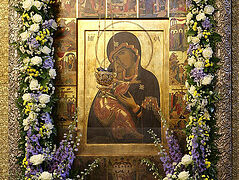
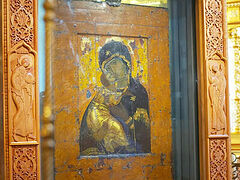
And everybody was happy... Everyone except the Grand Prince’s eldest son, Andrei Bogolyubsky. He did not share his father’s views. He wasn’t afraid to speak about it openly, but before then he hadn’t violated his father’s will. But in 1155, Prince Andrei suddenly showed open disobedience and went back to his native Zalesye region. He did not go there alone, but with his family, his people, his possessions—and most importantly, he took an icon from the Vyshgorod Convent of the Mother of God. Which icon? Now we know it as one of the most precious relics of the Russian land—the Vladimir Icon of the Most Holy Theotokos. And it was the Right-Believing Prince Andrei Bogolyubsky who laid the foundation for such veneration and nationwide fame of this holy icon.
 This icon appeared in Russia in 1131. It and the icon of Pyrohoshcha were brought from Constantinople as gifts from Patriarch Luke Chrysoberges. One of them was placed in Kiev in a specially built church of the Dormition of the Mother of God of Pyrohoshcha (1131–1136) in the Podil district. The original icon has not survived, but a copy of the copy made by order of Andrei Bogolyubsky for the Church of the Holy Protection on the Nerl near Vladimir still exists. The other one, which we now know and venerate as the Vladimir icon, was brought to the Convent of the Theotokos in Vyshgorod. According to tradition, it was a replica of an icon painted by St. Luke the Evangelist himself during the Most Holy Theotokos’ lifetime.
This icon became the foremost and main relic of the new center of Russia, and emphasized its continuity from Kiev, Constantinople and Jerusalem. In other words, it was important for the Right-Believing Prince Andrei to present the city of Vladimir as the new spiritual center of Orthodoxy and as the direct successor of the holy cities. But it was also important to the prince that the Mother of God Herself, through Her icon, accompanied him in his new undertakings and blessed them. It was supported by numerous miracles performed through the icon throughout the journey. Thus, St. Andrei Bogolyubsky believed that he was not alone in implementing all the radical changes that he had conceived, but had the help of the Mother of God. She chose him to change the situation that had developed at that time. She chose him so that he would stop the internecine wars in Russia and put an end to raids of the Polovtsy, from which the common people suffered the most.
You can assess the personality of Prince Andrei Bogolyubsky in different ways (recently, there were even some extremely negative assessments of his actions and character traits), but you must admit that the prince was not only a brilliant military commander, but also a strong politician. He was able to set goals and achieve them consistently. This means that the historians will never come to a consensus. After all, has there been a single politician in human history about whom there is an unequivocal opinion?
Prince Andrei Yurievich was the eldest son of Yuri Dolgoruky and a Polovtsian princess—a daughter of Khan Aepa. When the famous archaeologist Mikhail Gerasimov (1907–1970) tried to reproduce Andrei Bogolyubsky’s appearance, he gave him oriental features: wide cheekbones and slanting eyes. Modern studies, which are most probably more accurate, reproduce purely European features. In any case, being related to the Polovtsian khans gave Prince Andrei a huge advantage. The numerous Polovtsian detachments that the princes hired as mercenaries for wars with each other lived by their own laws and did not always obey orders. Especially when it came to plunder. But they obeyed Prince Andrei implicitly.
It is not known for sure which year Yuri Dolgoruky’s eldest son was born. And little is known about how he spent the first half of his life. St. Andrei Bogolyubsky is first mentioned in historical sources in 1149 as a participant in the wars for Kiev. According to most historians, then he was about forty. The prince immediately impresses everyone with his extraordinary valor. The historian Vasily Klyuchevsky (1841–1911) wrote about him: “The Prince loved to forget himself in the midst of a battle, to plunge into a very dangerous melee, without even noticing when his helmet had been knocked off… And yet, Andrei’s ability to quickly sober up from military intoxication was really extraordinary. Immediately after a heated combat, he would become a cautious and prudent politician and a discreet manager. Andrei always had everything in order and in readiness; he could not be caught off guard; he knew how not to lose his head amid the general commotion.”
 Victor Vasnetsov. Prince Andrei Bogolyubsky. The nineteenth century
Interestingly, the historian’s opinion is confirmed by the examination of St. Andrei Bogolyubsky’s remains: despite his constant participation in battles, he received only two wounds prior to his violent death. This circumstance cannot be attributed merely to luck; rather, it shows that the prince maintained clarity of mind and composure in all circumstances. One wound was serious: his cervical spine was damaged, which is why the prince walked with his head held high and was reputed to be a “proud” and “arrogant” man. The prince was also short-tempered. In our days, during the examination of his remains it was found that the prince had hyperthyroidism. And people with this condition are very quick-tempered, but they calm down quickly. Despite his hot-headed nature, the prince was merciful. The chronicler characterized him as follows: “Merciful to his kind, especially to Christians”, and noted that he repeatedly tried to persuade his father to conclude peace during internecine wars.
A brilliant military commander and astute politician, the Right-Believing Prince was a deeply religious man. Most of all, he venerated the Most Holy Theotokos and always relied on Her intercessions. It was Andrei Bogolyubsky who established the celebration of the feasts of the Protecting Veil of the Mother of God (October 14) and the Procession of Honorable Wood of the Honorable and Life-Giving Cross of the Lord (August 14) in Russia. Not only did he initiate the nationwide veneration of the Vladimir Icon, but also by his orders the Bogolyubovo Icon of the Mother of God was painted. Concluding our verbal portrait of the prince, it is worth noting his excellent education and love of beauty. It is indisputably evidenced by his Tale of the Victory over the Bulgarians and the Establishment of the Savior’s Festival in 1164, The Prologue “Tale of the Establishment of the Feast of the Protection, A Word on the Protection,” and a prayer that he wrote and the cathedrals of Vladimir and the Church of the Protection on the Nerl built on his orders. This is what kind of man Prince Andrei Bogolyubsky was, who from the very moment of his appearance in history joined the struggle for power and privilege. However, he did not fight for his own interests, but defended those of his father.
Apparently, in 1155, when Yuri Dolgoruky established himself on the throne of the Grand Prince, Andrei Bogolyubsky deemed his filial duty fulfilled, and left. His move is often portrayed as an escape that no one knew about, but that is very unlikely. A long line of carts with possessions and people moved very slowly. If Grand Prince Yuri Vladimirovich had wanted to stop his son, it would have been easy for him to do it. Surely there was some agreement between them. St. Andrei did what was required of him and deemed himself entitled to do as he saw fit. And Yuri Dolgoruky, although he was angry, did not stop his son.
Another important point that explains the prince’s action is as follows. In 1151, Yuri Dolgoruky and his sons lost the Battle of the River Rut (now the Protoka). At the conclusion of the peace, the defeated princes kissed the cross in confirmation of the oath that they would no longer lay claims to Kiev. Time showed that only St. Andrei Bogolyubsky took the oath seriously—he left the south for the north.
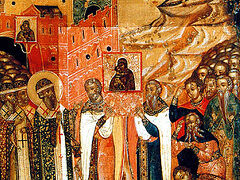
 Placement of the icon of the Mother of God in the Church of the Theotokos in Vladimir. A fifteenth century miniature
On his arrival, the prince set about developing the lands. He did not choose for himself ancient Rostov with its well-established traditions, or Suzdal that belonged to his father. Instead, he chose the young city of Vladimir, which did not have a strong boyar group and where traditions had not yet developed. Then he expelled his younger brothers, who were still boys—Vsevolod (the future Grand Prince Vsevolod the Big Nest) and Mikhalko—whom Yuri Dolgoruky had sent to rule in the Zalesye region. Andrei Bogolyubsky had no intention of sharing power with anyone. He did not want the same situation to develop on his lands as they did in Kiev: continual wars, from which civilians suffered the most. There was only one way to prevent internecine war: by establishing one-man rule and becoming “the sole ruler of the entire Suzdal land”.
Next, he rebuilt Vladimir as a sacred capital, just as Kiev had once been rebuilt: the Golden and Silver Gates, the Pecherny Town, the Dormition Cathedral instead of St. Sophia’s, and the princely castle-residence in Bogolyubovo. It is important to understand that Kiev was modelled on Constantinople, and Constantinople on Jerusalem. Thus, St. Andrei Bogolyubsky, with his construction work, emphasizes the continuity from the Holy City itself to Vladimir.
And after that, in 1169, he sent troops to Kiev—not in order to capture and possess it, but in order to destroy it. A whole coalition of princes was marching towards the capital city, among them were the princes of Smolensk, Pereslavl, Novgorod-Seversky, Vyshgorod, Dorogobuzh and Ovruch, led by Prince Andrei’s eldest and beloved son Mstislav. The prince showed the whole world that Kiev had lost its role as a spiritual, political and cultural center. Instead, a new one had appeared—Vladimir. St. Andrei Bogolyubsky did not assume the title of Grand Prince in Kiev, as it had always taken place earlier, but of his Principality of Vladimir.[4]
Thus, the Right-Believing Prince Andrei Bogolyubsky became a key figure in the history of Ancient Russia. He created a new system of government. True, it was not accepted immediately and unconditionally, but it was what the princes of Moscow later adopted. We can say that the prince was ahead of his time. Thanks to him, Northeastern Russia flourished. It was an upsurge in all spheres: spiritual, cultural, political and economic. He became the undisputed leader in Russia. This is evidenced, for example, by the Georgian chronicles: Emir Abulizan of Tiflis recommended Yuri Andreyevich as a good match for Queen Tamar, since he was a son of “the Russian sovereign, Grand Prince Andrei (Bogolyubsky), to whom 300 kings in those countries are subordinate.”
Perhaps he was able to achieve all his goals. The only thing he failed to do was to establish the succession of power by inheritance. The prince’s sons predeceased him, and power passed to his younger brother Vsevolod the Big Nest. But Prince Vsevolod continued the policy of his predecessor.
Prince Andrei Bogolyubsky was, beyond any doubt, a great man. He sincerely loved his land, took care of it and tried to arrange it in the best possible way. He always took into account the interests of ordinary people, which deserves special respect. At the same time, we must not forget that he was a human being, which means that he inevitably made mistakes like anyone else. And yet it was he who was chosen by the Most Holy Theotokos to glorify Her icon, through which She worked many miracles to Russian people and which remains with us to this day.