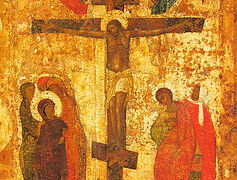
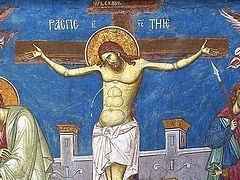
It’s a great consolation, brethren, to see here a church dedicated to the sufferings of the Lord Jesus. I’m even more comforted to see the zeal you have, dedicating every Wednesday to praying the akathist hymn to the Crucified Lord Jesus. The Apostle didn’t want to know about anything other than the name of the Lord Jesus and Him crucified. We preach Christ crucified, he says, unto the Jews a stumblingblock, and unto the Greeks foolishness; But unto them which are called … Christ the power of God, and the wisdom of God (1 Cor. 1:23–24). Your emulation of the Apostle is a holy thing. The entire Church venerates the Cross of the Lord Jesus today; all the more honor for your love for the Cross of the Lord, which venerates the Cross at all times in equal measure. May the grace of the Spirit preserve your holy zeal for our crucified Lord.
With this disposition, I’m wholly certain that you take pleasure in reflecting upon the Apostle’s words about Christ crucified as the power and wisdom of God for those who are called.
The crucified Christ is the power of God. How so? All of God’s works, for all their greatness, are simple and explain one another. It’s amazing how the Infinite One manifested His creative power within the confines of the world He created. It’s even more amazing how the same Infinite One manifests His providential power even in something as small as feeding a bird. But the reality of creation and providence is obvious. Shall we say it’s unworthy of the majesty of God to appear in the shameful form of a man condemned to death? But shouldn’t we first say that there’s no majesty on earth that would be fully worthy of the majesty of the infinite God? It’s the boundless goodness of God that allows boundless majesty to appear within the more or less narrow confines of creation!
The crucified Christ is the power of God. Human wickedness may have brought Jesus’ majesty to humiliation, but how great is the Humiliated One in this very humiliation! He Who raised the dead by His word and commanded the elements could, of course, come down from the Cross if He wanted, but He freely remains there. He hears the blasphemies of ignorance and passions but remains quiet and peaceful, as if conversing with friends. He endures the torments of the cruelest death, but only one voice breaks forth from His heart—that of devotion to the will of the Heavenly Father. Then, as He falls silent, exhausted on the Cross, the heavens and the earth raised their voices about Him. The sun darkened, the earth quaked, the rocks were rent, the veil of the Temple was torn from top to bottom, and many of the saints resurrected and appeared in Jerusalem. Even pagans—the soldiers who saw all this with their own eyes—said, Truly this was the Son of God (Mt. 27:54).
But this is only the beginning of the manifestations of the power of the Crucified One. Darkness lies over the nations, altars are dedicated to abominations, the true God is forgotten, the chosen people dream only of an earthly kingdom. Who will dispel this widespread darkness that so humiliates humanity? Who will give a saving impulse to the thoughts of the whole universe? Neither the rulers of nations nor the wise of this world can give man another heart. Their instructions may be clever, but the movements they produce dissipate into thin air. O, Lord! Only you can pour new life into a spiritual organism disordered by sin. For if I go not away, the Comforter will not come unto you; but if I depart, I will send him unto you (Jn. 16:7). This is how He prepared them, going to His death on the Cross.
And He fulfilled His word. The love of God is shed abroad in our hearts by the Holy Spirit Which is given unto us (Rom. 5:5). And despite all obstacles, it led the world by the way of the Cross to the triumph of sanctification and glorification. Yet once, it is a little while, and I will shake the heavens, and the earth, and the sea, and the dry land (Hag. 2:6), He said through the Prophet. And His words came to pass. All nations are on the move: Altars fall, idols are shattered, idolatrous sins are lamented with repentance. Persecution is waged in vain against those who worship the new name. The fires of persecution don’t extinguish the flame of love for the hitherto unknown God. The name of the Crucified One triumphs over the forces of the worldwide empire. And through whom? Through simple Palestinian fishermen, who have neither the means of education nor the benefits of power. Indeed, the Apostle had every right to say: God hath chosen the weak things of the world to confound the things which are mighty; And base things of the world, and things which are despised, hath God chosen, yea, and things which are not, to bring to nought things that are (1 Cor. 1:27–28).
The crucified Christ is the wisdom of God. The eternal Word left men His word; and the wise men of this world, hearing this word, cast away their wisdom in order to love the wisdom of the Crucified One. And how can we not exchange the wisdom of age-old paganism for the wisdom of the Crucified One, when His wisdom has everything that is capable of elevating the human mind, and there’s nothing that violates its pure principles; when the mysteries of human existence are resolved and the invisible mysteries of God are revealed in it! How can we not accept and embrace with our whole soul that wisdom that the soul seeks so much and can’t find anywhere on earth—but it sees it in Christ!
The soul itself tells a man that the teaching of the Crucified One is no earthly teaching, but was sent by the Heavenly Father. If any man will do His will—that of the Heavenly Father—he shall know of the doctrine, whether it be of God, or whether I speak of Myself—thus Christ testified to His teaching and His testimony was confirmed by the life and death of thousands of confessors and martyrs. The wisdom of the sages of the world is inaccessible to most people and can only be acquired by a few. The doctrine of the crucified Jesus is the property of all; it’s comprehensible to the unlearned, though at the same time astonishes people of profound thought; children and elders, men and women, rich and poor, educated and uneducated—all find in it what they need for eternal salvation. It gives life-giving light to all, just as the sun shines for all, as the Heavenly Father is good to all.
The crucified Christ is the wisdom of God. The enemies did the work of their corrupt hearts, but they didn’t see that they were instruments of the wise counsel of His eternal love for us. They didn’t notice how the Cross, fashioned by their hands, was at the same time arranged by the will of Him Who was crucified upon it. If they had followed the example of the wise thief and examined their own deeds rather than those of others and had felt their guilt before the righteousness of God, then they would have exclaimed together with the thief from the depths of their souls: Remember [us] when Thou comest in Thy Kingdom (Lk. 23:42). They would have fallen in reverence before the boundless love of God, which chose a means for the salvation of us sinners that is as wise as it is great.
Why think that the boundless might of God has no other way to save mankind than the death of the Son of God? You’d have to be too limited in understanding not to comprehend how the path chosen by the boundless will of God is in accordance with the wisdom of God. It was necessary to fulfill the boundless righteousness of God, and it was satisfied with the feat of the Cross—the humility of the eternal Son of God. It was necessary that satisfaction be brought by man, and it was brought by the Son of Man. The first sin was revealed in men through the fantastical hope of being as gods (Gen. 3:5), and the boundless humility of the Son of God was made manifest for its healing. Eating of the forbidden fruit brought a departure from the will of God. The suffering of the most pure flesh of Christ upon the tree of the Cross punishes this rebellion of carnality against the spirit.
Truth in Christ and through Christ is the wisdom of God. Christ is the power and wisdom of God for those who are called. Why not for everyone? Doesn’t He want to appear to each and every one, doesn’t He want to be known by all? Ah! He, the All-Good One, was pleased to reveal His glorious face to all for their enlightenment and blessedness—but not all desire to see His face. Those who are called are those who respond to the voice of God calling them to eternal salvation with their soul and life; it’s those who, being attentive to God’s calling, listen and study the testimonies of Heaven about Christ with all their soul and therefore know Christ. The Apostle testifies that Christ crucified is a stumbling block to the Jews and foolishness to the Greeks. Why is that?
He’s a stumbling block for the Jews because, occupied as they were with earthly things, they wanted to see Him only as an earthly king who would fulfill their hopes for earthly happiness; but He brought them neither glory nor the power of a great people. He seemed like foolishness to the Greeks because they sought only vain, empty, dialectic wisdom, which amused itself with words rather than seeking the truth of God.
It’s terrible to consider Christ the Lord as a temptation. But we must fear beforehand those dispositions that imperceptibly but forcefully draw us into this position. Do not the hopes of many of us, like the hopes of the Jews, rest only on the earth? Do not many desire to enjoy all the gifts they expect from God’s goodness only here on earth? Do they not wish to become rich and enjoy pleasures and to benefit from fame only here on earth? And with such dispositions, can they know and sense who Jesus Christ is for us? Habituated to valuing all things and circumstances only in relation to the earth, can they evaluate the unearthly significance of spiritual matters? Carried away by the pleasantness of earthly fame, temporal riches, worldly honors, they become ashamed of the lowliness of Christ; they cool to the glory of the name of the Crucified One; they lose both taste and meaning for the majesty of Jesus. My Kingdom is not of this world (Jn. 18:36), said the Savior, and Christians know this. But how can we part with the earthly splendor we’ve come to love? How can we love a kingdom that eyes darkened by the earth can’t see? How can we love something the soul is far removed from?
Seeking truth is a sacred endeavor. But how can we seek it? On this question, nothing is said—except that dialectical games with thoughts and words are just childish diversions. But even exercising thoughts with the truth, if it doesn’t extend its influence to the formation of the heart and will, is nothing but spiritual ruin, particularly harmful because pride of spirit feeds on the wealth of knowledge, however barren it may be. When knowledge isn’t united with deeds, then perverse deeds arise, which in turn give rise to perverse knowledge. Thus, wisdom doesn’t enter a corrupted soul. Pride, nurtured by barren knowledge, boldly doubts the most sacred truths, which it never began to understand; it rebels against everything that disagrees with its own opinions, even though its opinions are arbitrary. In this state, truths that by themselves constitute the source of pure contemplations and the deepest of thoughts, such as the redemptive suffering of the God-Man, seem somehow incongruous with themselves, seem foolish, when in fact it’s only the actual disposition of the soul that is foolish and destructive.
Our crucified Savior! Grant that we might, until our last breath, confess You as God’s power and God’s wisdom with our entire life, in sincerity of soul.
Amen.