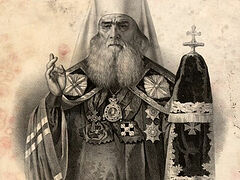
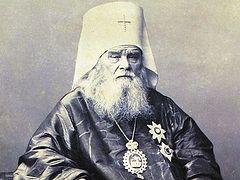
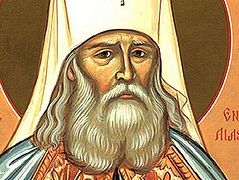
In 1850, Bishop Innocent was elevated to the rank of archbishop, and two years later, the Yakut region—with its population of 200,000 inhabitants—was added to his diocese. The well-known Russian writer I. A. Goncharov, following his circumnavigation on the frigate Pallada, was in Yakutsk during September-October 1854, where he personally met Saint Innocent and witnessed his tireless labors in translation and archpastoral work.
“Now he—that is, His Grace Innocent—is laboring here on a broader field, shepherding a flock of two hundred thousand Yakuts, several thousand Tungus, and other tribes scattered across a territory spanning nearly three thousand versts in length and width. Under his direction, the Gospel word is being rendered into their poor dialect, a tongue that has no civil standing among our recognized languages. I happened to be present at a committee meeting convened in the quiet of the archpastor’s cell, where the Gospel translation was underway. All the clergy here know the Yakut language. The rough translation is already complete. When I attended, they were doing the final review of the Gospel of Matthew. The Greek, Church Slavonic, and Russian texts were being carefully compared with the Yakut translation. Every word and phrase was being thoroughly weighed and examined by each committee member. One of the missionaries, the priest Khitrov, is also compiling a grammar of the Yakut language to aid in teaching literacy to the Yakuts. That grammar is already finished. You see what kind of work is being conceived here.”1
Goncharov spoke of Saint Innocent as a gracious and sociable man, marked by great diligence, well acquainted with and devoted to his region, and deeply concerned with the enlightenment of its people. In a letter to E. P. and N. A. Maikov dated 13 January 1855, Goncharov wrote with enthusiasm:
“There are majestic, colossal patriots here. In Yakutsk, for instance, His Grace Innocent—how I would love to introduce you to him. There you would see the features of a Russian face, the cast of a Russian mind, and the speech of a truly rooted yet vibrant Russian soul. He is very intelligent, knows much, and is not weighed down by scholasticism like many of our clergy—precisely because he did not study in an academy, but in Irkutsk, and then went straight to teaching both religion and life to the Aleuts, the Tlingits, and now the Yakuts. He—he is a true patriot. We used to read the newspapers together, and he would tremble like a youth at every happy report of our victories.”2
In 1857, the translation committee working under Bishop Innocent in Yakutsk completed its activity. Under his editorial direction, translations were produced in the Yakut language for all the books of the New Testament (except Revelation); from the Old Testament, the Books of Genesis and Psalms; and from the liturgical books, the Euchologion (Sluzhebnik), Trebnik (Book of Needs), Canonikon, and Horologion. By the summer of 1859, all these translations were published at the Moscow Synodal Printing House. On July 19, 1859, Saint Innocent celebrated the first Divine Service in the Yakut language.
Bishop Innocent deeply loved his native land. In a letter to Governor-General M. S. Korsakov dated November 18, 1869, he wrote:
“For the love of God, if it depends on you—stay in Siberia. There is no better place now; of course, there are also some unpleasant things here, but they are raspberries compared to what we have here, especially the ones yet to come.”3
The Bishop’s residence in Unalaska – Лариса, постарайтесь найти более крупное фото.
The bishop deeply lamented the reckless exploitation of the region’s natural resources. He formulated regulations for fur hunting and persistently ensured their implementation within the territories controlled by the Russian-American Company. This often aroused dissatisfaction among company officials. The chairman of the North American Company, General Politkovsky, wrote to Governor-General N. N. Muravyov on February 11, 1852:
“I do not know what opinion you hold of His Grace Innocent, but in our affairs, despite his natural intelligence and great familiarity with the region, he is often carried away by erroneous ideas about his responsibilities and very stubbornly defends the interests of himself and his subordinates without proper justification. I also know quite well that he does not like the Company and allows himself to speak very sharply and improperly about it. I would sincerely rejoice if the episcopal see were relocated anywhere out of the colony. The Company would be rid of many inconveniences and clashes now arising from the interference of ecclesiastical authority, which has significantly expanded its influence. For the colonies, it is enough to have a dean; we don’t need a bishop at all. The more intelligent he is, the harder it is for him to get along with the chief administrators and to be somewhat subordinate to the local authorities. This issue… will forever be a stumbling block to mutual harmony between the two powers.”4
However, Emperor Nicholas I praised Bishop Innocent in particular, saying that:
“He is irreplaceable in that land, and all his actions are driven by zeal for the benefit of the Church and the Fatherland.”5
The Crimean War
In 1853, the Crimean War began. While the main offensive was concentrated in Crimea, military actions were also conducted elsewhere. In the White Sea, British ships bombarded the Solovetsky Monastery, whose monks had to defend themselves. Russian territories in the Far East were not spared either. The local population, fleeing from cannon fire and looting by enemy landings, took refuge in the forests.
Archbishop Innocent personally traveled there, risking his life to support his afflicted flock. Once, during a moleben (prayer service) in the church of Ayan, praying for victory over the enemy, English officers burst in shouting and making noise. The bishop’s calm and reverent countenance so struck the British that they immediately quieted down and waited respectfully for the service to end.
Bishop Innocent later recalled, “If the English had known what I was praying for at that moment, they surely would have torn me apart on the spot.”
After the service, the British officers approached the bishop and announced that, as a matter of duty, they would have to take him prisoner. Laughing, the bishop replied that he was of no use to them, not being a military man, and they would gain nothing by taking him—only incur extra cost. He then invited them to his home, offered them tea, conversed with them through an interpreter, and eventually convinced them not only to leave him in peace but also to release Father Makhov, a priest they had brought with them as a prisoner.
The next evening, after Vespers, the British returned joyfully to announce that their general had agreed to release the prisoners.
The Garrison of Petropavlovsk-Kamchatsky, under the command of General Vasily Stepanovich Zavoyko, repelled the attack of the Anglo-French squadron from August 18 to 24, 1854, defeating the landing forces it deployed. When the candidate for the post of military governor of Kamchatka was being discussed, Bishop Innocent declared, “I will stand for Zavoyko with both hands, my whole body, and my entire soul.”
All the defenders of the city testified that the port withstood not by human strength, but by the mercy of God. Bishop Innocent sent a fervent congratulatory message to the Governor-General of Eastern Siberia, Nikolai Nikolayevich Muravyov, regarding the victory:
“With sincere and greatest joy, I have the honor to congratulate you on the wondrous, glorious, and unexpected victory over the mighty enemy who attacked our Kamchatka. First and foremost, glory and thanks to the Lord God, who gave strength and fortitude to our Kamchatka heroes and blesses all our good intentions and undertakings! Who now does not see that, had you not sailed and brought with you down the Amur both grain and people, then today in Petropavlovsk there would be only char and ashes. And so, what should we rejoice in more? In the discovery of the Amur, so timely, or in the salvation of Kamchatka, which so clearly proved the benefit of that discovery? Therefore, honor and glory to you as the chief cause of it all…”6
On October 26, 1854, Bishop Innocent issued a decree that henceforth, on August 24 of each year, a procession of the cross be held in Petropavlovsk-Kamchatsky through the places where the battles had occurred.
On March 18, 1856, the Treaty of Paris was signed. In a letter to Nikolai Dmitrievich Sverbeev, senior official for special diplomatic assignments under Governor-General Muravyov, dated August 25, 1856, the bishop wrote of this event:
“I greeted Pascha with special joy, and more than anything, I was and continue to be gladdened by peace. Glory to God in the highest! With this peace, He wills to humble our pride. We had become too closed in and lifted our heads too high—and had we succeeded in the current war, we would have raised our heads so far that we would no longer have seen what was under our feet or in our hands—and thus would have fallen straight into a pit. But now, nolens volens (‘willing or not’), we must lower our heads—and that will make us take a look at what is under our feet and on our feet, and where we are going.”
Developing the Far East
The historical merit of Saint Innocent in the development of the Ussuri region is indisputable. As a man devoted to his homeland and deeply concerned with her interests, Archbishop Innocent showed great care for a favorable resolution of the Amur question for Russia. To this end, he personally traveled along the Amur River and wrote a detailed memorandum, titled, Something About the Amur (Nechto ob Amure), in which, based on personal observation and interviews, he addressed the strategic necessity of the Amur for Russia:
“Imagining what the Amur might become over time, and knowing that there are people who openly oppose and even hinder the Amur enterprise, one involuntarily thinks—can it really be that these people will prevail? If so, then of course it is God’s will; and whatever He wills is beneficial, and thus we must submit. It seems either the time has not yet come for us to possess the Amur, or, perhaps, we are not meant to possess it. But one can say with high certainty that as soon as we abandon the Amur (and we shall have to abandon it if the Chinese do not allow us to settle there and restrict our navigation), then either the Americans or the English will immediately seize it—and they will not be as courteous to our neighbors. They will show even the Aigunites7 their place beyond the mountains (far from the Amur’s shores), and perhaps even farther... But may the will of Almighty God be done in all things.”
In March 1854, three archbishops arrived in Irkutsk: Archbishop Nil (Isakovich; †1874)—transferred to Yaroslavl in 1853, formerly bishop of Irkutsk, Nerchinsk, and Yakutsk; Athanasius (Sokolov; †1868)—newly appointed Archbishop of Irkutsk; and Innocent, Archbishop of Kamchatka and Yakutsk. They met for a consultation with the governor-general concerning the question of incorporating the Amur region into the Russian Empire.
“What a great celebration it was,” wrote one witness, “when the three archbishops concelebrated the Matins of the Bright Resurrection of Christ in this remote provincial city. The Holy Gospel was read in eleven languages, including Aleut, Buryat, and Yakut. At a formal banquet hosted by the mayor of Irkutsk, Petr Osipovich Katyshevtsov, Archbishop Nil remarked: ‘Here we three sit, hand in hand, yet we represent three continents: I represent Europe, Archbishop Athanasius represents Asia, and Archbishop Innocent represents America.’”8
On May 9, 1858, Archbishop Innocent, together with Governor-General N.N. Muravyov, arrived in the Ust-Zeya Cossack settlement and laid the foundation stone of a church in honor of the Annunciation of the Most Holy Theotokos. By mutual agreement between St. Innocent and Muravyov, the newly founded city, which would become the center of the entire Amur region, was named Blagoveshchensk (Annunciation)—in memory of that distant Annunciation Church in Irkutsk where Innocent had begun his priestly service.
Muravyov then traveled to the Chinese border city of Aigun, where, following diplomatic negotiations, the historic Treaty of Aigun was signed. This treaty confirmed Russia’s rights to the entire course of the Amur River and the Ussuri region. The Treaty of Aigun created favorable conditions for the further Christianization and enlightenment of the Amur territory.
Through the direct involvement of Muravyov and Russia’s commissioner to China, Vice-Admiral Count E.V. Putyatin, an agreement was also concluded with China guaranteeing full freedom of Gospel preaching for all Christian missionaries.
For his outstanding role in the annexation of the Amur region to Russia, Muravyov was granted the title “Count of the Amur” (Graf Amursky).
The already enormous diocese under Archbishop Innocent grew even larger. By 1859, his episcopal cathedral was relocated to Blagoveshchensk. He continued to preach, establish new missions, and open schools. It became increasingly difficult to manage such a vast territory alone, so in 1858, vicariates were established in Yakutsk and on Sitka Island.
In 1859, Archimandrite Peter (Yekaterinovsky)—the last rector of the seminary in Alaska—was consecrated Bishop of Novoarkhangelsk, serving as a vicar bishop under Archbishop Innocent.
The health of Vladyka Innocent began to deteriorate. His age, illnesses, and weakening eyesight compelled him to submit a request for retirement. However, his petition was not granted.
Vladyka Innocent was bound by a long-standing friendship with Governor N.N. Muravyov. In The Frigate Pallada, Ivan Goncharov wrote:
“On his way to the archbishop’s residence, the governor spoke with great admiration: ‘What a soul! What character!’ he exclaimed. ‘Just imagine what he has accomplished in our American colonies.’ ‘Yes, exactly—accomplished,’ he repeated with emphasis. ‘And our Yakut region—he baptized it through and through. There is nowhere he hasn’t been! He lived with the Aleuts on the islands, taught them how to pray and live like human beings—not just eat fish and squirrels, but eat with bread. And now that he has become a bishop, he continues teaching among 200,000 Yakuts... It was he who first opened Ayan as a more convenient port than Okhotsk for travel across the old Seven-Mountain Route.’”9
Saint Innocent played a direct role in the foundation of the Japanese Orthodox Church. In 1860, he met Hieromonk Nicholas (Kasatkin; †1912), the future Archbishop of Japan. Hieromonk Nicholas had been appointed rector of the Russian Consulate Church in Hakodate, Japan. To reach his post, he had to travel across Siberia, and ended up wintering in Nikolaevsk-on-Amur. This became a true missionary school for the young monk—a practical “course in the sciences.”
One day, Vladyka Innocent asked him:
“Do you have a decent cassock?”
“Of course,” Fr. Nicholas replied.
But the bishop disapproved of the typical academic cassock:
“When you get there, everyone will be watching: ‘What kind of priest did they send?’ You need to command respect right away. Buy velvet.”
Velvet was purchased. The bishop took up a pair of scissors and personally cut out a cassock for Fr. Nicholas. “This is much better,” he said. “Do you have a cross?” Fr. Nicholas did not—his cross was awaiting him in Hakodate. “Well, take this one,” said Vladyka, placing a bronze cross around his neck—the same cross he had received for the Sevastopol campaign. “It may not be exactly canonical, but it’s still a cross—and you can’t show up before the Japanese without one. And not just the Japanese—the Europeans will be watching too.”
In January 1870, the Holy Synod formally established a Russian spiritual mission to Japan, “To be composed of a head, three co-worker missionaries (hieromonks), and one reader.” Fr. Nicholas was elevated to the rank of archimandrite and appointed head of the mission. Just a few months before his repose, Metropolitan Innocent petitioned the Holy Synod to formally establish a Japanese diocese.
In 1867, Alaska was sold to the United States—an event that deeply affected Vladyka Innocent. In a letter to Count D.A. Tolstoy, Chief Procurator of the Holy Synod, dated December 5, 1867, he wrote:
“I have heard a rumor coming from Moscow, making it sound as if I had written in a letter to someone expressing great dissatisfaction with the sale of our colonies in North America to the Americans. This is completely false. On the contrary, I see in this event one of the providential paths by which Orthodoxy may spread into the United States, where it has already begun to attract serious attention. If I had been asked, I would have advised the following steps…”
a) The American diocese should not be abolished;
b) The bishop’s residence should be moved from Novo-Arkhangelsk to San Francisco;
c) The current bishop and all clergy of Novo-Arkhangelsk, with the exception of one reader, should be recalled to Russia. A new bishop should be appointed to America—one who knows English. His assistants should also be selected from those who speak English;
d) The bishop should be permitted to hire additional co-workers, as well as ordain American citizens who convert to Orthodoxy;
e) The bishop and clergy of all parishes should be granted permission to celebrate the Divine Liturgy and other church services in English. It is absolutely clear that, for this purpose, liturgical books must be translated into English;
f) The subjects taught in newly opened schools for the training of missionaries and clergy in San Francisco should be taught in English, and not in Russian, which sooner or later will be replaced by English.10
On December 30, 1866, in a letter to his closest assistant, Archpriest Dimitry Khitrov, in response to well wishes for long life, Vladyka Innocent wrote:
“Only men like Philaret, and those like him—that is, people who are always thinking—can live long, fully conscious of themselves and everything around them. But for the likes of us, seventy-five is plenty—if God grants even that. After that, it’s senex bis puer (an old man is twice a child).”11
The approaching year 1867 caused Vladyka an inexplicable sense of foreboding, which he repeatedly mentioned in his letters to Fr. Dimitry:
“You surely remember that I’ve long told you: the year [18]67 feels ominous to me. Three sevens have come together: 27 years as a bishop, 70 years of age, and the year 1867. And I’ve feared this 67th year. I don’t know what will happen now in [18]67. If I survive it, perhaps I will live a few more years, even if blind. But where am I to go to live out my days?”12
This foreboding came true for Vladyka in the most unexpected way.
On November 19, 1867, in Moscow, Metropolitan Philaret of Moscow and Kolomna passed away. Saint Innocent grieved deeply over the loss of his dear teacher and patron—and by Divine Providence became his successor.
On January 5, 1868, Archbishop Innocent was appointed Metropolitan of Moscow and Kolomna. On May 25, 1868, the peal of church bells echoed through all of Moscow, announcing the arrival of the new archpastor in the capital. On May 26, Metropolitan Innocent solemnly entered the ancient Cathedral of the Dormition (Uspensky Sobor) in the Moscow Kremlin.
Responding to greetings, Metropolitan Innocent said:
“Who am I, who dares to take up the word and authority of my predecessors? A disciple from a most distant time, from the most distant land, and one who spent more than half his life in an even more distant country—not more than a humble laborer on Christ’s small field, a teacher of children and childlike believers in the faith.”13
The state of affairs that Vladyka found upon arriving at his new cathedral was discouraging:
“In all areas—what disorder! Everyone is dissatisfied, everyone is complaining, and yet nothing is improving. The people—at least around Moscow—are growing poorer… Taxes are being collected by force; they take away the last horse and cow. In Moscow, the number of idle people increases by the day; of course, the same is true in Petersburg. Poverty is multiplying… What will happen next—even in five to 10 years? No one can say! And it won’t be anything good, because where there are many young, educated, and impoverished people who have nothing to lose—it is hard to maintain good order, and impossible to maintain it forever…” wrote the saint.14
Metropolitan Innocent devoted much attention to charitable work, establishing shelters for the elderly and orphans. His most beloved undertaking was the founding and expansion of the Orthodox Missionary Society, of which he served as chairman for nine years. On November 21, 1869, the society’s charter was formally approved. And thanks to the saint’s tireless efforts, a separate Yakutsk diocese was established on November 4, 1869.
N.P. Rozanov, a professor at the Moscow Theological Seminary, recalled Metropolitan Innocent:
“The new metropolitan, himself having come from the ranks of parish clergy, understood their needs and, in his kindheartedness, did not wish to ‘make an issue out of every little thing’, showing leniency toward human faults and weaknesses. He did not demand absolute silence from the clergy when he spoke and would willingly engage them in conversation—even occasionally joking.
“He did not want to receive deep bows from the clergy, and I remember how, during his first service at the Chudov Monastery (this was in 1868), upon entering the church and vesting, he quickly made his way to the altar and nearly stepped on the fingers of the deacons who, having finished vesting him, had thrown themselves face-down on the ground before him. It was clear that this gesture deeply displeased him—he frowned, and afterward no one bowed to him to the ground, as they had done to Philaret.
“At the Trinity Metochion, where he lived, a new spirit prevailed as well—his grandchildren would always be present with their father and would run out to meet petitioners arriving at the metochion, calling out ‘Grandpa’ and summoning him from his study.”15
Throughout the years that Vladyka Innocent headed the Moscow Diocese, his closest assistant was his own son, Archpriest Gavriil Veniaminov, a cleric of the Novodevichy Convent in Moscow. In the last years of his life, Saint Innocent was nearly blind and required constant assistance. Fr. Gavriil sorted his father’s mail and wrote responses under his dictation. In a letter to Bishop Dionysius (Khitrov) of Yakutsk and Vilyuisk (†1896), dated August 10, 1878, Fr. Gavriil wrote:
“This summer our archpastor and father lived at his dacha in Cherkizovo (which had once belonged to St. Alexis and then passed into the hands of the Chudov Monastery of the Moscow diocese). He went out walking more often and for longer than in any previous year. This clearly strengthened him and gave him a sense of peace and good spirits. He still serves almost every Sunday, and unfailingly on great feasts. He continues his administrative duties as before. Ah! If not for his eyes, which now can barely see, he would be an eagle still. But let the will of God be done.”16
On March 31, 1879, Saint Innocent fell asleep in the Lord. It was Great and Holy Saturday. On the very day of His own resting in the tomb, the Lord granted repose also to His faithful and tireless servant.
Saint Innocent was buried in the ancient Church of the Descent of the Holy Spirit at the Holy Trinity-St. Sergius Lavra, next to his patron, St. Philaret (Drozdov), and St. Maximus the Greek, the great enlightener of the sixteenth century.
On October 6, 1977, the Russian Orthodox Church, in response to a request from the Holy Synod of the Orthodox Church in America (dated May 8, 1974), glorified Innocent (Veniaminov) as a saint, honoring him as a great missionary, Apostle to America and Siberia, and Metropolitan of Moscow and Kolomna. His memory is celebrated twice a year, onMarch 31 / April 13, the day of his blessed repose, and September 23 / October 6, the day of his canonization
On October 10, 1994, the holy relics of St. Innocent were uncovered at the Holy Trinity-St. Sergius Lavra. During the summer months, his relics are available for veneration in the Dormition Cathedral of the Lavra, and in the winter, they are transferred to the Refectory Church.
In 1997, jubilee celebrations were held across Russia to commemorate the 200th anniversary of the birth of St. Innocent, Metropolitan of Moscow and Kolomna. The Russian Orthodox Church established the Order of St. Innocent in three degrees, as well as a medal, awarded to individuals for missionary and educational service. That same year, a monument to St. Innocent was erected in Blagoveshchensk to honor him as one of the founders of the city.
The great preacher, Saint Innocent, when sending off his son, Archpriest Gavriil, for missionary service in the Far East, said:
“Go forth to the great work appointed to you by God, but see to it that your heart does not grow cold in laboring on the field of Christ. Die upon it, and do not look back until you have fulfilled the duty laid upon you.”
Saint Innocent fulfilled this commandment in his own life, and it is this same spirit of dedication that he teaches to all who follow after him on the path of Church service.