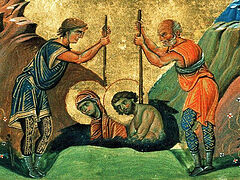
On October 20 according to the Julian calendar, the Orthodox Church honors the memory of the holy Martyrs Sergius of Rome, of Resafa (Rusafa), and Bacchus of Rome. The kontakion to these saints describes their feat of faith and life: “Having courageously confronted the enemy, you brought an end to his guile, and received from on high the crown of victory. O Illustrious martyrs, Sergius and Bacchus, with one heart you cry aloud: /How good and pleasant it is to dwell with God.’” Let’s take a closer look at their Lives.
The Martyrs Sergius and Bacchus lived in Rome during the terrible persecutions of Christians at the turn of the third and fourth centuries. They served as soldiers in the guard units under the pagan Roman Emperor Maximian. For their bravery, faithfulness, and meritorious service, they enjoyed special favor from him. This continued until it was discovered that these glorious men refused to offer sacrifices to pagan gods, but believed in the One and True Christian God. The emperor’s mercy instantly gave way to cruelty. By his order Sts. Sergius and Bacchus were stripped of their magnificent military attire, iron hoops were placed around their necks, and in this state they were paraded through the major Roman streets and squares for general humiliation and ridicule.
With the promise of earthly blessings, the impious ruler tried to turn Sts. Sergius and Bacchus away from the true faith. But the future martyrs did not listen to his flattering words. As St. Dimitry of Rostov wrote in his Life of these saints: “Filled with the grace of the Holy Spirit, they (Sts. Sergius and Bacchus) audaciously and earnestly began to prove to the emperor all the impotence of his false gods, boldly confessed before him the power and Divinity of Jesus Christ, and advised the emperor to get to know this Heavenly truth himself.” Unwilling to deal with his former favorites personally, the emperor sent them to Eparch Antiochus, a ruler of the eastern provinces of the Roman Empire.
So they were led from Rome to the East in iron fetters. Throughout the long journey, these courageous warriors of Christ prayed incessantly, and an angel of God appeared to them and strengthened them. Filled with joy and hope, the saints obediently continued their journey to martyrdom, never ceasing their prayers and psalmody for a single minute. Having reached the domains of the formidable Antiochus, Sts. Sergius and Bacchus appeared before him. They had once helped him attain the post he held. In vain did the eparch try to persuade the martyrs with his sweet speeches. As St. Dimitry of Rostov wrote, “The saints answered him: ‘You are trying to lure us with your words in vain, for those who seek Heavenly life, honor and dishonor, life and death make absolutely no difference: For to me to live is Christ, and to die is gain (Phil. 1:21).’”

The fierce and impious man’s response to the good done to him by the saints and their courageous confession of the true faith was an order to torture St. Bacchus to death and throw St. Sergius into prison. The holy Martyr Bacchus was brutally tormented until he commended his soul to God and breathed his last. In confinement, St. Sergius deeply mourned the repose of his companion and fellow soldier. And St. Bacchus appeared to him in a dream with a radiant face and in shining robes, comforting St. Sergius and strengthening him before his upcoming martyrdom. Once again, the eparch tried to tempt the valiant man into renouncing his faith with flattery, threatening to subject him to horrible torments. But St. Sergius answered:
“Do what you want. My Helper is Christ, Who said: …Fear not them which kill the body, but are not able to kill the soul (Mt. 10:28); now you have power over my body to torture it, but neither you nor your father, satan, have power over my soul.”
Enraged, Antiochus ordered St. Sergius to be shod in boots studded with nails from the inside and driven in front of his chariot. The saint endured this ordeal steadfastly for the sake of the Lord Jesus Christ with psalms on his lips. The bleeding wounds on his feet were healed by an angel of the Lord. Arriving in the ancient Syrian city of Resafa (Rusafa), the eparch, seeing St. Sergius safe and sound, again failed to make him renounce Christ and ordered him to be beheaded. After praying hard for the last time before his martyrdom, St. Sergius joyfully bowed his head to the sword and joined St. Bacchus in the Heavenly Kingdom, receiving the martyr’s crown from the King of Glory.
 The holy martyr’s body was buried in Resafa. Pious Christians tried to move it from there, but when they came with this intention to the place of his martyrdom, they saw a pillar of light, which terrified them. Therefore, the holy relics of the martyr remained to rest for a long time in Resafa near the Biblical River of Euphrates. They are now kept in Venice, and the ancient Syrian city of Al-Rusafa is now in ruins. But during the time of the Byzantine Empire it was called Sergiopolis after the Martyr Sergius who was slain there. In the fourth century, the city was an important pilgrimage destination of Christians wishing to venerate the saint. Through his prayers, many were healed. A Byzantine basilica was built over St. Sergius’ burial place, which has practically not survived to this day. During the recent war in Syria, the resting place of St. Sergius was occupied for a long time by Islamists who destroyed many cultural and Christian monuments there.
The veneration of the holy Martyrs Sergius and Bacchus was very widespread in the East: not only among the Orthodox, but also among the Maronites and Assyrians. One of the oldest churches in Constantinople, consecrated in honor of Sts. Sergius and Bacchus, served as an architectural precursor to the majestic Hagia Sophia. In Aramaic, the names of these saints sound as Mar Sarkis and Mar Bakhos. Until recently, one of the oldest monasteries in the world, named after St. Sergius/ Mar Sarkis, lived its hidden life in the Syrian town of Maaloula. The unique pre-Nicene marble altar of the monastery church, known for its rare semicircular shape, and its interior were severely damaged and desecrated by Islamists during the Syrian war. Among the broken crosses and the countless hacked and burned icons was a priceless ancient icon of the Martyrs Sergius and Bacchus, especially beloved by the locals. But another ancient half-length icon of the saints has survived–the famous Sinai image, dating from around the mid- seventh century. On it, the saints are depicted in long loose-fitting white garments with crosses in their hands, which symbolizes their martyrdom for Christ. Their gaze on this icon is detached and deep, which reminds us of their feat of faith and prayer.

The holy Martyrs Sergius and Bacchus, widely venerated in the Christian East, are less venerated in the Russian Church. There is hardly even a single small church dedicated to them in Russia’s vast expanses. Nevertheless, there is a spiritual link connecting Russian believers with these saints. St. Sergius of Radonezh, the “Abbot of the Russian Land”, bore the name of the Martyr Sergius of Resafa in monasticism and prayed to his Heavenly patron during his lifetime. And a modern saint, St. Nikolai (Velimirovic) of Zica, was so impressed by the heroic faith in Christ of these two illustrious men that he called them “valiant knights of the faith of Christ,” and, having the soul of a poet, composed a poem dedicated to them. It begins like this:
Sergius and Bacchus, glorious martyrs,
Servants of the Heavenly, eternal and sovereign King;
The earthly tyrant mocked them mercilessly,
Stripping them of their military insignia and attempting to humiliate them.
But God girded them with fortitude and courage,
and accepted them forever into His Kingdom and fellowship...
In the Canon to Sts. Sergius and Bacchus, the Holy Church highlights their qualities: “With endurance, spiritual courage and resolute intent, the two glorious martyrs transcended all the bitter fury of the tormenters and made their abode with the angels.” Patience, spiritual courage, and the strength of pious thoughts are the spiritual lessons these wondrous warriors of Christ teach modern Christians. Through the centuries, they have set an example for believers in trusting in the Lord Almighty, Who holds the entire universe and every human life in His hands, taking care of everyone as a loving Father: Are not two sparrows sold for a farthing? and one of them shall not fall on the ground without your Father. But the very hairs of your head are all numbered. Fear ye not therefore, ye are of more value than many sparrows (Mt. 10:29–31).
The troparion to these saints reads as follows: “O much-suffering Sergius and all-glorious Bacchus, ye adornment of Christian athletes and eye of the Church of Christ, enlighten the eyes of our souls. Entreat the Lord, that we may escape the darkness of sin and may be shown to share in the never-waning light, through your supplications, O saints.” Let us also ask for the Heavenly intercessions of the Syrian martyrs before the Throne of God.