Seraphim, the family dog Lulu, Irina and Oleg Muscovites Oleg and Irina are both fifty-five; Oleg works as a storeroom clerk and dispatcher, while Irina’s a housewife. Their oldest daughter is already married, their middle son is twenty, and the youngest is sixteen. This summer, Oleg, Irina and Seraphim, their youngest, spent their vacation time working as volunteers of the Patriarchal humanitarian mission repairing residential houses in Volnovakha.
We talk with them sitting in their cramped kitchen, with Irina being the most talkative of all, Oleg also takes part in our conversation, but Seraphim, like most teenagers, is sparing of his words. As we are talking to her, Irina is flipping pancakes on several frying pans; Nadia, her oldest, and the family are about to come for a visit, Seraphim came for the weekend from his cadet school, and he’s really missing home cooked meals. Their middle son, a student, is studying in his room. Stationed under the table, their fluffy, snow-white Lilu, a Royal Poodle, is getting in everyone’s way. Windowsills overflow with flowering plants, children’s art and icons hang on the wall—a flat that is typical for an Orthodox family with many children, nothing extreme in sight.
Neither thrill-seekers, nor builders
 Seraphim When asked if it was scary to travel to Donbas, everyone replied in unison: No, not at all! After my second attempt at asking about it, Seraphim looks sternly:
“I can’t even get what you're talking about! We didn't go to the war zone, did we? What’s so scary about it!”
Irina isn’t so categorical about it:
“On our way there, we knew the area we were going to wasn’t safe at all. We were forewarned right away that we should comply with strict rules: Never walk along the edges of the roads or wander around the area [so as not to step on petal bombs or mines]. We took responsibility upon ourselves for our teenage son—and we were confident in him, knowing that he would stay out of trouble, as he’s just past that age already. I heard an explosion once, somewhere in the distance, not sure what that was—but the locals told me: ‘Well, but you’re in the frontline zone, so it does happen that they find something and clear the mines.’ But we never felt any particular fear.”
Oleg adds:
“I’d say it is no worse there than in the Kaluga region, where we heard drones flying. Or like when we were driving through Tatarstan—they had air alerts there. It’s just the times we are living right now.”
 Irina cooking lunch for the crew Irina speaks about different kinds of fear; she was more worried that she wouldn’t be able to handle her workload—she was assigned as a main cook to feed a volunteer crew. She did have experience cooking for a large group of people before—she assisted as cook at their Sunday school and during their parish’s crowded camping trip, so she was aware of physical challenges of such work. But everything worked out in the most remarkable way.
“We thought we’d go directly to Mariupol because of the sea there. But, instead of Mariupol, we were sent to the small town of Volnovakha. At first this bothered me, because I was already imagining us swimming in the sea in our free time. But then I realized that there would be no time for swimming, so it was actually quite good that we ended up in Volnovakha. Because back in Mariupol, the teams are much more populous and they have two cooks per each crew, but then comes some force majeure and one cook is left all alone. I was asked beforehand if I could handle doing it all by myself, provided another cook wasn’t there. I said yes, if cooking just plain meals, I’d feed them. If the need arises, I’d make every effort and self-mobilize. But as a result we ended up in Volnovakha, where I was cooking for a group of about eight people, so it was practically like cooking at home for me.
Overall, I was worried—what if I’d be like a granny at summer camp? I thought that volunteers all have to be young and energetic. What if my blood pressure rises, or what if I get sick? You can't let people down, and instead of me assisting them they’d have only problems with me. But everything worked out well; my blood pressure was stable and other volunteers in our crew were about the same age as us, aged forty or fifty, and all of them managed well.
 The kitchen after repair work. Between cooking breakfast and supper, Irina wallpapered and applied the wall molding
Our crew was small, so I tried home cooking: I made omelets, borscht, and, on hot days, okroshka [a cold vegetable soup]. I cooked meat patties, but, since they had no meat grinder there, I came up with grating frozen meat. Our foreman purchased produce based on the list I made and he’d deliver it by car, as we were located far from the shop.
As a result, I managed not only to cook, but to help one charge of ours wallpaper and even nail the molding to the ceiling, heedless of the fact that I never had never seen these things in my life.”
Neither had Oleg any repair experience:
“Once when I was in the army, in the construction battalion, I had to handle concrete, and after that, I pledged to myself: ‘You will never, ever see me at a construction site again!’ Well, I also painted a roof in the village once, but that was it. As we were getting ready for our trip, we received instructions, something like a dummy course to give you an idea of what is a roof, what it is made of, and what stages of repair there can be. Simka [diminutive of Seraphim] and I studied it all at home.
Economically profitable dream
But it all began with an ad hanging on the door of their parish church, to which no one had paid attention at first—volunteers were needed to assist at repairing houses in the Donbas. This flyer could have just kept hanging there, unnoticed by all, if our rector didn’t address the faithful after liturgy one day: ‘Look at that announcement, I think it is a really good idea, so why don’t you go, anyone who is able to!’”
It all began with a flyer hanging on the door of their parish church: volunteers were needed to repair houses in Donbas
Irina was the first to seriously consider going there:
“In my mind it was something huge, something like joining an expedition to the North Pole, towards some uncharted territory: I even felt a romantic sense of mystery, like it was something truly far away and quite inaccessible. I began to fantasize about this trip. At first, I was thinking my friend would join me—and we would be cooks!—but she was unable to join, and I got sad. It looked like our family was destined to go to the seaside in the summer, and again we would end up thinking our life was spent all in vain... But then I suddenly had a thought: What if we all use my husband’s vacation time to go to do the repair work. My whole family is keenly interested in what is happening in Donbas, especially my husband. He keeps abreast of all the news and briefs us all on the current political events. Our boys would have benefited from this, too! Besides, the seacoast is close by there!”
 Volunteers, and their oldest daughter’s family, at their kitchen in Moscow
Oleg laughs:
“It so happens in our family that every good idea always comes from my wife. Seraphim enthusiastically picked up on the idea right away, he is fascinated by anything military, plus he recently enrolled in the cadet school. I liked the idea from the economic point of view. You know, if our whole family goes to the sea, our budget suffers quite badly after it. But in this case, our travel expenses and food are all paid. I also wanted to see Mariupol, because I had read a lot and heard stories about it; but here was my chance to see it for myself and to talk to locals. Well, and it’s nice, of course, to be able to do something good for others.”
At this point, Irina admitted that their trip had an extensive backstory:
“When our children were still very young, we received a lot of help from volunteers of the “Miloserdie” (“Mercy”) service. Our second son was born prematurely, so a lot of effort was spent on his rehabilitation, and then a third child was born right away. So, we had to travel to classes and medical procedures all the time, and it was the volunteers who simply saved us. For example, one day one of our helpers donated her entire salary so that we could pay for a massage, which we needed urgently. Then, a volunteer tutor helped us with our eldest daughter. And she taught her for a long time, free of charge…
So, in one way or another, I wanted to join the society of volunteers, and I knew that it had some amazing people
“So, ever since then, I always wanted to join the society of volunteers. I knew that there were amazing people there.”
As for the trip—Irina next called the phone number from the flyer hanging on the door of their church and found out that her dream might well become a reality. Except that they couldn’t take their dog on their trip to do the repairs. At first, they planned for the whole family to travel, along with their white poodle (Lilu is quite used to traveling and joins her owners on camping and hiking trips). And so, because from the very beginning their middle son was quite skeptical about his parents’ idea, it was decided there was no need to persuade him to go, but rather leave him at home with the dog.
A new roof—and a new life
 Oleg working on the roof “Misha somehow got us wrong at first,” Irina says. “He thought we would work there as volunteers building high rise housing. But later, when he learned that we were to help people who couldn’t return to their private homes, he said he’d probably join us on our next trip. Having a house means a lot to him and he can understand the feelings of an owner whose roof was bombed out. And why, in general, did the Russian Orthodox Church take action, doing these repairs? Because there is a governmental program to restore housing, but it applies strictly to high-rise buildings. As for the private sector—sorry, you are on your own. And who lives there—all those elderly men and women, who have nowhere to go, and they just gave up. But how happy they are once you help them; they get a new lease on life—I saw it myself, and I also heard such stories from others.
For example, there was the following case. Volunteers arrived on site and they were met by a granny, her gray hair hanging loose, dressed in some dirty clothes. So they start working there. But then a few days passed and the granny saw the result of their work, so she turned around and went straight to the city. She bought new clothing, went to the hairdresser—and returned looking like a different person, unlike her old self. We she arrived, the team didn’t recognize her! She had regained the desire to live again, and the gloom enveloping her heart had vanished as soon she realized she got her house back again. A new roof means a new life.
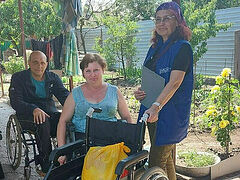
 Irina and Larisa Grigorievna. The owner of the repaired house baked pitas for her helpers And indeed, judging from my experience, I wallpapered a place for one granny, because I saw her shabby and dark kitchen and I thought, I certainly don’t want to live there! But when I added a new wallpaper, it came out looking so clean and joyful.
I wallpapered for the first time in my life. It was a mud house, basically, without a single straight wall, so I had to wallpaper it piece by piece, using really short strips. Then the owner asked me to glue the ceiling molding. I had no clue how to do this and all of my education wasn’t enough to cut it in such a way the pieces would align. As a result, I told her: ‘Larisa Grigorievna, sorry, I left all those terrible openings in between!’ ‘It's alright, I'll give you a filler, and you’ll paint over it.’ 'Oh, it looks too spotty now!’ ‘Oh, it’s okay, it will dry and turn white. Everything’s fine, I would have never done that on my own! Thank you! I’m going to make some pitas for you now.' Pita is a Greek flatbread and she was making masterfully them. At first, after the bombing stopped, she left for Greece to stay with her relatives and then returned, unable to stay there. She says Volnovakha is the best place in the world.”
To cut and hand things over is also help
 Seraphim uses angle grinder to cut a corrugated sheet During the nine days their family stayed in Volnovakha, the crew Oleg and Seraphim were working for had repaired two roofs.
“This means that Larisa Grigorievna, who made us pitas—she’s seventy-five—along with Galia and Volodya, both retirees, will live in warmth this winter. But you know, how many are still left there, who need help? The wait list is terribly long. People come to see the foremen and ask, “When will you do ours?” The rainy weather will soon arrive and houses will get wet, so they are on edge. There will be enough work there for a long time,” Oleg shares his impressions. “So even if you come to do just half of a roof, and those who arrive after you will finish it up, you would still make a difference. Ira didn’t work on the roof with us, but we wouldn’t have been able to work if we had nothing to eat.
“The roofs were in different degrees of destruction and in some places we had to re-make the entire frame, but in others, we just changed the slating. In our first house we made slating, and in our second we laid corrugated metal sheets. Many young men from our crew were also amateurs, like me. The foreman works the most; he has the main workload, but he is unable to build a roof all by himself. He stands at the top, but he needs someone to work down below hoisting building materials, tools, cutting off something, or bringing things. If you have to climb up and down to get every sheet of metal, what will happen to your legs and your back?
In the end, I did grow a bit weary, but it was like how you feel after a good workout—a healthy kind of fatigue
“Our foreman told us, “Even if you just bring a nail, you’ve made it easier for me—you’e already helped.” This work we’ve done—it was as if unseen, but it was very important. And Simka was our helping hand. We’d just yell, ’Sima, bring it here,’ he brings it, ‘Sima, cut it,’ and he cuts it. He used the angle grinder, a screw gun, and a stapler there.
“I had to do a lot of things for the first time, but I did nothing that was beyond my capabilities. In the end, I did grow a bit weary, but it like how you feel after a good workout—a healthy kind of fatigue.
The sea was their only disappointment
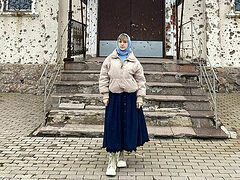
 Church of the Transfiguration of the Lord in Volnovakha rebuilt. The previous building burned down after a shell hit it But what about the sea that Irina was dreamt of? Well, they did see it, too. But honestly, on the day when they were able to go to Mariupol, it drizzled all day long, and the sea was complete frustration—too shallow, without any surf.
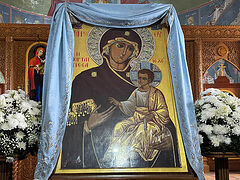
On Sunday, the volunteers attended a local church. The church in Volnovakha was completely rebuilt, as the former one burned down after a shell hit it, all that was left were s two icons. The Chelyabinsk region assisted with rebuilding of a new temple.
“That is where Oleg is from, it’s his native land, and it was so nice to see a sign on the church stating that it was restored at the expense of Chelyabinsk region,” Irina says happily. “And Volnovakha is generally under the care of Chelyabinsk region. We take to the road, and it turns out the road was also restored by Chelyabinsk region.”
Ira shows the photos on her phone: roses in bloom, a snow-white church, a destroyed house, Larisa Georgievna with pita.
 A family of volunteers in Moscow “It was interesting to talk to the locals; they reminded me of people we used to have in our Soviet childhood—simple and welcoming. They tried to treat us with some food all the time, or give us a watermelon. A neighbor would bring us plums, and I even made jam while I was there, which I brought back to Moscow.
“We're really glad our journey was a success. We not only helped, but we benefited a lot from it ourselves. Overall, any remembrance of life as a fleeting moment sobers up our soul. When we saw those fences riddled with bullets and craters in houses, and then we also spoke to a taxi driver in Mariupol—he drove us past Azovstal and shared a lot, as a living witness to what had happened—we felt it all keenly. We realized that our life could also be cut short and we have to live a real kind of life, because it is a precious asset, which holds the greatest value.”