On October 2, the Russian Orthodox Church honors the memory of St. Alexei (Soloviev) of St. Zosima’s Monastery.1 These words are in the troparion to the saint: “Like unto a guiding star thou didst appear as a comforter of Russia at a time of fierce trials, O most wondrous recluse, kindled with the fire of faith, thou didst attain Divine Love, having been entrusted the Orthodox flock by the grace of the Holy Spirit.” The troparion to the saint says that during his lifetime he acquired the rare gifts of consolation and love. Let’s take a closer look at his Life and spiritual instructions.
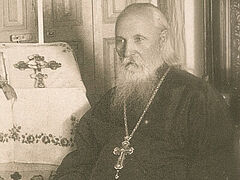
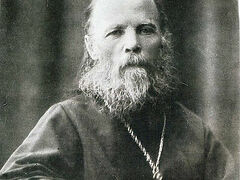
 Young Fr. Fyodor Soloviev. Hramvtolmachah.ru The future ascetic was born in 1846 in Moscow into a large family of a priest. The parents named him Fyodor (Theodore). His father was a kind and gentle man, and the boy revered and obeyed him. His mother died prematurely. Feodor first studied at a theological college, and then at a seminary. Living in Moscow, he usually walked long distances to the seminary. He would passed by Moscow theaters. Later, when he became an elder, he did not bless his spiritual children to go to the theater and taught them to revere their elders and superiors. His favorite seminary subject was theology.
On graduating from the seminary, Fyodor married a priest’s daughter whom he had known for a long time. They had a son, Mikhail. But his family joy was short-lived—his young beloved wife died early, and Fyodor suffered a very sad bereavement. At that time, Fyodor served as a deacon at St. Nicholas Church in Tolmachi. He was a very reverent deacon: he would always come long before the service and be almost the last to leave, praying in front of each icon. His voice was very beautiful and deep, and he served attentively and slowly. Already at a young age, an image of a true disciple of Christ was manifested in him, according to the Savior’s words: Be ye therefore merciful, as your Father also is merciful (Lk. 6:36). An unmercenary, he would give away his clothes to others, feed the poor and treat them with love. “Force yourself to be merciful and kind to your neighbors—this is a kind of podvig,” he later instructed his spiritual daughter. From his youth, he performed this podvig himself. At that time, he was in contact with another saint—the most kind Fr. Alexei Mechev. Fr. Fyodor was very keen on reading, silence and the contemplation of nature, in which he saw an earthly glimmer of Divine love. He served at the church in Tolmachi for over twenty years, and was dearly loved by the clergy and parishioners.
In 1895, he was assigned to the Dormition Cathedral of the Moscow Kremlin as a priest. At that time it was the principal cathedral of Russia. It housed the Vladimir Icon of the Mother of God, along with the relics of the holy hierarchs and Patriarchs of Moscow. This is how Fr. Fyodor recalled his service at the cathedral: “I used to enter the cathedral at three in the morning to serve Matins and become awe-stricken... Stillness reigned everywhere around. Moscow was still sleeping… In the mysterious semi–darkness of the church, the whole history of Russia would arise before me... I seemed to see the protection of the Mother of God from Her Vladimir Icon during the times of troubles, and the shadows of the holy archpastors of Moscow—the defenders of our Fatherland and pillars of Orthodoxy—seemed to pass by… And then I wanted to pray for Russia and all of its faithful children and wanted to devote myself entirely to God without ever returning to this vain world.” His soul longed for monastic life. After his son had married and the lives of his other family members had been put in order, he decided to quit his ministry in the capital and enter a monastery.
By Divine Providence, Fr. Fyodor ended up at St. Zosima’s Monastery. From his poetry of that time:
I’m not withdrawing from the world
To forget people completely,
But, rather, without any distractions,
To pray to Thee for them and for myself!
Indeed, while struggling at the monastery, he soon became both a man of prayer and a comforter of people in grief. After a trial period, he was tonsured with the name Alexei. His first obedience was in the choir on account of his truly beautiful voice.
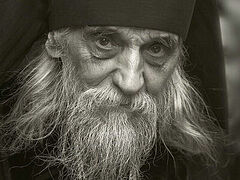
 St. Alexei of St. Zosima’s Monastery
Later, the abbot of the monastery appointed him to teach the Law of God to his fellow monks. Fr. Alexei always taught the basics of faith while standing and never while sitting. “You don’t have the fear of God. I’m speaking such exalted words, but you’re smiling,” he chided one of his students in awe of his eloquence. As Bishop Arseny (Zhadanovsky; 1874–1937), who knew him personally, recalled of the elder: “His humility is so strong that it seems that Fr. Alexei is ready to ask everyone’s forgiveness and, without hesitation, bow at the feet of the worst sinner, as it were... humility makes the abba say to anyone: ‘I know nothing—I’m a complete ignoramus.’ And he gets angry when others think he is clairvoyant or highly esteem him.”
People were drawn to Fr. Alexei, seeking his spiritual guidance, counsel and solace. And not only the brethren, but also pilgrims who were becoming more and more numerous. In 1908, Fr. Alexei went into semi-seclusion.
The spiritual children of the elder included Hieromartyr Seraphim (Zvezdinsky) and the philosopher Fr. Pavel Florensky. Grand Duchess Elizabeth Feodorovna the New Martyr would also come to ask for his advice. Ordinary people and peasants flocked to him as well. Meanwhile, troubled times were approaching, and St. Alexei found comforting words for everybody. “Don’t grumble, my child, stop it. If the Lord had forgotten you or hadn’t been merciful to you, you wouldn’t be alive. But you don’t see His mercy because you want your own way and pray accordingly, whereas the Lord knows what is best and most useful to you. Of course, you can always pray for deliverance from your sorrows and from your sins, but be sure to add at the end, addressing the Lord: ‘May Thy will be done,’” he instructed.
There is the following testimony about the elder in the book Reminiscences by the Orthodox author Sergei Fudel (1900–1977): “The elder was the spiritual heart of the monastery. The beauty of his whole appearance was striking when he came out of his semi-seclusion in a long mantia to hear Confessions of the faithful; the gray strands of hair on his shoulders, the might of his head, his height, his facial features, his surprisingly pleasing low baritone, and most importantly—his eyes full of attention and love for people. This love conquered and won you over. Whoever approached him plunged into it as into some ancient bosom, as into an element irresistible to him, still unknown and longed-for. The person could no longer disbelieve, because love in return had already been borne in him; fire is born from fire.”
In 1917, the recluse had to travel to Moscow, as he was included in the list of participants in the All-Russian Local Council. In addition to many church issues, the Council addressed the most important issue of the election of the Patriarch of Moscow. Bishop Arseny (Zhadanovsky) wrote about the elder’s arrival in Moscow: “Having taken the monastic name of St. Alexei, Metropolitan of Moscow, over his twenty-year stay at St. Zosima’s Monastery he had never visited his patron-saint; but then, thanks to his participation in the Local Council, he had to share with the monks of the Chudov Monastery the most difficult and dangerous moment in their lives when each of them was on the verge of death. The presence of the great elder with us uplifted the spirit, instilled calm in us and chased away all fear.”
 The Chudov Monastery, as well as the Moscow streets, were being fired at by the Red Army. While there, the elder, by the grace of God, more than once avoided being killed by the atheists’ bullets.
At the Local Council, Fr. Alexei was asked to draw lots from three candidates for the Patriarchal throne. The election took place at the Cathedral of Christ the Savior in front of the Vladimir Icon of the Mother of God, which had been moved from the Kremlin. The Russian writer Ivan Shmelev (1873–1950), who had known Fr. Alexei since his days as a deacon, wrote admiringly: “Could I have imagined that Deacon Fyodor from the church in Tolmachi was not an ordinary deacon, but an expert on Patristic works... that he would become a hieromonk, receive the schema, take on the great labor of Russian eldership, like Father Barnabas,2 or Elders Ambrose and Macarius of Optina?... Could I have imagined back then, in my Russian serenity, that a period of tribulation would come, and this former deacon, already as Hieromonk Alexei—venerated throughout Orthodox Russia as a holy ascetic—would be called from his seclusion at St. Zosima’s Monastery to the All-Russian Council where he would have the high and strict mission of taking out the name of the holy Patriarch-Martyr Tikhon written on a piece of paper from behind the Vladimir Icon of the Mother of God?”
Returning to St. Zosima’s Monastery, the elder received the great schema with the name Alexei. But this time he did not live there for long. In 1923, the monastery was closed by the godless authorities, and the monks were expelled. The elder moved to the home of his spiritual daughter in Sergiev Posad. St. Sergius of Radonezh appeared to him there more than once and conversed with him as the elder stood in prayer. His Holiness Patriarch Tikhon, a new confessor of the Russian Church who had been elected by the elder’s hand, would visit the saint who was already ill. St. Alexei reposed in the Lord on September 19/October 2, 1928. Multitudes of believers flocked to his funeral. The atheists tried to disrupt his funeral, but they failed.
Elder Alexei was canonized at the Jubilee Council of Bishops in 2000. This is what Metropolitan Juvenal (Poyarkov) of Krutitsy and Kolomna stated about him in his report: “The Lord endowed Elder Alexei with many gifts, among which those of wisdom, humility, love and clairvoyance stand out. It was through his hands that God’s will was fulfilled for St. Tikhon of Moscow, whose name Elder Alexei drew during the election of the Patriarch on November 5, 1917 at the Cathedral of Christ the Savior. He guided many in the salvation of their souls, performing miracles, and calling on people to repent and seek the one thing needful (cf. Lk. 10:42).”
Today St. Alexei guides us also in the salvation of our souls. He left behind spiritual instructions that are useful to modern believers. Being a model of mercy to others, he taught one of his spiritual daughters: “We must be merciful, my dear child: Blessed are the merciful: for they shall obtain mercy (Mt. 5:7). Above all, be merciful to the souls of your sinning neighbors, since we must have more pity on those who are sick and suffering mentally than those who are sick and suffering physically. Be merciful and do no harm even to animals… Christians should not have enmity towards anyone. There must be love, love and prayer.”
Some of his instructions were as follows: “Never go to bed without praying in case you die that night, and you went to bed without praying. Always reproach yourself in everything, be aware of your weakness, repent and weep before God... Take the trouble to read the Word of God and spiritual books. The Holy Gospel must be read daily. The Word of God will support and strengthen you in the truth.”

Another time, the elder exhorted: “If you have no spirit of confession, it will be hard for you to die. It will be hard to answer before God Who you did not confess openly, but only secretly, for fear of ridicule. You were ashamed to respond to non-believers and confess your faith openly. It is always possible to speak about God, in any circumstances. For instance, your children will say to you, ‘We can’t solve an arithmetic problem.’ And you reply, ‘Never mind, with God’s help you will solve it. Pray to God more diligently,’ and so on. You can do it at every step... Firmly rely on God’s mercy.”
There are the following words in a prayer to St. Alexei: “The holy offshoot of a pious root, from thy youth up thou didst devote thy life to the service of God, and having settled at St. Zosima’s Monastery, wounded by the love of Christ, thou didst acquire this virtue as the highest and eternal, and thou didst show thyself to the faithful as an inexhaustible wellspring of grace, pouring out mercy to all and healing the infirm. O Venerable Elder Alexei, pray to the all-compassionate God to grant us peace and show us great mercy.” Let us also turn to the prayerful intercession of St. Alexei.