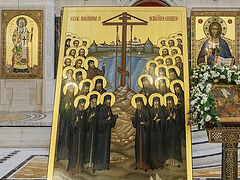
Icon: “Synaxis of the New Martyrs and Confessors of Saint Petersburg,” painted for the Cathedral of St. Catherine the Great Martyr in Tsarskoe Selo.
On November 13 (New Style), the Church commemorates the Synaxis of the New Martyrs and Confessors who shone forth in the land of Saint Petersburg. This feast was established in 2022 and timed to the day of the martyrdom of the Holy Hieromartyr John Kochurov, the first Orthodox priest killed by the Bolsheviks in 1917. Along with his memory, the Synaxis includes the commemoration of the Royal Passion-Bearers; the Venerable Martyr Elizabeth; the patron of Sretensky Monastery, the Hieromartyr Hilarion (Troitsky); and several dozen other saints. Let us briefly recall the lives of some of them.
Hieromartyr Alexis Stavrovsky (1834–1918)
 Hieromartyr Alexis Stavrovsky He was born into a priestly family in the Saint Petersburg province. He graduated from the theological school, seminary, and academy. After completing the Academy, he taught at the Alexander Nevsky School. He served for thirty-four years in the Church of Sts. Peter and Paul, after which he was appointed rector of the Cathedral of St. Spyridon of Trimythous in the Admiralty. Altogether he served fifty-six years in the priesthood. The churches in which he served flourished under his care. He had great influence on his fellow clergy in the military chaplaincy. He possessed the gift of preaching and materially supported students of the Saint Petersburg Theological Academy.
For his service, he was presented to Emperor Nicholas II on the 300th anniversary of the Romanov Dynasty. The priest was granted hereditary nobility. His Holiness Patriarch Tikhon appointed him protopresbyter of the military and naval clergy.
In 1918, an important Bolshevik official was killed. In retaliation, the new authorities executed 500 people in a single night. The eighty-four-year-old Father Alexis was arrested. In prison, he remained cheerful in spirit and supported his fellow inmates.
The prisoners were transferred to Kronstadt, gathered onto a barge, and told that every tenth man would be shot. Father Alexis turned out to be the ninth. A young priest stood near him. Smiling, the elderly martyr said to him:
“I am already old—my time is short; I have received everything in life that was possible; my wife is an old woman, and my children are all grown. Go with God, and I will take your place.”
He stepped into the place of the young priest and was executed, fulfilling the Gospel words: Greater love hath no man than this, that a man lay down his life for his friends (John 15:13).
The barge with the murdered prisoners was sunk.
Hieromartyr Vladimir Lozina-Lozinsky (1885–1937)
 Hieromartyr Vladimir Lozina-Lozinsky He was born into a large family of physicians. After the death of his mother, his father moved with the children to Saint Petersburg. According to his sister, “Vladimir always tried to show compassion and care for everyone; he was the soul of any gathering, able to unite and cheer all around him.” In 1904 he graduated from the gymnasium and entered the law faculty of Saint Petersburg University. In 1910 he began working in the Senate. At the outbreak of the First World War, he devoted himself to transporting the wounded from the Saint Petersburg train stations, giving himself selflessly to the suffering.
In 1917 the Senate was closed by the Bolsheviks. Vladimir began working for the railroad while simultaneously considering the priesthood. In 1920 he entered the Theological Institute in Petrograd and submitted a petition for ordination. The petition was granted. Until his first arrest in 1923, he served as rector of one of the churches in Saint Petersburg. He was soon released through the intercession of his relatives.
But another arrest followed—this time for serving panikhidas for the Imperial Family, which the authorities regarded as a “monarchist conspiracy.” This time he was sentenced to ten years in the camps.
At first he served his sentence in exile in Solovki. According to those who knew him, he was “so airy-bright, so gently kind, that he seemed the very embodiment of sinless purity, which nothing could stain.” He bore the trials in submission to the will of God. His relatives visited him there and succeeded in having his sentence reduced. The priest was transferred to the Irkutsk region. In 1934 he was released. He served only briefly as rector of the cathedral in the city of Novgorod. In 1937 he was arrested together with a group of parishioners. He was executed in December of that same year.
Hieromartyr Nicholas (Klementyev) (1875–1937)
He was born into a priestly family in the Kostroma province. He completed the theological school and seminary in Kostroma and then entered the Saint Petersburg Theological Academy. A note survives from his time there: “Nikolai Feodorov Klementyev is studying at the St. Petersburg Theological Academy; of excellent-good conduct.”
After graduating from the Academy, he began teaching logic and Latin at the Alexander Nevsky Theological School. He married, served in several churches in Saint Petersburg, and later was widowed.
 Hieromartyr Nicholas (Klementyev) In 1922 he was arrested in connection with the “confiscation of church valuables.” After his release, he received monastic tonsure and episcopal consecration as Bishop of Sestroretsk, vicar of the Petrograd diocese. The diocese was headed by His Holiness Patriarch Tikhon (Belavin), the Confessor. In this ecclesiastical ministry the Hieromartyr Nicholas opposed the renovationists. He was arrested and sent into three years of exile in the Irkutsk region. After completing his exile, he returned to Leningrad, where he temporarily lived with his daughters.
During the general introduction of passports for all, he was denied residence registration in Leningrad and moved to Tikhvin. In 1933 he was appointed Bishop of Veliky Ustyug.
In 1935 Bishop Nicholas was arrested along with several fellow clergy for “participation in a counterrevolutionary group.” The charges stated, among other things: “Archbishop Klementyev, in the city of Veliky Ustyug since the end of 1933, organized around himself the most reactionary and anti-Soviet-minded part of the clergy, with whom, under the pretext of diocesan council sessions and various celebrations, he arranged gatherings at which questions of resisting Soviet power were discussed. In addition, he widely used the church ambo for counterrevolutionary agitation.”
He was sentenced to five years of exile in Kazakhstan.
Already in the camp, at the age of sixty-five, the hierarch was arrested again for “counterrevolutionary activity.” In a written statement regarding his arrest he wrote:
“Upon arriving here, I wrote one letter to Archbishop Boris (Shipulin) of Tashkent, asking him, as the spiritual overseer of the Vannovskoye parish, to bless me—if permitted by the Soviet authorities—to serve in the prayer house so that I might partake of the Holy Mysteries. And if it were impossible for me to receive Communion in the church, to bless me to receive Communion at home… Archbishop Boris, originally from Veliky Ustyug and my fellow student in the Academy, replied to me in writing, granting me his blessing for both church Communion and Communion at home… I have nothing further to tell the NKVD about myself. Nikolai Klementyev.”
In response, the indictment stated:
“In the Tyulkubas district, being hostile toward Soviet authority, he conducts systematic counterpropaganda aimed at discrediting the measures of the Party and the government. He maintains close ties with counterrevolutionary clergy and with exiles in various cities of the USSR, with whom he maintains communication and to whom he gives directive instructions for counterrevolutionary activity.”
He was sentenced to execution by a troika of the UNKVD of the South Kazakhstan region. In January 1937 he was shot.
His Holiness Patriarch Kirill once said: “Those who, in dreadful prison cells—hidden from public view, without any connection to the mass media, in complete solitude—stood face-to-face before their tormentors, reveal a wondrous example of steadfastness and holiness.”
Truly it is so. Each time one reads even the brief lives of the New Martyrs of Russia, one is struck by the firmness of their faith and their readiness to die for Christ.
Pray to God for us, O new martyrs and confessors who shone forth in the land of Saint Petersburg!