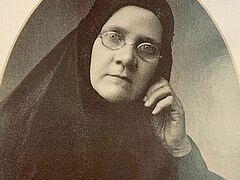
Abbess Olympiada (Baranova)
On July 1, 2025, Abbess Olympiada (Baranova) of Holy Protection-Khotkovo Convent turned seventy-five. The previous years also saw significant dates for her. 2022 marked the thirtieth anniversary of the resumption of monastic life in the ancient Holy Protection Monastery—the place of the monastic labor and resting place of Venerable Cyril and Maria, the parents of the abbot of the Russian land St. Sergius of Radonezh. From the very first days, Mother worked there to revive both the walls and the prayerful service. In 2023, the thirtieth anniversary of her abbatial obedience was solemnly celebrated. A year ago, forty years had passed since the most important event in Mother Olympiada’s life—her taking of monastic vows.
The Moscow Patriarchate’s Monastic Herald publication shared with its readers her memories of the monastic school she went through in Riga, in the famous Holy Trinity-St. Sergius Monastery under the leadership of Abbess Magdalena (Zhegalova). Mother Olympiada was among the twenty young abbesses whom this “All-Russian abbess,” an outstanding ascetic of our time, raised up for the monasteries that were opening during the Church spring of the 1990s.
Abbess Olympiada shared her story about her spiritual mother and her experience of the continuity of the traditions of Russian female monasticism.
“How good it was that I started out in such strictness!”

The Holy Trinity-St. Sergius Convent isn’t famed for its ancient history—it was founded at the turn of the nineteenth-twentieth centuries. But as with monasteries that date back centuries, at its beginning lay a deeply personal, heartfelt desire to serve God. The efforts of the foundresses—the Mansurov sisters, ladies-in-waiting at the Empress’ court, high-ranking benefactors, even members of the royal family—were at the time focused on performing many good deeds for which they received the special blessing of St. John of Kronstadt. In the twentieth century, the monastery endured many trials in connection with the wars and subsequently with the oppression inflicted by the Soviet government but was never closed, being one of the sixteen that were miraculously preserved on the territory of the USSR. The monastery preserved the traditions of monasticism, and those seeking the monastic life went there.
—I arrived at St. Sergius Monastery in Riga in the 1980s and lived there for twelve years. I must say right away that I don’t regret a single hour I spent there. I loved my abbess, Mother Magdalena, immensely—I don’t know who in the world could be higher than such an abbess… The sisters and the whole of Riga loved her. On major feasts, practically the whole city was in the monastery. On Mother’s name’s day and on the Sunday of the Myrrh-bearing Women, the monastery was drowned in flowers from pilgrims—the abbess’ room and the church were filled with them… When they couldn’t fit any more flowers, Mother would say: “Well, take the gerberas to Olympiada”—I really liked gerberas…
Mother Magdalena led a very dignified life. At one time, when she was quite young, she went through a lot. At the end of the war, the Germans deported her entire family to Germany and they wandered through Europe: Poland, Austria, Czechoslovakia… Her father, a priest, was appointed after the war to serve in Orthodox churches in Czechoslovakia, and Liudmila (Mother’s name in the world) worked as a teacher. In 1949, His Holiness Patriarch Alexei I secured the return of several Riga priests to their homeland and gave them parishes. Mother graduated from the teacher’s college in Riga and worked with very difficult disabled children. Then the hierarchy entrusted her with teaching the Law of God in Sunday School.
Liudmila Zhegalova’s monastic life began in 1952 when she entered the Holy Trinity-St. Sergius Convent in Riga under Abbess Tabitha (Dimitruk), becoming the spiritual daughter and successor of this remarkable ascetic, a zealous guardian of monastic tradition who in the 1960s managed through tremendous effort and fervent prayer to preserve the monastery and save it from closure.

—When I came to the monastery, Mother Magdalena was sixty years old and still strong, though she suffered from hypertension. At that time the monastery didn’t even have a blood pressure monitor—they measured it the old-fashioned way with a ruler and a nut on a string. That’s how simple things were. There was no gas heating—everywhere, in the church, the cells, the refectory, the prosphora bakery—only stoves. If your obedience was in the kitchen (and newcomers were assigned from day one either to the kitchen or, if they ended up at the hermitage outside the city, to the cattle barn), you had to chop firewood in the morning, carry out two buckets of coals, light the stove, and only then start cooking. We cooked whatever Mother blessed. We weren’t spoiled with food, but Riga wasn’t a poor city and we always had plenty of vegetables, dairy products in abundance, and fish on feast days. We always got candy on our name’s days, and cake only if a parishioner brought it for a memorial. Otherwise, everything was quite ordinary, and no one complained or demanded anything for themselves.
Mother really loved to pray. Since her blood pressure was almost constantly high, we’d go to her cell to read the Midnight Office. Mother would lie on her bed as if dozing, but in reality she heard everything. The moment her cell attendant stopped, she’d say: “Why are you silent? Read aloud!” Then we’d help her up, dress her, she’d take her medicine... And for all her frailty, the abbess was always at the helm. Always. She treated us with great love. If everything was fine, she’d call us “little children,” but if something was wrong, she’d get angry: “You came here from distinguished spiritual fathers, and this is how you behave!” And she’d give you a penance. Especially for willfulness—if someone did something without a blessing. She could assign a thousand prostrations. She punished me too at times, but here’s what's important: She’d punish you, you’d leave, walk around for a day, and the next day you’d catch Mother somewhere:
“Forgive me!”
“I’ve already read five kathismas for you!”
And all you could think was: “Look how much I upset the abbess—she even read five kathismas for me!”
Some thought, of course, that Mother was very strict, but she needed the sisters to learn to cut off their own will.
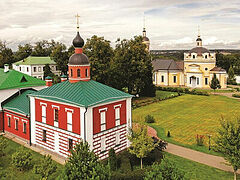
Beyond training in asceticism, Abbess Magdalena’s strictness proved an invaluable gift for the sisters who in the 1990s were sent to the ruins of monasteries destined for revival. Mother Olympiada, appointed to Khotkovo, found in place of what had been a glorious monastery in the not-so-distant past a refuge for marginal characters, devastation, and hostility. Everything had to be literally raised up and pulled out of the most pitiful condition on weak women’s shoulders. Would they have endured this if not for the harsh demands that the wise abbess had accustomed the sisters to?
 Holy Protection-Khotkovo Monastery in the years of ruin
As for appearance, Mother wouldn’t tolerate any brown shoes or colored dresses. At the hermitage, since there was farm work and field labor, you could wear polka dots or stripes, but in Riga—only black, or at most gray if it was hot. And it never occurred to anyone that it could be otherwise. If you arrived in brown shoes—it was “Here’s a tube of paint, paint them black.” Only those on prosphora obedience had their own uniform: blue dresses. Once all the prosphora bakers came out on the porch to get some air on a hot day, and the people who saw them thought there was some special feast at the monastery. But that was just their uniform. And the prosphora bakers had to tie scarves on their heads, over their apostolniks so not a single hair would fall—they were very strict about this. The monastery would bake prosphoras and sell them to twelve churches in Riga, earning its livelihood this way. There was a special silence in the prosphora bakery. While they prepared and rolled out the dough, a sister would come to read the morning prayers, the Midnight Office, and an akathist, and then everyone would go to church. Everything was baked in a Russian wood-burning stove. The prosphoras were delicious!
No one even talked about vacations! The sisters never left the monastery. And Mother herself never went anywhere while we were there. Only when she had a stroke did Bishop Leonid1 invite her to his dacha by the sea in Dubulti. He occupied one half of the house and the other half was given to Mother—that’s where she’d go for the summer.

Vladyka and Mother were spiritually united in everything. He greatly respected her, and he told us: “As long as I’m alive, no one will touch you.” We truly lived under his protection as if sheltered by Christ Himself. Though he wasn’t Latvian—he was born in St. Petersburg—the local authorities treated him with great respect. A hereditary doctor, he survived the Siege of Leningrad and was already a believer at that time, and one St. Petersburg priest told me that he would regularly send the church whatever bits of flour he could spare, to bake prosphoras for Divine Liturgy. Vladyka served at the Riga cathedra for over twenty years. Later, when it became difficult for him to move around, he lived in the episcopal quarters at our monastery. But he always went to church. He tonsured all the sisters himself. He was a man of few words, always speaking to the point, giving his thoughts room to breathe while keeping his words sparse: “It’s not the clothes that make a monastic, but the life. Amen.”
You look back and think: “My God, how good it was that I started out in such strictness!”
When I first came to Mother, I immediately received an obedience:
“Go to the candle shop.”
“But I’ve never made candles in my life!”
“In the monastery we say: ‘Forgive me, bless me, pray for me.’ We don’t say anything else in the monastery. Go.”
“Forgive me, bless me.”
And I went. The candle shop was hot and stuffy... You’d come back from there saying:
“We bought some carp (in a basin, no exaggeration, five feet wide) that needs cleaning. It was hot there; it’ll be cold here...”
But either way, we handled everything.

None of us ever had our own money either. But since the monastery sold prosphoras, we were all given thirty rubles a month to spend on the essentials (the monastery didn’t provide everyday household items). One sister would be assigned to do the shopping; they’d give her a two-wheeled cart, and each of us would give her money with a shopping list. And if someone’s relatives gave them, say, fabric for a riassa that was better quality or more expensive, Mother wouldn’t bless them to sew it:
“You get the same as everyone else.”
(We have the same custom in Khotkovo now: If any sister’s parents bring something, some treats, the sister comes and says: “They brought me a bag of candy, bless me...” “They brought it? Fine, take it to the refectory. What’s for you is for everyone.”)
When the relics of St. Seraphim were uncovered, we were allowed to go venerate them. We bought tickets. But what would we wear? We had no coats.
—What do you mean, no coats?
— All that time we lived there, no one had thought about coats; we walked around in our riassas and shawls, and there wasn’t really anywhere special to go anyways. Mother, poor thing, even cried: “It’s my fault, I didn’t notice that the sisters have no coats.” And we hadn’t asked. Mother’s cell attendant went and bought coats for everyone—identical, the simplest ones, and that’s what we wore on the trip.
The winters were snowy. We had to clear the courtyard by hand, and the path along the monastery, and by the tram tracks. We’d get up in the morning: the young ones to shovel snow, the elderly to go to Midnight Office. Sometimes we’d have to shovel for half the day. Gradually the sisters would leave for other obediences. I remember once I was left alone, and a respectable-looking gentleman was walking by:
“Poor little thing, what’d you get fifteen days for?”
“Well, I screwed up,” I said...2
When I came in 1980, there were many elderly sisters in the monastery, and I was the first young one. For over twenty years before me, they hadn’t allowed anyone to be registered at the monastery at all. And for some time after that, they still wouldn’t accept either young women or those with higher education—they wouldn’t register them. They took in one young girl—a local one!—and she was immediately ordered out of the monastery because she was under twenty-five. When entering the monastery, you had to submit your documents to the Commissioner for Religious Affairs. And so all the sisters who had higher education were listed as janitors, barmaids, groundskeepers—that was the only way to get permission. And there were actual raids looking for unregistered people. They’d come for an inspection, and Mother would only have time to tell the sisters: “You have two minutes to get out of here!” They’d grab whatever they had, run out into the street and scatter in all directions. And anyone who was slow would hide in corners around the monastery...
I only had a vocational medical education, and I was already approaching thirty, plus it was an Olympic year—that’s the only reason they registered me.3