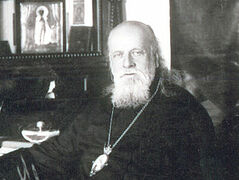
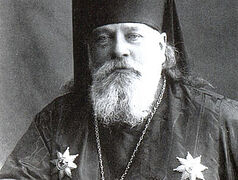
On December 11 according to the new calendar the Holy Church honors the memory of Hieromartyr Seraphim (Chichagov). The troparion to the saint briefly describes his spiritual labors on earth: “Loving the host of the Heavenly King more than the earthly, thou didst appear as a zealous servant of the Holy Trinity. Keeping the instructions of the pastor of Kronstadt in thy heart, thou didst multiply the manifold gifts given to thee by God for the benefit of the people of God, and as a teacher of piety and a champion of the unity of the Church, thou wast vouchsafed to suffer even unto blood. O Hieromartyr Seraphim, pray to Christ our God for our souls to be saved.”
Let’s take a closer look at his Life.
The future hieromartyr (secular name: Leonid Chichagov) was born on January 9, 1856 in St. Petersburg into an aristocratic family. From childhood, the boy was particularly religious. His mother sent her son to the Corps of Pages, and then he completed the Artillery Academy. After that, he went to the Balkans, where he participated in the Battle of Plevna. On his return, he was awarded a saber with an imperial dedicatory inscription and received three high awards. It seemed that a brilliant military career was opening up before him—serving the Tsar and the Fatherland, and all the earthly benefits associated with it. But the Lord prepared another path for the future hieromartyr—to serve Him and be vouchsafed Heavenly and incorruptible blessings: For them that honor Me I will honor (1 Kings 2:30).
The young officer met St. John of Kronstadt, who became his spiritual mentor and blessed him for the priesthood. After the death of his wife, the future hieromartyr became a monk with the name Seraphim at the Holy Trinity-St. Sergius Lavra. An important milestone in Fr. Seraphim’s life was his contribution to the canonization of his great namesake St. Seraphim of Sarov by writing the Chronicle of the Diveyevo Convent, the akathist to St. Seraphim of Sarov, and his detailed Life. Fr. Seraphim visited Diveyevo where he met Mother Pelagia (secular name: Parasceva, Pasha of Diveyevo), a “fool-for-Christ”. His talks with her inspired his to compile the Chronicle. She told him: “It’s good that you are here! I have been waiting for you for a long time: St. Seraphim commanded me to tell you to inform the Emperor that the time has come for the uncovering of his relics and his canonization.”
 An icon painted by St. Seraphim (Chichagov) One day, St. Seraphim of Sarov himself appeared to Fr. Seraphim. He recalled it this way: “After finishing the Chronicle, I was sitting in my room in one of the buildings in Diveyevo and rejoicing in having completed the hardest task of collecting materials and writing about St. Seraphim. At that moment, St. Seraphim entered the cell, and I saw him as if he were alive. It did not cross my mind for a single minute that this was a vision—everything was so simple and real. But imagine my astonishment when Fr. Seraphim bowed to me from the waist and said: ‘Thank you for the Chronicle. Ask me whatever you want for it.’ With these words, he came close to me and put his hand on my shoulder. I snuggled up to him and said, ‘Father, dear, I am so happy now that I want nothing but to be always with you.’ Fr. Seraphim smiled in agreement and became invisible. It was only then that I realized it had been a vision. There was no end to my joy.”1
Soon, despite the opposition from people close to the Emperor, St. Seraphim of Sarov was canonized. The family of Emperor Nicholas II came to the Sarov Monastery for the celebrations organized by Fr. Seraphim (Chichagov).
In 1906, Fr. Seraphim became a bishop. By the will of God, in the rank of bishop he served in several different dioceses, including Sukhumi, Chisinau, Oryol, Tver and Leningrad. For his service in the Oryol diocese, namely for organizing parish life there, Vladyka was awarded an order from the Sovereign himself. Wherever Vladyka served, he always showed his military officer stamina, strength of will, and organizational talent. There were many difficulties, but despite the all he opened orphanages, hospitals, parish councils, and actively fought against wrong beliefs, heresy, and sectarianism. Vladyka possessed artistic and musical talents. Thus, icons of the Savior and St. Seraphim painted by him are known and kept at the Church of St. Elias in Obydenny Lane in Moscow. The saint also left behind many musical pieces, liturgical music, and vocal compositions.
 Members of the Imperial Family, accompanied by Archimandrite Seraphim (Chichagov) at the Sarov Monastery, 1903
The year 1917 arrived. At that time, Bishop Seraphim was serving in the Diocese of Tver. The authorities still did not touch him, but he had conflicts with the local clergy because of his strict attitude towards military service. Being a man with a valiant military background, Vladyka Seraphim believed that young people must serve in military units after graduating from the seminary. In the same year, he was expelled from his diocese by the Renovationists. In 1921, St. Seraphim was arrested for the first time and spent several months at the Taganka Prison. He was charged with crimes against the Soviet Government. He was sentenced to exile in the Arkhangelsk region, where he spent about a year in the rank of metropolitan. He returned from exile to Moscow, where he was arrested again. He was charged with organizing celebrations on the occasion of the canonization of St. Seraphim of Sarov.
In 1927, he accepted the controversial Declaration of Metropolitan Sergei (Stragorodsky), realizing that the restoration of centralized Church authority was vital. He was appointed Metropolitan of Leningrad and Gdov. At that time, the diocese of Leningrad was experiencing great internal dissension between the Renovationists, the Josephites (supporters of Metropolitan Joseph [Petrovykh], who was in opposition to Metropolitan Sergei) and other factions. Metropolitan Seraphim was determined to subordinate to himself all the parishes of the metropolia entrusted to him.
Arrests began, including of monastics. The first were Josephites, with whom Vladyka was fighting. Later, new Martyrs, whom we now venerate, appeared among them. Then the authorities began to arrest Sergianists, and Vladyka Seraphim was one of them. A new arrest was threatening Vladyka Seraphim as well. By that time, his health had deteriorated. In October 1933 he retired and moved to Moscow, and then to the Moscow region, where he lived out his life.

The ruthless and bloody year 1937 arrived. It produced a host of new saints for our Church and the whole world. Metropolitan Seraphim was arrested again. The bloodthirsty executioners carried the infirm eighty-one-year-old elder out on a stretcher and sent him to the Taganka Prison. Interrogations lasted several weeks, but the courageous soldier of Christ did not give a single testimony. On December 11 of the same year, he was shot at the Butovo firing range (now in Moscow). Vladyka’s relics have never been uncovered; they rest in a mass grave of one of the Butovo ditches... For unto you it is given in the behalf of Christ, not only to believe on Him, but also to suffer for His sake (Phil. 1:29).
“Learn to forgive all their shortcomings and mistakes, both in view of their submission to the evil spirit and, undoubtedly, an abnormal state of their mind. Say to yourself, ‘Lord, help them, for they are spiritually ill!’ Such an awareness will prevent judging, because only those who are perfect and do not make mistakes can judge—they know everything, and most importantly, they know for sure that people do not act according to the circumstances developed around them, but according to their own free will, according to their passion,”2 wrote Metropolitan Seraphim in one of his letters. He teaches us to forgive our enemies, to forgive our executioners… He sets us an example of the courage and perseverance that everyone needs in our time.
In another letter, he taught the recipient and us who read his lines the most important things: “Be with Christ alone—the only Truth, Righteousness and Love, and with Him everything is wonderful, clear, pure and comforting. Move away with your mind, heart, and thoughts from evil that holds sway over the graceless, and care about one thing—to keep in yourself, by faith, the grace of God through which Christ and His peace begin to dwell in us… Learn inner prayer so that it should not be noticed by your appearance and should not confuse anyone. The more we are focused on inner prayer, the fuller, more meaningful, and more joyful our lives are. Then time passes more imperceptibly and faster. The Jesus Prayer and your own short petitions, ‘Lord, help me!’, or ‘Protect and strengthen me!’, or ‘Teach me!’ and so on are especially useful for this purpose… He who performs inner prayer looks at everything outside indifferently and vaguely, because this is the prayer of the heart, not of the mind, separating you from the surface of the earth and bringing you closer to the invisible Heaven.”3
 “The Savior in the Chiton”. An icon painted by St. Seraphim He also taught about the purpose of Christian life: “If we keep in mind that we have our being, strength, feelings, mind, heart, and will from God, receive numerous blessings from the Lord, and can participate in bliss and eternal life in His Heavenly Kingdom, then we cannot doubt that the purpose of everyone’s life is to serve God and glorify the Creator.”4 There are also the following instructions of Vladyka: “He in whom the Holy Spirit dwells does not exaggerate his virtues, does not put on airs, does not exalt himself over others, does not indulge his passions, but strengthens himself with unceasing prayer, never deceives, does not lie, but tries to do only what pleases God. He avoids any occasion for enmity, keeps away from evil, readily forgives offenses, and prays for his enemies. He has no pangs of conscience, he is not troubled by passions, and is not tormented by envy. Filled with the Holy Spirit, he rejoices in the Lord and in his salvation!... The Spirit of God does not dwell in those who rest. This is what distinguishes the children of God: They live in tribulations, while the world enjoys itself and is proud of its luxury and comfort.”5
And lastly, his spiritual reflections on prayer are also important: “In order for prayer to become our necessity, our joy, the need of life and the most precious gift, we must cultivate the spirit of prayer... Prayer should begin with praising God and thanking Him for His innumerable blessings. Then we must offer to God a sincere confession of our sins with contrite hearts, and in conclusion we can express with great humility our petitions for the needs of our soul and body, devoutly leaving the fulfillment and non-fulfillment of these petitions to His will… Each such prayer will leave its trace in the soul; its daily practice will root prayer; and patience, without which nothing can be achieved in life, will undoubtedly inculcate the spirit of prayer.”6
Vladyka Seraphim was an eloquent preacher. In particular, in one of his sermons he taught about the purity of the heart: “In order for the heart to find the path and reach the gate of the Kingdom of God, it must be pure and free from passions… Such a purified and sanctified heart is a dwelling-place of the Holy Spirit… Seeking the Kingdom of God is not a retreat into the wilderness or a complete renunciation of the world… It teaches us how to reach a point where worldly and earthly affairs do not interfere with spiritual and heavenly affairs.”7
Now that we are walking through the Nativity Fast, the following words of Hieromartyr Seraphim are especially edifying for us: “Did the Son of God really become incarnate in order to improve and change people’s external lives, to grant them earthly peace, to trample upon physical death, and to destroy disasters, storms, strife, and wars? He came into the world to change the internal lives of His disciples and followers, to save their souls from spiritual death, to pour out the redemptive grace of the Holy Spirit upon them, to reconcile and unite them to the Heavenly Father through Himself, to draw them to the true Kingdom that is not of this world, and finally, to grant them blessedness and eternal life… Oh, boundless is the love of God! When will people understand it? Sing praises to God, sing praises: sing praises unto our King, sing praises (Ps. 46:7)!”8
Metropolitan Seraphim (Chichagov) was such an amazing man and a light of the Church The Russian Orthodox Church canonized him as a new hieromartyr in 1997. His example teaches us perseverance in trials, and firm faith in Christ and His promises. The kontakion to the saint reads as follows: “Bearing the name of the Wonderworker of Sarov, thou didst nurture ardent love for him. And proclaiming his ascetic labors and miracles to the world through thy writings, thou didst inspire the faithful to glorify him and wast vouchsafed a grateful visitation of the venerable one himself. Now dwelling with him in the Heavenly abodes, O Hieromartyr Seraphim, pray to Christ our God that we may be partakers of the joy of the seraphim.” May we also be worthy of St. Seraphim’s prayerful intercession!