Part 1: “Orthodoxy Will Be Preached and Spread As These Fateful Days Unfold”
OrthoChristian.com had a visit from the Orthodox geopolitical blogger, Conrad Franz, from Austin, Texas—a graduate of King’s College, New York in media studies. Conrad was invited to Russia by the Moscow Patriarch Department for the Church’s Society and Mass Media Relations, to get firsthand experience of our Church life—in Moscow, Moldova, and the Donbas.
In Part 2 of the interview, Conrad talks about his trip to Moldova.
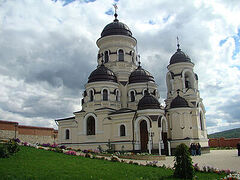
 A small town church in Moldova
Ten signatures needed to divide the Church
—Conrad, what did you come away with from your trip to Moldova?
—I loved Moldova. It was a beautiful country with very pious people. I was one of the few people in our group going into it that had actually covered the Moldova Church persecution on my on my show for the past year and a half. You know, one of our main sources on the show is OrthoChristian.com, and every week I check it for new church persecution news, so that I can report on it and bring it to people that perhaps don’t like reading articles, but like listening to podcasts. So, we had been talking about it for a while. Archbishop Markell, for example, is a hero of ours because he stood strongly against vaccination mandates and those sorts of other globalist issues in Moldova.
When I went there, I expected to hear some stories about persecution. I already knew about the bribing of priests. But at the first meeting we had with a priest, he immediately told us that the room is bugged and we need to speak very carefully, and he knows his phone is being monitored. I thought, really? Like, is this real? And then it was. Everyone told us the same thing all over the country. Priests in the north, priests in the south, priests closer to Romania, priests closer to Ukraine. They told us that they know they’re being watched and they feel it explicitly.
And one of the strongest moments we had was when we went to a small village—I think it’s called Gruneste or something. I forget the Romanian Moldovan name. It was a small town that was about two hours north of Chișinău. We met there with basically a good half of the parish community who stayed to talk with us and the priest. They were a community whose priest had taken money from this new Bessarabian Metropolia,1 which we largely suspect is financed by the European Union. And of course, Moldova is one of the poorest countries in Europe. The average monthly salary is between 500 and 600 euros.
So they offer the priests these exorbitant salaries and tell them, look, all you have to do is leave the canonical church of Moldova and join up with this thing that’s encroaching on their territory. And I think the other implication is you sort of have to go along with Maia Sandu and the current government’s pro-EU, pro-globalist, pro-LGBT, pro all sorts of satanic medical stuff—whether it be abortion or weird vaccinations. Go along with all of this; maybe you’re really not for it, but just don’t speak up against it. And we’ll give you all this money. And that’s what happened.
He only needed ten signatures from his parish in order to fully move his parish over. And he could only get nine. And apparently those nine were lied to. He misled them about what it was they were signing. But he couldn’t get that tenth signature. But he nevertheless left his bishop, Ioan, who was the canonical bishop of his diocese, and joined the Bessarabian Metropolia. And it got to a point where the parishioners wouldn’t go to his services, they wouldn’t stay around him, and they even had to physically remove him from the building. And once they had done that, the police came and helped the priest get back inside. The police were completely against the parishioners siding with this totally corrupt priest who was violating all of the canons.2 And finally, when they succeeded in communicating to the priest that they were not going to be giving any money, not going come to services if he’s there, the priest basically packed up his things, cut the electrical wiring to the parish so they couldn’t heat it, stole the tongues out of the bells so they couldn’t ring the bells, and then became a squatter in the rectory where the parish priest is supposed to live. And while we were meeting, I asked them, is he squatting over there, twenty feet away from us, right now? Yes, they said, he’s in there, with all the things he took from us.
This just shocked me. I thought, how could somebody who was ordained a priest of God behave this way? And it makes perfect sense that those who would take the bribe money would be the most unscrupulous. If you’re willing to take money to go against your own bishop, then why would you care about stealing or any of these other sorts of things? So that was very dramatic.
 A church in Chisinau We talked to people in the only church in Chișinău that serves the Liturgy in Slavonic—despite the fact that a huge majority of the people often regularly talk in Russian. We heard from some of the young men in that parish that they had been approached by shadowy figures, secret police at night, basically with violent threats saying: Look, if you keep up what you’re doing, we’re going to come and beat you up. And when you hear all of those stories together, you start to realize this is like a gangster state. Many priests told us that what they are experiencing right now is worse than some of the worst Soviet times—which is shocking to hear.
—In the USSR, the worst repressions were happening in the Russian Soviet Republic, especially around Moscow and Petersburg. The peripheral republics were a little freer. So now they’re getting that repression, only from a different angle. What about the Romanians? What do they have to say?
—It’s so crazy because I post about this, and all these Romanians in my comments tell me that I have no idea what I’m talking about. Moldova is Romania. This is just a local ethnic dispute. They say I have no idea what I’m talking about. Most of the parishes in the Moldovan Church under the Moscow Patriarchate serve in the Moldovan Romanian language. Yes. It’s not like they’re foisting the Russian language on people who don’t want to speak it or hear the service in it.
We went to the most beautiful monastery, under the Moscow Patriarchate, Orthodox Church of Moldova, their ruling hierarch is Metropolitan Vladimir. They have the most beautiful Romanian chant. It was amazing. So this idea that they have to go to the Bessarabian Metropolia to hear the Liturgy in Romanian is absurd. It’s just not true. The reason all this is allowed to happen, and why people in Romania might hear about it and look the other way, is because there is a strong sentiment in Romania that Moldova should be part of Romania. And I’ll be honest, that’s above my pay grade. If the people in Moldova want to become a part of Romania in the future, maybe that will happen. But that has absolutely nothing to do with the current canonical violations that are occurring.
The Romanian Orthodox Church recognizes Metropolitan Vladimir as a canonical bishop. The Romanian Orthodox Church not only recognizes Patriarch Kirill as a canonical patriarch, but they have not recognized the schismatics in Ukraine. So with all of that in mind, they [the Bessarabian Metropolia] have absolutely no justification for encroaching on the canonical territory of Moldova. If you think that you should be there, write an appeal, call for some kind of meeting, meet with Patriarch Kirill, write some letters, have some discussions. But that’s not what’s happening. They think that because the EU is on their side, and President Maia Sandu, who is also a Romanian citizen, gets much of her money and takes orders from Romania, they think that they’ll be fast-tracked into the European Union if they just purge Moldova of Russian influence. And for them, this means the Moldovan Orthodox Church.
—Yes, that what’s also happening in Ukraine. Those who push for the uncanonical OCU in Ukraine think that the Ukrainian Orthodox Church unites people—and they’re right. It’s just that one can only call that kind of maneuvering diabolic. Their whole point is to divide people; divide and conquer.
—To divide the Church.
—Yes, is dividing the Church a godly thing to do? I have the utmost respect for Romanians; they are very religious people. It’s a very religious country, for the most part. But I’m not sure whether this is really a good thing that they’re doing. I don’t know how many actual Romanians are even involved in this. We recall what happened in their last election, when a traditional, non-Russophobic candidate won the election but was then banned by Romania’s EU government from serving or even running. This is what’s happening in Europe now, and it is very troubling.
—I’m no anti-nationalist, but the reason is that the Romanians are very nationalistic. When I press some of these people, they finally admit that they don’t support what is being done to the people of Moldova. Obviously they recognize that Church as canonical—but deep down, “We all know that Moldova is Romania. The Russians just don’t need to be there.” I say, I see where you’re coming from, but that has absolutely nothing to do with persecuting canonical priests, beating up bishops, and so forth. Why should the Church suffer? Why should the believers suffer?
Again, we know it’s of the devil. And you think about the early days of Christianity. The Romans didn’t put a spear to one’s neck right away and say, blaspheme Jesus Christ. You just had to burn a little bit of incense for the emperor. Just include the emperor in your veneration. Just include the emperor in your honoring of God. But that was unacceptable to Christians.
Christians died for that. Just go under the Romanian bishop, they say. There’s no difference. Why are you so loyal to Russia? What does it have to do with Orthodoxy? And to me, this the same as burning that pinch of incense before the emperor.
—It’s hard for us to understand the way people feel in the Balkans. These issues look to us like petty nationalisms, but they take it all very seriously. I can’t judge them too much because one of the many terrible things that the communists did was to chop up historical territories and move them around like pieces on a chessboard, basically laying a bomb under the future of peace in the area.
The history is very complicated, and it requires serious study. A lot of important history that explains people’s feelings on all sides has been consigned to oblivion.
—My co-host explained to me in our podcast concerning persecution in Moldova that the number of churches and the support that Orthodoxy had under the Russian Empire dwarfs what the Romanians did with Moldova. Moldovans remember the Russian Empire with gratitude, despite the problems of the Soviet era.3
—And of course, Romanians do not have fond memories of the Soviet era, to say the least. The Russians have a saying: The hurt is over, but the memory remains. All of the hurt seems to be connected in their minds with Russians. And so it’s as if the Russians were left holding the bag for all the bad things that the communists did, although ethnic Russians were probably the most oppressed overall by the communist regime.
 With Fr. Nicolai Moldova also contains Prednestrovia, which is mostly Russian, and Gagauzia, where the Orthodox people of Turkish extraction live.
—Prednestrovia is not experiencing this persecution. And the capital city, Tiraspol, is a really beautiful city. They are wealthier than the Moldovans, and the city is in much better shape than Chișinău.
But the Gagauzian Orthodox are facing similar levels of persecution as the Moldovans. The bishops try to visit Russia or the Holy Land, Uzbekistan, or any of these places, to do number of ecclesiastical things. They get stopped at the border, they get held up for hours on end, the police make sure that their flights are missed, they let them go once their flights have taken off and they have missed all their reservations. They do extensive searches of their bags. You know, the Archbishop and other priests have said that, at this point we’re expecting them to start planting things on us, and then accusing us of weird things like drug trafficking—because the corruption is just so deep.
“Russian shills” and dishonest British journalists
—You live in Texas, where one can talk about these issues more freely. But that is not the case everywhere in the US, and especially not in the UK, in Western Europe. Do you get trouble from people for your reportage and views?
—I’m glad you bring up the UK, because I’ve had some hit pieces written against me and my friends from there. Another hit piece came from Texas Monthly, which is sort of the monthly magazine of record in Texas.
But the funniest one came from the UK. The BBC has what they call the Documentary Podcast. It’s audio-only documentaries. So Lucy Ash, and I’m forgetting the other woman’s name, came to Texas to do a big report for this podcast on the rise of “far-right Russian Orthodoxy” in Texas.
Fr. Moses McPherson, Fr. John Whiteford, are very well-known priests who live and serve in Texas. So this Lucy Ash interviewed these two priests, as well as my friend Buck Johnson, on whose show I’ve been several times. Ms. Ash’s final interview was supposed to be with me. They also talked to a homeschool mother at Fr. John’s parish. And after they talked to everybody else, I basically gave them the runaround; told them I was going to do the interview—maybe I’m not, maybe I am. And then the last day I told them, nope, I’ve been praying about it and I’m not going to do it.
And so they call me a Russian shill; they take a lot of my quotes out of context. They asked Buck Johnson the question: “So what perspectives of yours changed about the world when you became Orthodox?” He gave a very good spiritual Christian answer, and then they followed that up with: “What about geopolitically? Have you had any changes of heart?” And he said, “Yeah, you know, I realized Russia wasn’t this horrible place it had been made out to be.” Well, they cut out the section where they asked, “What perspective of yours changed about the world when you became Orthodox?” and he gave his long answer. They made it appear as if he had said immediately that his opinion of Russia has changed—now he loves Russia. Which isn’t what he said. They framed the question and answer in a very dishonest way.
They also implied that Fr. Moses was taking Russian money to fund his new parish building, which is a complete lie. So I’m grateful that I didn’t do the interview.
But they made me sound great. They said in the interview that after a night of prayer, I turned down the interview. But I’m glad that I didn’t do it, because they would have chopped it up like they did with Buck Johnson.4
And it is true, the most vitriolic anti-Russian sort of unnuanced take undoubtedly is coming out of the United Kingdom. But thank goodness for James Dellingpole. He is a UK journalist who was also on our trip to Russia. He wrote a recent piece in the Spectator titled, “Believe it or not, Russia is great.” It’s really good, and I recommend everyone read it.
—Thanks again, Conrad. You are planning to visit the Donbas soon, and we would really like to hear about your trip when you return.
To be continued…