Today, Ferapontov-White Lake Monastery is primarily associated with the frescoes that the great iconographer Dionisy painted there. But this holy place has its own rich history, which we will briefly examine below.
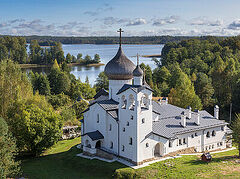
 Ferapontov-White Lake Monastery. ferapontov-monastyr.ru
The monastery was founded in the fourteenth century by St. Ferapont of White Lake, a wonderworker and spiritual friend of St. Cyril of White Lake. The latter heard a voice during prayer telling him that he should go to White Lake and establish a monastery there (now known as St. Cyril of White Lake Monastery). He took with him his co-struggler, Monk Ferapont, who soon left to labor in reclusion a bit farther away, about twelve miles from the city of Kirillov. At first, he lived alone in a wooden cell he had built. Over time, several people gathered around the God-loving monk, wanting to share in his ascetic labors. Thus was founded Ferapontov Monastery. St. Ferapont performed the most difficult physical labor together with the brethren, having humbly refused to become abbot of the monastery.
In 1408, the first wooden church was built there in honor of the Nativity of the Most Holy Theotokos. Soon, by the will of God, the saint left the monastery and St. Martinian became the abbot, completing its establishment. He was a disciple of Elder Cyril of White Lake and a humble and righteous man who led a very strict lifestyle. Under him, the monastery was put in good order and gained renown, and the number of brothers multiplied. The abbot enjoyed the love and respect of both the brethren and the simple faithful. He spent seventy years in monasticism. Later, St. Martinian’s relics were found incorrupt, and they continue to work miracles to this day.
After some time, Archbishop Joasaph (Obolensky), a novice of St. Martinian, became the abbot of the monastery. After a fire in 1490, he built the stone Cathedral of the Nativity of the Theotokos and invited the iconographer Dionisy to paint it (he worked there with his sons from 1501–1503). Unique frescoes cover several hundred square meters of the inside of the church and nearly all of them have survived to this day. The frescoes were painted on damp plaster using crushed colored minerals. Dionisy depicted Christ Pantocrator with the Archangels Michael and Gabriel and the Holy Forefathers, the Evangelists, the Mother of God, St. John the Baptist, and St. Nicholas. Around the perimeter of the cathedral was a pictorial interpretation of the Akathist to the Mother of God with compositions of the Praises, the Holy Protection, and the Synaxis of the Theotokos. He also adorned St. Martinian’s tomb. Contemplating Dionisy’s frescoes inspires viewers to reflect upon their own moral improvement.
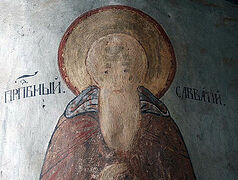
 Sts. Ferapont and Martinian of White Lake Among Dionisy’s contemporaries and the inhabitants of Ferapontov Monastery of the sixteenth century, one notable figure was Elder Varlaam the Scribe, who possessed excellent penmanship and skill in creating printed miniatures. According to some researchers, he may have assisted Dionisy in his fresco work. At that time, the monastery not only created and copied books, but also gathered a library of ancient manuscripts. Another of the iconographer’s contemporaries who labored at Ferapontov Monastery was the well-known Church figure of that time Metropolitan Spyridon, who wrote the theological work, Exposition of Our True Orthodox Faith. Blessed Galaktion the Fool-for-Christ also lived at the monastery.
In the sixteenth century, the monastery flourished, with its lands expanding thanks to Moscow princes. In 1530, Vasily III donated to the monastery for the birth of his son, for which he had prayed there. With these funds, a church was built there in honor of the Annunciation of the Most Holy Theotokos with a refectory. Later, Tsar Ivan the Terrible visited the monastery several times, bestowing liturgical vessels, lands, and money upon it, and sending large donations for the remembrance of the souls of those who had fallen into disfavor and were slain by him.
Over the course of the next two centuries, however, Ferapontov Monastery suffered disasters due to fires and lootings by Polish-Lithuanian bandits. For ten years in the second half of the seventeenth century, the deposed Patriarch Nikon served his exile at the monastery, enduring oppression, insults, and hardship throughout those years. The windows of his cell were barred, strict guards allowed no one to visit him, and he was forbidden to communicate with the monastery brethren. The prisoner tried to ease the burden his presence caused the monks by catching fish for them and helping to care for the elders who lived there.
He wrote to the Tsar:
I’ve been cast away to Ferapontov Monastery for six years now and confined to my cell for four. Now I’m sick and barefoot, and I haven’t been able to wear a cross for three years. I’m ashamed to even step into another cell... My hands are ailing... My legs are swollen, so I can’t keep the rule of prayer. There’s only one priest, and he’s blind—he says he can’t see the books. The guards won’t let me buy or sell anything, no one comes to see me, and there’s no one to ask for alms.
Under such conditions, he developed the gift of healing. Dozens of people would gather outside the door of his cell, until the elderly and sick prisoner was transferred to confinement in the St. Cyril of White Lake Monastery.
With Patriarch Nikon’s transfer, the royal personages paid less attention to the monastery and donations dried up. The buildings needed repairs and the large brotherhood needed sustenance. Over time, the monastery became completely impoverished and fell into disrepair, despite the abbot’s attempts to repair the churches and chambers. In the mid-eighteenth century, Hieromartyr Arseny (Matseyevich), Metropolitan of Rostov, languished within the monastery walls.1
In 1798, after 400 years of existence, the monastery was abolished and turned into a parish. The brotherhood was separated from the abbot and transferred to another monastery, the ancient churches were transferred to the parish, and other buildings were taken over by the state. In the second half of the eighteenth century not only the Ferapontov Monastery but many others were closed by Catherine II’s decree “On State-Funded and Non-State-Funded Monasteries,” which undermined the spiritual life of the Russian people.
The nineteenth century brought the parish period in the life of the monastery. Notable rectors of this period include Frs. Arseny and Pavel Razumovsky. The parish was classified as rural, and under these conditions Fr. Arseny tried to preserve the church buildings.2 Special permission had to be given to raise funds for repairs. He managed to erect a stone wall around the monastery and renovate the Church of the Annunciation. Fr. Arseny compiled an inventory of the property of the abolished monastery, where St. Martinian’s sticharion and staff and manuscript lives of the founders of the monastery were still preserved. During his time, the monastery was often visited by pilgrims, whom he spoke to about its centuries-old history. He also compiled new descriptions of the monastery.
 Fresco by Dionisy in Ferapontov Monastery’s Cathedral of the Nativity of the Theotokos In particular, A. N. Muraviev wrote in 1855:
The wild nature began to come to life the closer we got to Ferapontov… The sunny May day enhanced the local beauty; the historic monastery of Patriarch Nikon appeared from a distance in full splendor, as if not yet abolished, with its tent-shaped domes in the form of pointed towers, which gave it an appearance more Gothic than Byzantine. Its exterior is so majestic and its location so picturesque that you can’t help but regret its desolation, for this place seems as if purposely created for a monastery.
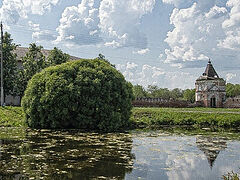
The hills, groves, and fields had such a cheerful and pleasant appearance that the eyes and heart couldn’t help but rejoice—such was the first impression of Ferapontov Monastery. But then it turns very sad when, having passed through the gates, you see the inner desolation of the former monastery, the ruined cells and wall, and the courtyard, overgrown with weeds, with trampled graves, and the pile of stones where there was once a dwelling… The most picturesque view opened up ... onto the blue depths of the waters, in the midst of which Nikon, with his brethren in his cell, had constructed a small island from enormous stones, as the base for a remarkable cross. On this cross he wrote the accusatory inscription that got him an even stricter confinement in St. Cyril of White Lake Monastery: “Nikon, by God’s mercy the humble Patriarch, erected this cross during his imprisonment in Ferapontov Monastery for the word of God and for the holy Church…”
The bell tower, which stands over the narthex in the armor of its scale-patterned pyramidal spire, is adorned with clocks, but their chimes have long ceased to mark the time in the abolished monastery. Now time is told differently, not by the measure of hours, but by the melancholy spectacle of ruins. Through the gaping gates beneath the bell tower, the scattered monuments of the former monastic cemetery bitterly call to mind the passage of time; there’s no need for any chiming clocks anymore: The final hour has tolled for the monastery!
But the historian was wrong: It wasn’t the last hour of the monastery’s existence.
In 1898, Fr. Pavel Razumovsky organized a celebration in honor of the 500th anniversary of its founding. The Church of St. Martinian was renovated for this event and a procession was held with many believers taking part. All this attracted the hierarchy’s attention to restore the monastery. Mother Taisia (Solopov), abbess of Leushino Monastery, played a large role in this. In 1900, she shared with one of her correspondents: “A strong desire has been kindled in me to restore this ancient holy monastery, transforming it, of course, into a convent.” A decree of the Holy Synod from 1903 stated: “To restore the ancient, abolished men’s Ferapontov Monastery, turning it into a convent, and entrust the work of restoring it to Abbess Taisia of Leushino.” Receiving a blessing from her spiritual father, St. John of Kronstadt, she began to fulfill the obedience entrusted to her.
Thanks to Mother Taisia, Ferapontov Monastery received its first sisters, who initially lived in quite cramped and cold conditions. As she recalls: “There was nowhere to place these newcomers—the first sisters of Ferapontov Monastery! There wasn’t a single room that was suitable for living!... They had to endure the entire first half of the winter of 1904 in extremely cramped conditions and hardships of all kinds.”
 Abbess Taisia (Solopova) Fr. John of Kronstadt wrote to Abbess Taisia:
I congratulate you with the start of the restoration of Ferapontov Monastery. You’ll have much to grieve and labor over in this matter. But the Lord will help you—and He’ll give you, great eldress, strength to restore the ancient monastery to the glory of God... I’m sending 300 rubles for the Ferapontov Monastery. Please don’t offend me with refusals or objections that I need it myself... I send my blessing to you in the name of the Lord... Your son and brother, Archpriest John Sergiev.
Gradually the monastery’s operations were established, the number of sisters grew, and they began performing monastic tonsures there. St. John especially rejoiced in the new tonsures. Together with Mother Taisia, he regularly visited and served at Ferapontov. By 1906, there were several dozen Leushino sisters who had voluntarily transferred there. In 1904, the treasurer of Leushino Monastery, the future Nun-Martyr Seraphima (Sulimova), was appointed abbess. She was distinguished by her love of neighbor, discernment, and compassion for the surrounding population. In 1909, she opened a Church school for peasant girls at the monastery. In October 1913, they celebrated the 400th anniversary of the uncovering of the relics of St. Martinian. The service was solemn, and the last of its kind in the newly opened monastery.
By 1917, Ferapontov was in its heyday. The nuns had built living quarters and a guest house and various charitable activities were developed. They served daily and sang properly. But by the next year, the number of sisters was already decreasing. Famine set in and the sisters lost their spiritual guidance in the persons of two priests who used to take turns serving there. One of them died and the other, Fr. John Ivanov, a future hieromartyr, was arrested. The monastery parishioners tried to intercede for him, but in vain. He was shot in September 1918. Then Mother Seraphima was also arrested and shot. Hieromartyr Barsanuphius (Lebedev), Bishop of Kiillov, was shot with her. All three were later glorified in the Synaxis of the New Martyrs and Confessors of Russia.
 A procession around the walls of Ferapontov Monastery, early 20th C.
The monastery was closed in 1924 and the nuns were dispersed. It’s known that one of the sisters, Nun Anna, was tortured by the authorities. A club, a warehouse, and a school were set up on monastery grounds. Several buildings were given to the Leningrad Museum of Social Reconstruction of Agriculture. However, the faithful continued to go there to pray, pretending to be scientists. Services were held in the Church of St. Martinian until the mid-1930s. The monastery’s property was seized, including ten bells that were sent to be melted down.
From the 1930s to 1960s, the Cathedral of the Nativity of the Theotokos was closed and preserved. In the twentieth century, members of the intelligentsia managed to establish the Museum of Dionisy’s Frescoes on monastery grounds.
In 1989, the Ferapontov parish was opened. A former monastery resident, the 100-year-old Novice Alexandra, lived to see its opening. When they celebrated the first service, she asked, “Why not sing the troparion to St. Martinian? His relics are here. He’s the master of the monastery. You have to sing it.” A year later, the parish was given the Theophany gate church for services. At present, the rest of the monastery’s churches remain state-owned. The Ferapontov Monastery Episcopal Dependency Orthodox religious organization is registered on the territory of the monastery.
There are currently no services in the Nativity of the Theotokos Cathedral, with its Dionysian frescoes. However, the faithful haven’t given up hope for the restoration of a full-fledged monastic life within the ancient monastery walls.