The world-famous city of Bethlehem is located on two hills six miles south of Jerusalem. The name “Bethlehem” means “House of bread” in Hebrew. It became the birthplace of the “Bread of Life”—our Lord Jesus Christ.
 Photo: Foxnews.com
People from all over the world flock to this city to see firsthand the place where the great mystery of the Incarnation of God among people took place. It is not very easy to get there now as its territory belongs to the Arabs.
It was dark when we reached the “border”, which the driver categorically refused to cross. And we unloaded our belongings—backpacks, sleeping bags, wheelchairs—and then proceeded on foot.
A small star, alone in the cloudy sky, accompanied us, and we symbolically named it the “star of Bethlehem”. Once it had hidden behind a cloud, with the blessing of Fr. Igor, our group stopped to rest. After a short break, we went after the newly appeared star again. It got noticeably colder. “If only it doesn’t start raining!” we thought. We had left all our warm clothes and tents at the Gorny Convent. We walked fast. As it turned out later, we had taken a roundabout way, skirting Bethlehem from the east, but we would have shortened the path had we walked straight ahead. Obviously, it was needed in our case.
The city stands on hills, so there are frequent ascents and descents. It seems you haven’t the strength to walk, you fear falling behind the group, your legs are stony, and your bags drag you down. I saw that Irina, our doctor—a thin and fragile woman with a luggage on her shoulders—was no longer able to push the wheelchair with Oleg uphill. Oleg was a psychologist and just a cheerful guy, the soul of our little company. I automatically grasped the wheelchair, and we continued climbing. Imagine my surprise when, at the top of the hill, after rolling the wheelchair, I suddenly felt an extraordinary lightness in my legs!
Narrow side-streets, turns, the last descent, and here it is—the Church of the Nativity of Christ. A dark magnificent edifice…
It was very late. We settled for the night right on stone slabs. Due to fatigue, we could hardly understand where we were: we just threw down our bags, sleeping bags and crashed out on the move. A young Arab named Usam, who had accompanied us the last few yards to the church, brought us some juice and sweets to console us. We jokingly called him the “Good Samaritan”. Offering his small apartment for the night, he did not understand our insistence on sleeping beside the walls of the church.
 The Church of the Nativity in Bethlehem. Photo: Pac.ru
We would later regret our refusal. When some of us were asleep, a police squad arrived. “Either to a hotel or beyond the Arab territory!” we heard. What should we do? Neither persuasion nor explanations had any effect on the policemen. We were even ready to go back to the Jewish land, so amicable and hospitable to us, but some of the pilgrims, who had been pulled out of a deep sleep, were too tired to even figure out where we were and what was going on around us, where to go and why. The wind was cold, there was only stone around, and the police were behind us.
Like lost souls, we barely managed to shuffle our feet through nighttime Bethlehem, remembering that the Holy Family had nowhere to lay their heads either.
Part of our group had to be accommodated at a hotel for a rather impressive sum. The owner kindly left the group that was ready to go back across the border to spend the night in the lobby on the ground floor.
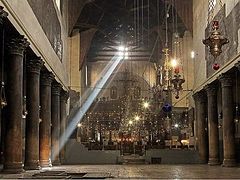
In the morning we entered the sunlit Church of the Nativity of Christ, which appeared before us in all its glory. Built of huge white-gray slabs, solemnly mysterious and mighty, it seemed to be hewn out of a rock. Here it is—the famous “Door of Humility”. Once the door here was large and wooden. But when Palestine was under Saracen rule, one day soldiers broke into the church on horseback, disdaining the Christians’ holy site. Bees flew out of two marble columns, four rows of which stand aside the church, and started stinging the blasphemers. There were so many bees! Panic-stricken, the Saracens could not understand what was happening. So the Muslims fled. There are still holes—in the shape of a cross—from which the tiny warriors flew out. And after the incident, the huge door was reduced to such a size that now everyone must bend down and bow from the waist in order to enter.
According to tradition, this is the only early church in Palestine that was not destroyed during the Persian invasion because of an image of the Magi on the wall of the basilica. The Church of the Nativity of Christ was built in 323 A.D. by Empress Helena Equal-to-the-Apostles. According to tradition, the house of Jesse, King David’s father, used to stand on this site. It was here, in this city, that the future king was born. And Joseph also went up from Galilee, out of the city of Nazareth, into Judaea, unto the city of David, which is called Bethlehem; (because he was of the house and lineage of David:) To be taxed with Mary his espoused wife, being great with child. And so it was, that, while they were there, the days were accomplished that she should be delivered (Lk. 2:4–6).
Recalling the history of the church, after reading the Gospel aloud—which Fr. Igor did at every holy place described in the Old and New Testaments—we walked around the basilica, venerated the icons and asked… each making his own request. The wonderworking Bethlehem Icon of the Mother of God, the renewing image of the Savior on a column, which has been weeping since November 1996... Our reflections were interrupted by a Greek who appeared from the Grotto of the Nativity. He addressed us with a slight accent:
“Are you Russians?”
“Yes, we are,” Fr. Igor replied.
“Come in, the service has begun,” the invitation followed.
 The Bethlehem Icon of the Mother of God
That’s how we unexpectedly found ourselves at a Greek Orthodox service. It was like a reward for all our wanderings and experiences of the previous night.
After the Liturgy, antidoron was distributed. While in the holiest part of the church—in the Holy Grotto of the Nativity—we were finally able to venerate the Silver Star, the exact spot where the Lord was born. There is an altar above it, at which the Liturgy is celebrated. According to tradition, a few steps from here there used to be the manger in which the Newborn Infant was laid. We didn’t want to leave, but we were being hurried—the Catholics were preparing for their service.
We got upstairs and went outside into the courtyard through the side door of the church. A sad sight awaited us…
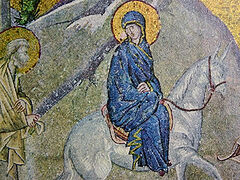
Adjacent to the Grotto of the Nativity is an underground gallery with many caves—Joseph’s Cave, where the righteous man was commanded by an angel to flee with the Holy Family to Egypt—and behind it is the cave where many of the babies killed by Herod are buried. If in the Grotto of the Nativity all of us were silent from awe and joy, then here we wanted to cry from anguish and sadness…
Then was fulfilled that which was spoken by Jeremiah the prophet, saying, In Rama was there a voice heard, lamentation, and weeping, and great mourning, Rachel weeping for her children, and would not be comforted, because they are not (Mt. 2:17-18).
The following caught my eye: not only the remains of babies, but also of adults were before us! Apparently, the warrior’s hand did not spare anyone—neither the babies, nor their mothers, who had covered their children with themselves.
What did each of us think about when looking at the remains of the first martyrs for Christ? Unbaptized murdered babies have become the prototype of victims of the most terrible crimes in the history of mankind—those killed in the wombs by the will of the mothers themselves. But today’s Rachel does not lament…
So, in the great Church of the Nativity of Christ, as in the life of every human being, happiness and grief, joy and sorrow, devout prayer and the bitterness of repentance, birth and death, the exultation of life and the horror of losses met. God, be merciful to us, sinners!