Many mixed Russian-American families in the US have a very special blessing: celebrating Christmas twice. On December 25, people usually visit their relatives, and then attend services in the church on January 7. Elena and Heath Cherneski are members of two parishes in Washington, DC—St. John the Baptist Cathedral of the Russian Church Abroad (ROCOR) and St. Nicholas Cathedral of the Orthodox Church in America (OCA). They shared their own traditions of celebrating Christmas twice.
 Heath and Elena in the Holy Land
—Russian Orthodox people in America have a tradition of celebrating Christmas twice a year. Is this a blessing for you?
Elena: Of course, absolutely.
Heath: It extends the Christmas season in a wonderful way. We still end up doing something on Western Christmas on the 25th of December, mostly because we have traveled most of the time that we’re together.
We have been traveling over that holiday, and it is a good opportunity to do something because most of the places we travel have some Christmas activity going on. So, we celebrate while we’re traveling and then when we come back home, we celebrate Christmas again in January. I think it’s a wonderful way to extend the holiday season.
—I have heard from many Russian-American families that they usually come to their American relatives on December 25th, and go to the church on January 7. Is this your story as well? Do you do the same thing?
Elena: We do. Christmas time is a mandatory winter break for us. Sometimes I visit a Protestant family and go to their church. So yes, we do both—visit relatives and friends, and travel…
—What travelling traditions do you have on Christmas?
Heath: For the last two holidays, we went skiing.
Elena: We went to the Holy Land and London, and went skiing last year. This year, we plan to go to Yellowstone.
—You were in the Holy Land for Christmas?
Elena: Yes, We were in Bethlehem for Western Christmas, December 24th and 25th. It was a big celebration there, really amazing. It felt very special.
Heath: It was really special to visit friends in Ramallah and to be in Bethlehem at that time. Christians and Muslims were both celebrating on December 25th, and we were singing there. It was just remarkable to see so many different people celebrating the Birth of Christ together. We had a unique experience that I don’t think I’ve ever come close to before. And I don’t have words to describe how special it was. It was just really, really wonderful.
 Photo: foma.ru
Elena: We were there with our friends. We hired a guide, and she showed us around the city. We went to the Church of the Nativity, where Christ was born. There is the Star there, and we venerated it. It was amazing.
The next morning there was a liturgy served by Russian monks, and we went.
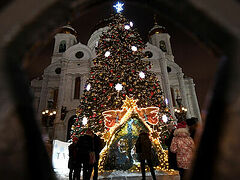
The whole town was celebrating on December 25th. There was a huge Christmas tree on the square in front of the cathedral.
—That’s wonderful. And how do you usually spend January 7?
Heath: We go to church, and then we have a family meal and exchange presents.
Elena: I usually take either a vacation day or say it’s Russian Christmas, and I take a day off work to go to church. And then, we do something together with the family.
—You are not ordinary parishioners. Both of you are singers in the choir. What do you feel when singing Christmas hymns?
 Heath and Elena in the Holy Land Elena: I feel amazing, because this is a very special feast for Orthodox Christians. And I feel honored that I can actually read those words from Scripture about Christ’s Birth, about the Mother of God, about the shepherds.
And now it’s double special, because we were in the Holy Land at Christmas. We’ve been where Christ was born. We’ve been where the shepherds were.
It’s amazing to read those words now—they bring back memories from that trip. It feels like we were there just yesterday.
After the service, we continue celebrating at home. We really love singing. Many of our friends are singers, and we sing carols together. We were singing even in the Holy Land, and people joined in, clapping along. They were from all over the world.
So, singing carols is a big, important part of how we celebrate Christmas.
—Heath, you converted to Orthodoxy a few years ago. How would you compare your feelings of Christmas before becoming an Orthodox Christian, and now?
Heath: For me, the Christmas celebration is not because I celebrated as a Protestant before. Our family celebrated Christmas quite a bit, and it was a very important day, but it wasn’t because of the commercialism. It is the birth of Christ. So, I would say that, in general, holy days and feast days, especially Christmas and Pascha, feel more vivid.
It is simply much deeper and much richer now. I would describe it as a beautiful picture that once existed in black and white but is now infused with color. For me, the difference is not so much in Christmas, because Christmas was always a very special day, centered on time spent in church and the reading of Scripture. That remains the same in the Orthodox tradition. The greater difference, for me, is the Paschal celebration. I much prefer the depth of the liturgy during the major holy days.
So, I would say that the difference between Protestant Christmas and Orthodox Christmas is not especially large. Still, it is more colorful and, I think, a little more spiritual now that I am an Orthodox Christian.
—Elena, do you think that’s true?
Elena: Absolutely. That’s one of the reasons that I very much liked Heath from the first day that we met. He said that he’s very spiritual and he takes Christianity very seriously. And he’s looking actively for God and wants to be with God.
He always said he likes Orthodoxy. It’s like a black and white picture became a colorful because we have saints, icons, and relics. That’s one of the bonding values among us.
—You attend services in two churches in Washington: St. Nicholas in the OCA and ROCOR’s St. John the Baptist. The OCA uses the Western calendar, while ROCOR observes the old calendar. I have always wondered how it’s possible to celebrate Orthodox Christmas officially twice?
Elena: We like celebrating (smiles). St. Nicholas does it twice also because of Russian parishioners. They also have a Vigil on January 6 and a Liturgy on January 7. So, yes, we have a choice, and we like to celebrate everywhere.
—Can you share what Christmas means to you?
Elena: I was listening to a sermon many years ago, and it really resonated in my heart. The priest was saying, What’s the purpose of God being born 2,000 years ago if He did not get born in my heart today? The meaning of this holiday is that we honor God and His journey and His being here on earth.
It’s the beginning of His life, the Incarnation of God in our world, where we, sinful people, live.
For me, Christmas is about honoring Christ and making space for Him in my heart, so that He is born in me.
—Heath, what about you?
Heath: In my family, we focused very much on spending time in church on December 24th.
I guess Christmas is a very humbling time for me. It makes me feel very special that God gave His Son to us. So for me, it’s always been a very special moment of reflection, and not just since I’ve converted to Orthodoxy. And the feelings I have are mostly centered around humility, that a God Who created the entire universe would give His Son for us.