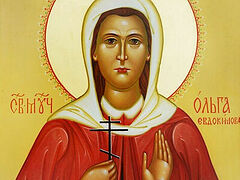
Eugenia Petrovna Domozhirova. The Tver Prison. 1932. Fond.ru How did I choose to write about the holy New Martyr for the next month? For me, this is sometimes a very simple question (I confess: there are my favorites among the saints), and sometimes extremely difficult: the Lives are short, there are no photographs, and it is hard to popularize. In general, it always happens in different ways. Sometimes the photo catches my eye. I look at the saint’s face, and am strongly attracted to it.
Thus a photograph played a special role in the case of the New Martyr Eugenia Domozhirova. Eugenia Petrovna bears a striking resemblance to my aunt—my father’s sister. And she, in turn, is the spitting image of her mother—my grandmother. The similarity is all the more surprising because there are no blood ties between my father’s lineage and the Domozhirovs’. It’s just the way the Lord arranged it. Every time I look at the photo of New Martyr Eugenia I remember my aunt and my unforgettable grandmother.
Zhenechka1 was a general’s daughter. She was born in Riga in 1871. She studied at the Institute for Noble Maidens in Warsaw. It is known that such educational institutions cared not only about the good manners and high level of knowledge of their students, who were all from noble families (having risen to the rank of general, Pyotr Domozhirov automatically received the right to a noble title). The necessary household skills were also instilled: the ability to take care of oneself and to be content with little.
But the most important element in the education of girls was the spiritual. The institutes for noble maidens of the Russian Empire they were able to instill faith and love for the Lord in their students. It was the inviolable foundation of life on which the future destinies of many, many graduates were based. Here it would be appropriate to recall the holy New Martyrs Princess Kira Obolenskaya and Catherine Arskaya. These two women showed such an example of steadfastness in faith and faithfulness to Christ, even to death, that it can well be cited as lessons of courage in schools. Both graduated from institutes for noble maidens: Princess Kira from Smolny, and Catherine Andreyevna from Alexandrovsky, which was equal in status to the former.
In addition, St. Eugenia took courses at a Red Cross School. Her biography does not reveal to us why she chose the path of a nurse. But her Life states that the girl was in poor health from birth. Very often pious souls chose as their vocation the area in which they themselves endured suffering.
 Nurses and the wounded in a ward of the hospital of the Community of the Protecting Veil of the Theotokos. Petrograd. 1914–1916. Photo studio named after Karl Bulla
One more important detail: In her youth, the maiden took a vow of chastity. That’s how wisely and subtly she understood Divine Providence, which did not endow her with good health. She devoted her whole life to the Lord, to His service. She loved God with all her heart; Christ was the center of her worldview and her life.
At the age of twenty-five, St. Eugenia began working at a military hospital in Warsaw. Then she worked at the Alexandro-Mariinsky Institute,2 where she went from being a nurse to being the head of a hospital.
Eleven years later, when she was thirty-six, Eugenia Petrovna came to Moscow. She got a job as a nurse at the Moscow Institute of Nobility. To move at a mature age to another part of the empire, with a demotion… Which of my contemporaries would understand such a step? Note that she did not move from the backwoods to the capital. Riga, where Eugenia Petrovna was born, was the capital of Livonia, which had de facto autonomy and highly developed industry; Warsaw, where the future martyr worked, was the capital of Poland, which was then part of the Russian Empire. At that time Moscow was the second largest city in the empire. It was 1907.
I want to digress a little here. Eugenia Petrovna did not know what would happen next, but we know that ten years later a catastrophe would be unleashed, the Russian Empire would fall, burying under its rubble all the bonds and foundations that had been formed in our land for centuries. And this disaster would directly affect Eugenia Domozhirova, because she was living in Central Russia at this time. But if she had stayed in Warsaw, everything could have been different. After all, according to the Brest Treaty, signed on March 3, 1918 (I will not discuss the disappointing results of the First World War for our fatherland), Soviet Russia renounced any claims to Polish territories, and in October of the same year Poland was proclaimed an independent state. As such, there were no persecutions of the Orthodox faith there. However, there is one circumstance: Poland has always been a Catholic country. Orthodoxy began to spread in these lands only after they had become part of the Russian Empire in 1832. And the missionary activity of the Orthodox Church did not begin there at once. And it was not very successful: Orthodoxy was embraced mainly by poor segments of the population, impoverished peasants, while wealthy Poles belonged to thriving Catholic communities and were not going to abandon them. And with the separation from Russia, demands for restitution began in Poland—the destruction or transfer of property of the Polish Orthodox Church to the ownership of the Roman Catholic Church or local authorities. Many Orthodox shrines were looted or demolished. Now, only in photographs can you see St. Alexander Nevsky Cathedral and the Church of the Archangel Michael, which were destroyed in Warsaw.
 St. Alexander Nevsky Cathedral (Warsaw)
It is hard to say what Eugenia Petrovna’s destiny would have been had she stayed in Warsaw. One thing is obvious: the Lord brought her to the place where the power of her faith could shine with a great radiance, and He called her to martyrdom as His beloved child.
Let’s go back a bit. After working at the Moscow Institute of Nobility for five years, Eugenia Petrovna had to quit her job for health reasons. Two years later, she returned to her service; the First World War had broken out, and the motherland needed help. She worked as a nurse on the Western Front, in Polotsk, until the disastrous year 1917. The revolutionary upheaval completely weakened her health, poor as it was, and Eugenia Petrovna gave up her service and went to live with her sister in the city of Tver. She very often attended church services, and was well acquainted with the clergy of Tver and the faithful children of the Orthodox Church who were pastored in the land of Tver. Specifically, she was close to Archpriest Alexei Benemansky (a new hieromartyr; commemorated: December 5).
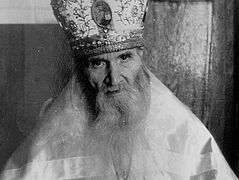
 Archpriest Alexei Benemansky, 1922. Pravicon.ru In 1932, a wave of arrests took place in the Diocese of Tver—clergymen and laypeople were seized. On March 15, Eugenia Petrovna was arrested. It was a group case, and Fr. Alexei Benemansky did not escape it either. All were charged with “anti-State activities”. Eugenia Petrovna pleaded not guilty. On July 9, 1932, the special OGPU3 “troika” (a quasi-judicial committee of three officials) sentenced her to three years exile in Kazakhstan. In essence, this meant that Eugenia Domozhirova was to move from Tver to Kazakhstan and live the ordinary life of an ordinary person for three years. But there was a postscript in the sentence—all those exiled had to follow the order of exile in stages—that is, as prisoners, passing through the first “stage” of stops in prisons, with terrible, unsanitary conditions. In other articles I had already written about this monstrous mechanism of the violation of human dignity, and here I will quote an excerpt from my material on the New Hieromartyr Alexei Benemansky:
“The cynicism of the authorities was in the fact that the court’s verdict was to transfer the convict to the place of exile as a prisoner. This meant passing in stages through all the prisons of the south, through all the unbearable transfers of exile on foot. From the Lives of the New Martyrs enough is known about these ‘stages’ and transfers on foot. At first, people were loaded like cattle into freight cars, often so overcrowded that they could only stand. It lasted for days without food or water. On arriving at the destination, some of the prisoners remained in these cars: they were dead. Transfer of exiles on foot was a separate torture. Emaciated from hunger and thirst, people were driven in ‘stages’ on foot for many miles a day. Those who fell exhausted were forced up with the blows of rifle butts. Those who had no strength to rise were beaten to death. The others went on, while the bodies of the sufferers were torn to pieces by wild animals… Fr. Alexei survived.”
But Eugenia Petrovna didn’t manage. She reached Kazakhstan, but she just didn’t have the strength and health for more. The Lord took her to His Heavenly abodes from the Alma-Ata Prison on the eve of the feast of Holy Theophany—January 18, 1933.