Photo: Telegram God is with us! He is! And He ever shall be!
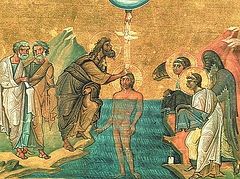
Today we stand on the banks of the Jordan—not only in remembrance, but in the very reality of our spiritual life. We celebrate Theophany. And while our imagination paints majestic scenes—heaven opened, the dove, the voice of the Father—the Apostle Paul in today’s reading brings us back from the contemplation of heaven to our everyday earth. He utters words that are the key to understanding the feast: For the grace of God that bringeth salvation hath appeared to all men, teaching us (Titus 2:11).
We are often accustomed to perceiving grace as a kind of “cloud of comfort,” an invisible energy meant to solve our problems, calm our nerves, or magically set life right while we remain passive. But the Apostle speaks of something else. Grace is a teacher. If for years we stand in church, yet our heart remains cold and our habits unchanged, then we are not learning in this school. We have taken the “key” to the Kingdom of God, but are afraid even to put it into the lock, because beyond the door lies the labor of transformation. Grace does not cancel our effort; it makes our effort fruitful. God does not save us without us.
The Apostle Paul gives us three clear landmarks of what the manifested Christ teaches us. These are three pillars upon which the life of a person who has met God is built.
Chastity. This is not merely bodily purity. It is wholeness. In a world that tears us apart with news, anxieties, and other people’s opinions, chastity is the ability to preserve “the mind of Christ.” It is when our faith does not end at the threshold of the church, but continues to act in the office, in a family dispute, on social media. To be chaste today means to guard inner stillness and not allow the poison of hatred into one’s soul.
Righteousness. This is faithfulness to God in the small things, when no one is watching. It is easy to be “righteous” in rhetoric, denouncing the vices of the world. It is hard to be righteous when one must admit one’s wrong before a loved one, or act according to conscience where it is “unprofitable.” Grace teaches us to be Christians, not merely to be “right.”
Godliness. This is a living sense that God is here. It is the habit, in the midst of a workday, of asking oneself: “Lord, how does this action of mine, this word of mine, appear before Thy Face?” It is an honest standing before the Creator, without masks or fine phrases.
Let us attend to the Apostle’s words; he calls us to live this way “in this present world.” Not in an idealized past, not in an imagined future, not in the seclusion of a monastery, but here—in 2026—with all its informational noise, aggression, weariness, and uncertainty. It is precisely here, in this “present world,” that Christ enters the waters of the Jordan. He sanctifies not “ideal water,” but the water in which we live.
To renounce ungodliness means to stop bargaining with sin. We are masters at finding pious justifications for our passions. We call our cruelty “the defense of justice,” our indifference “peace of soul,” our conformism “humility.” But Theophany is a moment of truth. Grace has appeared in order to tear off these masks.
My dear ones! The feast of Theophany is a mirror. Christ enters the Jordan not because He needs purification, but because purification is what we need. He offers us not merely a rite, but a way of life. If we leave the church today without resolving to change at least one trait of our character, at least one habit of justifying our anger, then the feast has passed us by. May the grace that has appeared to the world today become for each of us not merely a beautiful memory, but a real power. May it teach us to be honest, to be whole, and—above all—to be loving, despite everything.
Happy Feast of the Theophany of the Lord!