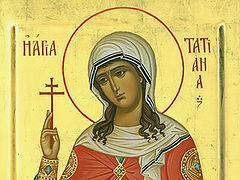
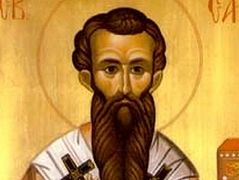
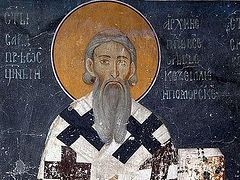
In honor of tomorrow’s feast days of both Martyr Tatiana and the great St. Sava of Serbia, we have translated this 2017 interview from Soyuz TV with Hieromonk Ignaty (Shestakov), a monk of Sretensky Monastery. Fr. Ignaty is fluent in the Serbian language, and a graduate from Moscow State University in Balkan Studies.
 Lomonosov Moscow State University. The so-called "Old Building" was built in 1793 and rebuilt in 1819.
—Today our guest is a monk of the Moscow Sretensky Stavropegial Monastery, editor of the Serbian language Pravoslavie.ru website, Hieromonk Ignaty (Shestakov). Fr. Ignaty, this is your first time with us, and we are very glad to welcome you. We are dedicating today’s program to our students, because tomorrow is Tatiana’s Day, which in our country is traditionally celebrated as Students’ Day. Tomorrow is also the feast day of St. Sava of Serbia. You are an expert in Serbian culture and the Serbian language, so it will be very interesting for us to hear about this saint specifically from you.
Our first question concerns how Students’ Day appeared in our country and why it is celebrated precisely on Tatiana’s Day, January 25.
—On Tatiana’s Day, Empress Elizabeth Petrovna signed the decree establishing Moscow University. Since then, the holy martyr Tatiana has been regarded as the patroness of our student body—first and foremost, of course, of Moscow University, where there is a house church dedicated to her. In Russian culture, this day became a day of students, which, naturally, took different forms over time, but in general it marks this period of student life and the labors of study. During the Soviet era, this tradition was practically lost for understandable reasons. But beginning in the 1990s and up to the present day, it has fully returned to the life of our society and of students, which is, of course, very heartening.
—You are a graduate of Moscow State University. What were your student years like? How did you celebrate this holiday?
—To be honest, I don’t recall that we celebrated Tatiana’s Day in any special way. Personally, my student years were already more mature, since I returned to the student desk after serving in the army. Nevertheless, I remember that—by God’s Providence, of course—we formed a group of believing young men. There were about eight of us; all of us were in a period of actively entering the Church and naturally we experienced strong temptations—on the one hand was student life, very full and usually rather turbulent, and on the other were our first steps in the Church. I remember that we supported one another greatly in this and went to the Church of St. Tatiana. I have several old companions from that time. Today they are priests and monastics. We met at the Church of St. Tatiana, but we also went to Sretensky Monastery while we were still students. Incidentally, these two communities were always very closely connected, because Fr. Vladimir Vigilyansky and Fr. Maxim Kozlov—who themselves were graduates of Moscow State University and served in that church—were always very close friends of the Sretensky Monastery and took a direct, fraternal part in its formation. These two communities grew stronger and developed almost in tandem.
—And they are located not far from each other.
—Yes, not far from one another; and some active parishioners of the Church of St. Tatiana later even joined the brotherhood of Sretensky Monastery.
That is how my student years passed. They were both a path of scholarly knowledge and study, and at the same time a path of getting to know God. All of this went on in parallel, and for me and my close friends, one was unthinkable without the other.
—What was your field of study?
—I graduated from the Department of History at Moscow State University and specialized in the History of Southern and Western Slavs. At that time we were called Yugoslavists, and the narrowest specialization was the Balkans—Serbia. We studied the language, history, source studies—the whole range of these disciplines—as well as economic geography. We studied the country’s history and language. By that point, apart from Church history and, indirectly, political history, little else interested me so deeply. All the more so because, until quite recently, Church history was poorly taught at our secular history faculties. That subject was taboo throughout the entire Soviet period; if any of its periods were known, it was mostly the Middle Ages. And that was precisely what interested me most of all. I wrote my diploma thesis on the history of the Serbian Church during the Second World War. It was very interesting, including for our professors, because for them as well it was in many ways a new subject.
When I had already entered the monastery, about six months later I was assigned to an obedience at the newly opened Pravoslavie.ru website, and my knowledge of the language once again proved helpful: we were translating current news. Thus, everything became interwoven into a single whole—Serbia, Moscow State University, and the holy martyr Tatiana.
—Did the study of Serbian culture and the history of the Serbian Church somehow help your spiritual formation?
—Without a doubt, yes. In the life of the Church and of Christian peoples in general there is an interesting phenomenon—by studying the life of other national Churches and other Orthodox peoples, by becoming acquainted with their culture and with the culture and history of the Church, we mutually enrich one another. From my own personal experience and from the experience of people with whom I communicate a great deal—both Russians and Serbs—I see that we, brothers within the great Orthodox family, cannot live without one another. This communion is very important. It is not merely informative ethnography, where we learn about some interesting customs and are touched by them, enjoy the songs, the costumes, or certain elements of worship… No, it is far deeper than that.
For example, consider the experience of certain aspects of the Russian Church: worship, or relationships within the parish, the monastery, church administration, the media—things to which we are accustomed as everyday realities and about which we even begin to feel a bit bored, sometimes saying that there is stagnation, that nothing new is happening. But when we encounter Bulgarians, Georgians, Serbs, Romanians, or other Orthodox peoples, we suddenly see that this experience of ours is in fact a very serious body of accumulated wealth. Even when you share some quite elementary things (for example, rules of document workflow), it is of great help to them. It often happens that what seems ordinary to us, what we are used to, is in reality the richness of our church life—our traditions, our prayers. For instance, our general attitude toward prayer in Russia. When you find yourself in a different environment, you realize that this is a very serious matter. Of course, at the same time you also learn from them. And this is extremely beneficial for our church life.
For example, it is useful for our clergy, monasticism, and episcopate to become acquainted with the life of their, so to speak, colleagues abroad and in other Local Churches. Then we begin to look at ourselves quite differently. We see certain of our own mistakes, or what we still need to develop. It happens that when we start some new undertaking, we do not show much enthusiasm for it; but then we see that for another Orthodox people, even a first acquaintance with this initiative greatly inspires them in their church life. And when we see this, we begin to develop our own initiatives and strive to bring them to completion.
Of course, we ourselves also acquire very rich experience from them. If, for example, we take what is personally closest to me—monastic life… In Russia it certainly has its own particular features. But when you learn how monks live on Mount Athos, in Serbia, in Romania (where there are such large monastic communities that when you see them, you simply cannot believe it), their relationships with one another, certain aspects of the typikon, prayer, and worship—this, of course, is of great help.
When documents of the Inter-Council Presence were being reviewed in our monastery, we discussed them very actively at the level of the brotherhood. The abbot constantly organized meetings, asked someone to prepare briefing notes, to discuss certain points. In our monastery, some brothers know Greek and studied in Greece, others know different languages, and this helped us greatly, because we were immediately able to gather the experience of the majority of the Local Churches on important or sensitive questions of church and monastic organization.
 Hieromonk Ignaty (Shestakov)
—Have you studied abroad?
—Not in the classical sense. I did not enroll in any faculties in order to study there for a long period of time. But in a practical sense—yes, because I had to work a great deal with Serbian church historians, and not only church historians. This is because cooperation with the Orthodox Encyclopedia involves a great deal of such work. We took part in academic conferences, engaged in publishing activities, and translated films. Last year there was a very interesting experience: we translated the well-known film, The Second Baptism of Rus’, which was broadcast many times on numerous television channels, as well as a film about His Holiness Patriarch Kirill released for his 70th birthday. The author was Metropolitan Hilarion (Alfeyev). There were also films about the elders of the Pskov Caves Monastery, The Fall of Byzantium, and films about feast days. We specifically prepared subtitles for them. This work is very much in demand, because unfortunately it is very difficult for the Serbs themselves to produce television content at such a level. There are financial difficulties, few people to do the work, and the organization and administration are not the same; and perhaps there is not such strong support from the professional community. Therefore, our Russian assistance often comes at exactly the right moment. Both the Serbs and the Greeks, as well as other Orthodox peoples, perceive this as their own heritage. For them it is a great infusion of positive creative energy.
—So it turns out that the Sretensky Monastery, your website, and the monastery publishing house actively cooperate with national Churches?
—Yes, but not only them. The Department for External Church Relations helped us as well. Vladyka Hilarion [Alfeyev, now serving in Prague] gave his blessing for the translation of these films. We were given the texts—which is very important—as well as special copies. We also try to promote other good productions of this kind—simply because the Serbs themselves ask for it. The same situation exists in Bulgaria, Romania, and Greece; for them this is very important. Apparently, they feel that we cannot live without one another—and that is truly the case.
St. Sava, enlightener of Serbia
 St. Sava of Serbia —Tomorrow is the feast day of St. Sava of Serbia. This day, probably, is also a national holiday in Serbia, among other things, right? Please tell us more about this saint.
—First of all, it must be said that for the Serbs, St. Sava, the first archbishop, is in fact the founder of the independent Serbian Church. Before him it certainly already existed; the Serbs had been baptized. This process was not instantaneous, but stretched out over a period of time. But it was Sava who achieved the emergence of an independent Serbian Church, which bore different names—the Archbishopric of Peć and the Patriarchate of Peć—but that is not so important. The essence is that St. Sava laid the foundation of the independent Serbian Church and, in effect, created it.
Sava was the youngest son of the Serbian ruler Stefan Nemanja, who shortly before that had accomplished the task of politically uniting the Serbs. According to tradition, after becoming acquainted with a Russian monk Sava followed him to Mount Athos. There he took monastic vows and, many years later, returned to Serbia. Before that, his father came to him on Mount Athos and also received the monastic tonsure. They even lived together in a single cell. When his father—now venerated as St. Simeon the Myrrh-Gusher (also a greatly revered Serbian saint)—reposed, political turmoil began in Serbia because of rivalry among St. Sava’s brothers. Then Sava, together with his father’s relics, came to Serbia, remained there, reconciled the brothers, convened a church-national council, and afterward went to the Patriarch of Constantinople and obtained autocephaly—the independence of the Church. He made the first generation of his disciples bishops, founded dioceses, but most importantly, he was an enlightener of the Serbian people. For this reason, Serbian Orthodoxy in Serbia is often called svetosavlje—that is, “St. Sava-ism,” a particular form of Orthodoxy.
The veneration of St. Sava can be compared to the veneration of Sts. Cyril and Methodius. Just as for us the feast of Cyril and Methodius is the Day of Slavic Literature and Culture, so in Serbia the day of St. Sava is the day of students, of everyone who studies in schools. Special events are held in all schools. Throughout the country it is a festive day, when St. Sava is commemorated in a special way—but not only him. It is a day of enlightenment, a day of the book, a day of learning. Thus, in many respects it resonates with our own feast of the holy martyr Tatiana. It is interesting that in Serbia the feast of St. Sava is celebrated on the 27th rather than the 25th, while we celebrate St. Sava together with St. Tatiana—and I think this is not accidental either. This difference apparently arises because we commemorate the day of his repose, while the Serbs commemorate the day of his burial—but this is not a particularly essential point. So one can say that in Serbia this is a kind of day—if not exactly of the student—then of enlightenment and education, and above all of spiritual enlightenment and education. St. Sava is called the father of the nation, the father of Serbian culture. On this day special prayers and hymns are sung to him: “All of us Serbs, wherever we may live, are your children.” It is precisely the legacy of St. Sava that unites them; for them it is, in fact, their spiritual and national identity.
For example, in present-day Montenegro there is no such day, simply because the name of St. Sava is, so to speak, not in political favor. Yet it is interesting that the Serbian Church in Montenegro celebrates this day even more actively than the Serbs in the present-day Republic of Serbia. That is, if in Serbia it is just one day (the Church usually organizes events within a single day—poetry evenings, academic conferences, concerts), then in the dioceses of Montenegro it lasts no less than a week. This period is called the “Days of St. Sava,” and they are held in a very engaging way. Each day the bishop travels to some small town where a cultural program has been prepared; sometimes he serves there as well. This is called a “spiritual academy”—a gathering of people where a concert takes place with national performances, and poems are always read—poems which, in the Russian tradition, we would call spiritual verses, dedicated to St. Sava. Ninety percent of the participants are, of course, children. When preparation for the celebration begins, schools, for example, give assignments to draw a portrait of St. Sava or to write some kind of essay about him. Such interesting competitions are held.
Thus, for the Serbs this is both a day of national unity and of enlightenment. The relics of St. Sava have not survived—the Turks burned them during one of the Serbian uprisings. But St. Sava nevertheless remains invisibly present among the people. It is no coincidence that in Belgrade the construction of the largest church in Europe—the Church dedicated to St. Sava—is now nearing completion.
—Have you personally attended these celebrations?
—Yes, I have—specifically in Montenegro. Once Bishop Joanikije invited me, and it was very interesting. In every town people prepared for the feast and gave everything they could. In some places it was held in a community center, in others simply near the church or inside it; I even remember one occasion when it took place in a stadium that was filled with people. Of course, it is very important for them when guests come from Russia. Here we see what missionary power simple communion between us possesses. I have often noticed that Russians who have visited Serbia turn more strongly toward the faith when they see Serbian church life. They say: “Everything is so joyful with you, not so strict, and very loving.” This greatly draws people toward church life. And the Serbs, conversely, when they see our traditions and Russian church characteristics, also try to emulate them—in the good sense of the word—and make a certain effort within themselves. As is well known, there are no prophets in one’s own homeland. Something similar exists in Russia as well—we like to listen to foreigners—thinking that perhaps they will tell us something we need to know…
There is a positive aspect here of the Slavic soul, both Serbian and Russian. Impulses of church life coming from Russia have a very positive effect even on people who are not yet church-going. Out of love for Russia and Russian culture, they often become involved in church life. It is a remarkable phenomenon.
—The Serbian people are also considered long-suffering: They were under Turkish rule; they were constantly at war and endured hardships. Our destinies are somewhat similar. How did the Serbian people overcome these difficulties, including in the twentieth century?
—I think, first and foremost, through the purity of their morals. When I was last in Serbia visiting a friend who works in a church archive there, I came across a reprint edition of Khomyakov’s1 epistle to the Serbs. And in it Khomyakov says precisely this: “Preserve simplicity and purity of morals—this is the guarantee of both your national and your spiritual identity, and of your endurance through all these trials.”
The Serbs may not have been very “churched” people, because the church organism had in fact been destroyed. For five hundred years they lived in a situation where state and political power were in the hands of the enemy. This partly extended to the Church as well, because the independence of the Serbian Church was abolished; there were very many Phanariot bishops—Greeks—who were also incorporated into the state system of the Ottoman Empire, and therefore the ordinary Serbian people often regarded them with distrust. Church life connected with worship, processions, and monastic life endured great trials over a fairly long period of time. From approximately the seventeenth century until the end of the nineteenth, monasticism in general survived only with great difficulty. The form in which we imagine it—a monastery with at least fifteen or twenty brethren—practically did not exist in Serbia, and this went on for centuries. Incidentally, when after the Revolution there was a wave of emigration, Russian monks breathed new life into Serbian monasticism, especially women’s monasticism. The Serbs themselves say that women’s monastic life was saved by the Russian nuns who arrived. The tradition had been broken. In fact, where could one see it, how could one learn it, if in each Serbian monastery there lived only one or two people?
Yet the people themselves were extremely pious. First of all, the family was a small church—that is, people lived in a traditional way. Society was patriarchal; people were in constant labor and constant struggle, and thanks to this the people survived and preserved their culture. Until quite recently (and essentially even now) Serbia has been a people’s country. There is no aristocracy as such, because it was repeatedly cut off. Nevertheless, the Serbs preserved their own, even if simple, folk traditions (for example, the tradition of the krsna slava—a very short prayer rite—and others). And it was within this folk Christian culture that the Serbs held fast to their confession of faith. And it must be said that they emerged from that period with honor. I would dare to say that the communist period inflicted even greater damage on both the spiritual and physical health of the Serbian ethnos than five hundred years of Turkish yoke. Today the Serbs are a nation facing extinction.
—Is this connected with their division and wars, or with moral decay?
—It is clear that the collapse of the state, the loss of vast territories, and the sheer physical destruction of the people themselves and their culture dealt the Serbs a severe blow in the twentieth century. There were several such waves. But it seems to me that the greatest blow was internal decay—just as, in fact, happened with us as well. This includes abortions, problems of the family, and divorces, which are also a very acute issue for them. A large number of people do not enter into marriage. Of course, one can always find explanations for this—economic and political factors—but it is impossible to compare modern conditions with those of the seventeenth century; yet they survived then. Clearly, this is primarily connected with the fact that everything became permissible for man, and at the same time he drifted away from faith.
Nevertheless, among the Serbs both popular faith and a martyr Church have been preserved—and it must be said, this Church is very much alive. Young people are very actively coming to the Church.
 Hieromonk Ignaty (Shestakov)
—A return to their roots?
—A return to oneself and to one’s Father, the Savior. This is a distinctive feature of Serbian church life, in which the voice of the people is very important and significant, and this finds understanding within the church hierarchy as well. From the outside, it may look like a certain lack of order, but nevertheless there is a kind of evangelical truth in this. Apparently, in former centuries the Church was arranged precisely in this way: the people were very close to the hierarchy, to the clergy; to some extent they could even put them in their place, yet they were always ready to defend their Church. For five hundred years the Serbs, in essence, did just that, because there were five hundred years of constant uprisings. And yet during this time many monasteries were built and fresco painting developed.
—Including monastic life on Mount Athos: the Hilandar Monastery, which St. Sava restored.
—When he was on Athos with his father, they found this Greek monastery, which existed in a semi-ruined state and had been abandoned, and they bought it from the Greeks; they reached an agreement and signed charters transferring it to the Serbs. In effect, St. Sava restored it, and his father also labored ascetically there. To this day there is the famous vine, which is believed to have sprung from the grave of Simeon Nemanja when his relics were there. The fruit of this vine is given to men and women who have long been unable to conceive a child. They pray to St. Simeon, receive the fruit as a holy thing, and it truly helps.
 Hilandar Hilandar is, one might say, the Serbian embassy on Athos. The Serbs take great care of their monastery. Unfortunately, several years ago there was a very large fire there, and the monastery suffered greatly. Much was burned, but now it has largely been restored, and most importantly, there is a new brotherhood. Abbot Methodios is a relatively young man, originally from central Serbia. He regularly comes to Russia and has visited us at monastic conferences and at the Holy Trinity-St. Sergius Lavra.
Hilandar is a place of great importance for the Serbs. I have often spoken with church-going people, and as a rule they say that their first steps into church life were a semi-touristic trip to Hilandar. They did not yet understand anything about the Church, but they were told:
“Let’s go to Hilandar.”
“Why should we go there?”
“It’s ours—the Serbian place on Athos.”
“Ours? Let’s go!”
There they met the monks and attended services. Hilandar probably has even greater significance for Serbia than our St. Panteleimon Monastery on Mount Athos has for Russia. For the Serbs, Hilandar is like a serious spiritual clinic. And since they are a relatively small people, it is very important for them that they have their own monastery and cells on Mount Athos. But in general, Serbs also live in other Greek monasteries.
—As do Russians.
—Yes, like the Russians, and like the Romanians.
—In the summer I was at Hilandar; we met the monks there, and they treated us to hospitality—the famous Athonite hospitality. When we said that we were from Russia, they showed us a photograph with Putin, who had visited there when he was still prime minister. And Medvedev (when he was president) was also on Mount Athos. The Hilandar monks treat Russians with great love—we felt it ourselves.
—Here is a question: Yugoslavia was divided into Montenegro, Serbia, and Kosovo, which was recently lost. Please tell us about this division. Did the people themselves become divided, or did they remain a single whole? How did this process affect the Serbian people in general?
—It affected both the entire Serbian people and the Church, which once again found themselves in new conditions—essentially divided by state borders. The first royal state of Yugoslavia was founded at the end of the First World War. Then came the Second World War, and Yugoslavia gradually became the Socialist Federal Republic. In it, the Serbs lived together with other peoples of the former Yugoslavia—Croats, Slovenes, Albanians; in fact, there were many peoples there, including Hungarians and Slovaks. In Bosnia there were villages with Ukrainians and with Muslims. Everyone lived—albeit in different republics—within the borders of a single state. Nevertheless, if we speak about the Serbian Church (and the territory of the former Yugoslavia is its canonical territory), one way or another the Serbs were one of the state-forming peoples. First, they were the most numerous; second, the capital was in Belgrade, and so on. That is, they felt that they were in their own state.
Now, due to circumstances, all the former republics have broken apart into separate states, and in many of them the Serbs, together with their Church, suddenly found themselves as an ethnic minority. In general, this process of disintegration was very bloody—if we speak of Croatia, Bosnia and Herzegovina, and that same Kosovo, which at that time was part of Serbia. It was accompanied by the destruction of Orthodox culture. Enormous damage was inflicted—one could even say upon all of universal Orthodoxy—because this is the westernmost outpost of the Orthodox peoples’ settlement. Take, for example, the territory of Croatia… Serbs had lived there for five or six centuries and carried out economic activity there. Incidentally, at one time these dioceses were among the wealthiest. And all of this was destroyed in the course of military actions—methodically and deliberately. At times the damage was colossal; in Kosovo alone one hundred and fifty churches were destroyed, and in other places about three hundred. These are serious losses—people were deprived of church life and of their homes. They were displaced.
What is unique and interesting is that unified state power effectively disappeared, while the Church came to the fore and became—to use official language—the only social institution that united the Serbs across this entire territory; and it remains that way to this day. In fact, it is the one thing that still unites the Serbs in all the areas where they live. The ethnic picture has, of course, changed greatly: in some places they have become a minority, and in others they have been reduced almost to nothing. Church life there is also fading. Nevertheless, the Church is that single anchor which holds this people. After eighty years of existence as a single Church within the borders of one state, it suddenly found itself within the borders of six states, and in each of them the attitude toward the Church and Serbian Orthodoxy is different, depending on the surrounding context. In some places it is a Muslim environment, in others Catholic, in others a different language altogether—that is, a different ethnos, different people. Thus, the Church finds itself in a unique situation.
This is important to understand, because from Russia we often do not see this, and out of ignorance make some generalized assessments, like, if they are Serbs, then they must all live in Belgrade. In fact, the Serbs have a similar view of Russians. They may ask you something about Novosibirsk, where you may have never even been.
In essence, the Church unites the entire people and cares for them far more than the state authority of Serbia does. The Church also does this through the memory of St. Sava of Serbia, who unites them all. Today the Serbs are the children of St. Sava. Whoever they have always been, that is who they remain, regardless of which political parties they are divided into or where they live. But the Church exists in very difficult conditions. I think that if we look at the dioceses, about half of them are in a heterodox environment or were very badly affected by war. One has to labor a great deal under difficult circumstances.
On the other hand, this sobers the Serbs themselves. They understand that many losses are the result of their having turned away from God and from faith. For Yugoslav life—especially compared with the Soviet period in Russia—was rather sybaritic: more joyful, freer, and materially more prosperous.
—There was powerful industry there.
—Yes, but as we have already said, this had a negative effect on spiritual life. People surrendered themselves to material things and forgot about the spiritual. Inevitably, a kind of punishment occurs, which the Lord sends in order to sober people.
—May this be an example for us today. Thank you very much for today’s conversation. Unfortunately, our time has run out, but perhaps someday we will continue our discussion.
—Certainly. Thank you as well. On the day of St. Tatiana and St. Sava, I would like to wish our students that they do not forget what is most important—that they keep their hearts and souls in purity. Because, as one of our scholars once said, wisdom will not enter a soul and mind defiled by sin. Therefore, I wish everyone to preserve purity, sobriety, mindfulness, to preserve their physical beauty, and to labor in their studies and in the sciences.
Dear brothers and sisters, may the Lord bless you!