The life of this great ascetic of piety, Metropolitan Anatoly of Odessa, was amazingly eventful. It can be roughly divided into two stages: before the Revolution of 1917 and after it. In the first half, we see an extraordinary amount of academic research and work, theological degrees, pastoral work, and wise and firm rule of the dioceses he was appointed to; Vladyka was a great scholar, a historian and patrologist, an active pastor who was deeply concerned for the people of God and his fatherland. The second stage of his life was just as eventful, but it was marked by persecutions for the faith, stoic endurance of suffering, confession and martyrdom for Christ.
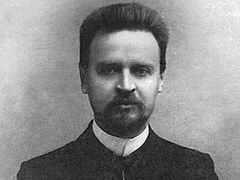
 Hieromartyr Anatoly (Grisyuk), Metropolitan of Odessa
Metropolitan Anatoly was a very active man, a great Orthodox scholar on a Churchwide scale, a thoughtful, strict and at the same time loving pastor who had fervent faith in God. Fr. Anatoly’s advanced scholarship was particularly surprising, given his non-priestly and non-professorial background.
The future hieromartyr was born into the family of an ordinary accountant of the district treasury in the town of Kremenets (the Volhyn province in what is now Ukraine) on August 19, 1880. He was baptized with the name Andrei.
His Life tells us that Andrei studied at the Kremenets Theological School, then at the Volhyn Theological Seminary, and then at the Kiev Theological Academy. It is a remarkable fact, since at that time only children of priests and deacons were admitted to theological schools. It was not easy to get into a theological school from another social class. Firstly, the training was expensive. Secondly, they did not admit “just anyone”, but looked at your family and pedigree. Thirdly, there was a large number of applicants for every seat. What conclusion can be drawn from all this about young Andrei? Even then, in 1890, the ten-year-old boy discerned the path he would choose in life. Theological schools were set up according to the institution’s charter, “for the primary education and preparation of children for the service of the Orthodox Church”, and therefore were “in a living and inseparable relation with seminaries”. At the age of fourteen, Andrei was absolutely confident in his decision and enrolled in theological seminary. And as a ten-year-old boy he was supported by his parents who took serious steps to enroll their son in a theological school and paid for his education for four years. I don’t think it was easy, especially since Andrei wasn’t the only child in the family.
Andrei was not mistaken in his choice. In 1903, at the age of almost twenty-three and thirteen days before his birthday, he was tonsured a monk at the Kiev Caves Lavra with the name Anatoly. Less than a year later, he became a hieromonk. In the same year, 1904, he graduated from the Academy. A year later, he was appointed acting associate professor at the Department of General Church History.
It should be noted that Fr. Anatoly was a polyglot, which helped him a lot in his academic work. He knew the main European and some Oriental languages and could read many historical sources in the original. He was highly appreciated by his contemporaries, scholars and bishops alike.
Archbishop Anthony (Khrapovitsky) wrote: “Hieromonk Anatoly is a talented and well–informed teacher, although he is still very young. He is becoming an expert not only in the history of events in Church life, but also in theology in general—that is, in the Holy Scriptures and patristics. Possessing well-developed, precise and accurate speaking skills, he manages to describe many events in the course of one lecture, give several strong characteristics, and explain the essence of a very abstract subject—for example, theological disputes of the fourth century. Adhering strictly to Orthodox teaching, Fr. Anatoly, however, has a bold mind and is not a slave to literary textbooks, instead using them like an established scholar.”
 Archbishop Anthony (Khrapovitsky) Fr. Anatoly even worked in Istanbul as part of his historical and academic research, studying manuscripts in ancient languages. The result of his hard and painstaking endeavors was the work entitled, A Historical Essay on Syrian Monasticism until the Mid-Sixth Century. For this work Fr. Anatoly received a Master’s degree in Theology in 1911. Let me cite one of the reviewers: “A thorough acquaintance with the primary sources and extensive literature on this subject, a deep insight into the spirit of the Syrian anchorites, the clarity of thought and picturesque language distinguish the author’s work and make it a valuable contribution to the literature on this subject.”
1911 was a landmark year for Fr. Anatoly. That year he was elevated to the rank of Archimandrite and awarded the title of professor extraordinaire. The following year was eventful as well. Fr. Anatoly was awarded the Professor V. F. Pevnitsky Prize for sermons delivered at Passion Services during Lent. He was also transferred from the Kiev Theological Academy to the Moscow Theological Academy.
In 1913, Archimandrite Anatoly was appointed rector of the Kazan Theological Academy and consecrated Bishop of Chistopol, vicar of the Diocese of Kazan. 1913 gave Fr. Anatoly several important meetings—one of them took place in Moscow. Vladyka arrived in St. Petersburg, where he asked the Holy Synod for funds to repair the buildings of the Kazan Academy. And in Moscow, he was introduced to Grand Duchess Elizabeth Feodorovna Romanova, the future Elizabeth the New Martyr. Vladyka presented her with a diploma for the title of honorary member of the Kazan Theological Academy. And that was not their last meeting.
In 1914, the First World War broke out. Here I want to quote our contemporary, a Ph.D in History and hagiographer (author of the Lives of saints; in this case—the New Martyrs), Archimandrite Damaskin (Orlovsky). I took these words directly from the Life of Hieromartyr Anatoly. They were written in 2005, but they reflect our modern reality so much that if you don’t know that it was written about 1914, and not about 2024 or 2025, then you might think that Fr. Damaskin wrote these lines prophetically about our time.
“In the first months of the war, society seemed to have woken up from its slumber and people flocked to churches to pray. The church services at that time were particularly solemn, special petitions were proclaimed during the litanies for granting victory to the Russian army, and Saturday memorial Liturgies and memorial services for the repose of soldiers who fell on the battlefield for their fatherland were constantly celebrated. Solemn send-offs of soldiers were held in the villages. They would begin with the tolling of a large bell, then all the parishioners would gather in church, their priest would address them with a few words, and a prayer service would be celebrated. At the end of the prayer service, all those who were going to military service were commemorated by name. After the prayer service, the cross procession, together with the members of people’s volunteer corps and those who were seeing them off, walked to the outskirts of the village where fervent prayers were offered up again for the health and salvation of those called up to defend their fatherland.”
Bishop Anatoly established a committee on war needs at that difficult time for the country. There were also plans to open a field hospital. The committee became a kind of board of trustees for families left without a breadwinner. Vladyka Anatoly called on the faithful of his diocese to donate for trusteeship and medical purposes. Following the example of the diocese, boards of trustees were established in parishes as well. By July 1915, there were 664 such boards (and there were 672 parishes, which means that almost every parish had a board of trustees).
Soon the front began to threaten the Kiev Theological Academy, and Vladyka Anatoly set about preparing a shelter for the professors and students of his alma mater.
 The Kiev Theological Academy and Monastery
And on October 28, 1915, Bishop Anatoly met with Grand Duchess Elizabeth Feodorovna again. He concelebrated with Archbishop James of Kazan, Bishop Juvenaly (Maslovsky) of Kashira and Bishop Boris (Shipulin) of Cheboksary. A group of hierarchs performed the funeral service for the newly departed Archimandrite Gabriel (Zyryanov), St. Elizabeth Feodorovna Romanova’s spiritual father.
Bishop Anatoly witnessed the tragic events of 1917 as a thirty-seven-year-old venerable archpastor, a historian and patrologist, professor, and active pastor. The time of his confession of the faith was beginning.
In 1918, the new regime banned the activities of all religious educational institutions. Vladyka Anatoly acted very subtly and wisely. He found a loophole in the new rules: studying religion privately was not prohibited. And Bishop Anatoly transferred the entire Kazan Theological Academy to a private education mode. He obtained the State seal and official stamp from the authorities, which allowed the academy to exist privately. Vladyka kept almost the entire teaching staff and half of the students. Lectures were read at the professors’ apartments, the library and the academy’s office were preserved as well. Amazingly, the Theological Academy lived in the harsh reality of militant atheism from the government, and the possibility of the priestly ordination of its students remained. In the context of the planned total extermination of clergy, it was an extremely important moment for the Orthodox Church. Bishop Anatoly wrote personally to Patriarch Tikhon about everything that happened.
In 1921, the authorities established control over Patriarch Tikhon’s correspondence. In March of the same year, Bishop Anatoly’s correspondence with His Holiness fell into the hands of the VeCheKa officers.1 On March 26, 1921, Bishop Anatoly was arrested.
 Patriarch Tikhon
It came as a shock to the Bolsheviks that the Kazan Theological Academy still existed and continued its activities. It emerged from the correspondence. The academy professors were also interrogated, and the authorities received confirmation of a very unpleasant discovery for them. Vladyka Anatoly behaved courageously, steadfastly and very calmly. He bluntly stated that he considered the existence of the academy to be quite legitimate, since it had not been abolished by the Soviet Government, because he still had the official stamp and the State seal, issued by the authorities, in his hands.
None of the professors gave away any students of the Theological Academy, whereas the authorities were most interested in the list of names of future priests. If the militant atheists had received such a list, then all the students would have been arrested instantly. But actually, there were no lists of students, and those interrogated refused to give any names.
 Vladyka Anatoly This whole situation with the academy appeared like a mockery of the godless authorities, although God knows that Bishop Anatoly pursued absolutely different goals in his feat of preserving this theological educational institution. He was sentenced to a year of “correctional labor”, which meant a term in a camp. The bishop was released nine months later.
After his release, in February 1922, Vladyka was transferred to the Diocese of Samara. Exactly a year later, they came for him. The OGPU2 planted a forged “appeal”, allegedly written by Vladyka, on him. The fake was made so stupidly that Vladyka’s personal signature in the “appeal” was typed, not handwritten. But Bishop Anatoly was arrested anyway. During the investigation, he managed to prove that the document was a fake. However, it took almost five months to prove it. In early August 1923, Vladyka Anatoly was released.
He was at large for a little over a month. He was elevated to the rank of archbishop and arrested again almost immediately. Vladyka was sentenced to three years of exile in Turkmenistan. There, unwittingly relieved from the cares of diocesan administration and pastoral ministry, Vladyka took up research work. Even in his younger years, as a talented historian and patrologist, he had been compared by many to the great Orientalist, Church historian and Professor of the St. Petersburg Theological Academy Vasily Bolotov (1854–1900). And now, exiled, Bishop Anatoly corresponded with Professor Bolotov’s pupil and successor, Alexander Brilliantov (1867–1933). These were lines full of profound philosophical reflection based on historical analysis.
“Sometimes I wonder if Russian Orthodoxy is in danger of suffering the deplorable fate of the ancient North African or the Syriac Church, and for reasons not so much external as internal, inherited from the previous period of our Church history,” His Eminence wrote in these letters. And his words sounded like a prophecy.
Archbishop Anatoly was released in 1927. And in 1928 he was transferred to the Diocese of Odessa. In 1932, he was elevated to the rank of metropolitan. By that time, the regime’s undeclared war against the Orthodox Church had only gained momentum. Churches were closed one by one everywhere and converted into granaries, clubs, or simply demolished; the episcopate and clergy were arrested, exiled, and shot.
The open war against religion did not spare Odessa. The Transfiguration Cathedral, the military St. Sergius Cathedral, St. Nicholas Church, and many other shrines were blown up. Many churches were closed. The OGPU methodically sapped the diocese of its vitality, doing away with the best priests.
Vladyka Anatoly was worn out by the OGPU with its endless interrogations. He would be seized right from his bed at night and during services in church. It was done deliberately at the most inopportune time, cynically and maliciously. Vladyka did not stop the service even once. He always finished everything properly and only then went to the interrogation. For this unwavering steadfastness, the OGPU officers mocked the saint: they kept him in the corridor for several hours before bringing him in for interrogation. Vladyka endured everything courageously and meekly. He had no illusions about the atheists’ objectives, so he did not provide any obvious reasons for his arrest. And in the late 1920s and early 1930s, they desperately needed any pretext for this.
 Prison, 1936. Metropolitan Anatoly (Grisyuk). It was only in 1936 that the authorities managed to arrest Metropolitan Anatoly as a result of a provocation that they had themselves orchestrated and implemented. The authorities closed one of the churches and immediately spread the rumor that after a service in another church, where Vladyka was serving at that time, an assembly was to be held to demand that the authorities reopen the closed church (the very fact of such an assembly was a crime at that time). A throng of people gathered. The celebrating priest had to explain to them in the presence of Vladyka that the information about the assembly was false. Provocateurs from the crowd started shouting that the clergy were not standing up for the churches. But Vladyka’s silent and stern presence dampened the crowd’s enthusiasm, and incidents were avoided. However, this was quite enough for them to arrest Metropolitan Anatoly. It happened on the night of August 10, 1936. Providentially, he was imprisoned in the city where his alma mater—the Kiev Theological Academy—and the Kiev Caves Lavra, sanctified by the ascetic labors of a host of saints, were situated. Here he had begun his spiritual journey, and here his final path of confession and martyrdom began.
From the protocol of Vladyka’s interrogation:
“The investigation has information that you conducted anti-Soviet agitation among the clergy and church people of the city of Odessa. Recall the acts of anti-Soviet agitation that you carried out.”
“I did not conduct anti-Soviet agitation. However, I recollect a case when during a conversation with my secretary... in connection with the closure of churches in the diocese... I expressed my opinion that this situation had no comparison in Russian Church history. I added that if churches were destroyed during the Tatar invasion, then cities were destroyed too; but now cities are developing and being beautified, while churches are being closed and some even pulled down. There was also a case when, summing up the closure of churches, in particular in Moldova, I... made an observation that it was the elimination of the Church organization.”
“The investigation has information that you were in contact with representatives of the Vatican negotiating with them to establish ties between the Eastern and Western Churches in order to unite Orthodoxy and Catholicism to create a united anti-Soviet front. Tell us under what circumstances this contact was established and through whom exactly.”
“I had no contact with any representatives of the Catholic Church, and I did not hold any negotiations on the unification of the Orthodox and Catholics. I assert that I am a staunch anti-Catholic and, in accordance with my religious beliefs, as an Orthodox hierarch, I could not have conducted such negotiations.”
“You are being charged with, firstly, carrying out work aimed at creating an anti-Soviet bloc by uniting the Eastern and Western Churches on the basis of a Unia with the Russian Orthodox Church’s subordination to the Pope, and, secondly, systematically waging anti-Soviet agitation and making use of the religious prejudices of the masses for counter-revolutionary purposes. Do you plead guilty?”
“I plead not guilty to the first point. As for the second point, apart from individual statements in private conversations that could be interpreted as a manifestation of my anti-Soviet orientation, I plead not guilty again.”
In the indictment, all of Vladyka’s words and explanations were taken out of context, distorted, and all his emphases were twisted and turned upside down. There was no reaction to his statements at all. In them Metropolitan Anatoly pointed to another circumstance: His health had significantly deteriorated. Vladyka was tormented by a stomach ulcer that had gotten worse in prison and his legs had almost given out. He was fifty-six years old—not even “elderly” by modern standards—but Vladyka referred to his age as “old”. That’s exactly how he felt. His life was too full of events and ascetic labors, and more recently—of confession and stoicism.
After four months spent in a remand prison in Kiev, he was taken to Butyrka Prison in Moscow. There exhausting interrogations resumed. The charge: Vladyka had allegedly met with a high-ranking Catholic official to organize anti-Soviet work, collect anti-Soviet information intended for the Vatican, as well as convert to Catholicism. Metropolitan Anatoly denied all this nonsense.
Five years of labor camps. On January 27, 1937—in winter—Vladyka was sent in “stages” to a camp in what is now the autonomous Komi Republic.
I’ve written so many times about these inhumane “stages”… All the descriptions of these walking transfers from the Lives of our New Martyrs are like peas in a pod, only the climate differs— depending on the locations of the camps, the “stages” killed the sufferers either with emaciating heat or severe frosts that cut to the bone. At first, the convicts were loaded onto freight cars like cattle, and they rode standing up, in cold or heat, without food or water; then, if the place of exile was in the north, they were driven on foot across the Siberian expanses, with freezing temperatures and knee-deep snow… If you fall, you will be hit with a rifle butt. If you can’t rise, you will be devoured by wild animals. The mortality rate in the “stages” was exorbitant.
Now imagine Vladyka, who could barely walk, with a stomach ulcer (this diagnosis means pain that makes people faint), with belongings that he had carry on his own (in the camp you have only what you have packed; don’t expect more from anyone. So, convicts carried everything with them: from spoons and bowls to mattresses. In addition to the bare necessities, Metropolitan Anatoly carried the true jewels—a Gospel and his pectoral cross).
And Vladyka Anatoly also walked. He was hit with rifle butts as well. But his condition was so poor that even the cruel escorts relented and sometimes allowed him to get into the back of the truck. Once he felt a little better, he was forced to walk again.
This monstrous transfer lasted over three weeks. On February 14, 1937, Metropolitan Anatoly arrived at the Kiltovo agricultural Colony in Komi. God alone knows how Vladyka managed to survive…
 The Kiltovo agricultural colony in Komi, Monastery of the Exaltation of the Holy Cross
But even in those horrible conditions, the Lord was merciful to Metropolitan Anatoly. He was not taken to hard labor for two and a half months. No, it wasn’t because they pitied him—it was just that there weren’t enough guards and too many prisoners, and the camp was overcrowded. Vladyka was not taken to hard labor until May, when it gets relatively warm even in the harsh climate of Komi.
He tried his best, forcing himself beyond his human capabilities. We can judge his state of health by his camp characteristics. Here is one of them: “He works conscientiously, and his attitude toward the tools is careful. He is disciplined. The quality of his work is satisfactory.”
In the summer, Vladyka contracted pneumonia. There was no provision for an infirmary, and no one relieved him from hard labor. Poor nutrition, exhausting labor… And now we see a different description: “He does general work, but does not fulfill the norm. He uses the tools carelessly. He is disciplined in production. He has not participated in public work. He is disciplined in domestic matters. He has a careless attitude to public uniforms. He received a warning for bad work.”
He just couldn’t. He couldn’t do it anymore. He had no vitality left.
Six months passed. Metropolitan Anatoly was recognized as disabled, but a month later he was sent back to hard labor. He was almost blind. From the description of him: “He does sixty-two percent of the work. He doesn’t labor very well due to his old age, but he makes efforts.” Due to old age… But Vladyka was only fifty-seven at the time…
In January 1938, he was finally admitted to the hospital. Vladyka took the most precious things with him: his Gospel and pectoral cross, which had miraculously survived in prison, during the “stages” and in the conditions of “shakedowns” in the camp.
 Hieromartyr Anatoly (Grisyuk)
He was ordered roughly to hand over these objects, but Vladyka refused pointblank. The Gospel was forcibly pulled from his hands, but they were unable to tear the cross off his chest. Metropolitan Anatoly of Odessa, a great scholar of his age, a caring pastor, and a confessor of the faith of Christ, was dying as a Christian with a cross on his chest. With his arms folded on his chest, he covered this cross to the last, protecting it from the persecutors who could not break Vladyka’s spirit and could not take away from him the symbol of Christ’s victory over death and God’s love for mankind.
The Lord took His faithful servant to His Heavenly abodes on January 23, 1938.