Last November, Schema-Archimandrite Mikhail (Krechetov) reposed in the Lord. For most of his life, he served in the Protection of the Most Holy Theotokos Church in the village of Akulovo, Moscow Province. Until 1983, an amazing man with many gifts from God named Elder Tikhon (Pelikh) lived in retirement at this church. His story is presented below.
 Elder Tikhon (Pelikh)
The future elder was born into a religious peasant family on August 26, 1895, in the Kharkov Province. He was baptized the same day, being named in honor of St. Tikhon of Zadonsk. He was orphaned at an early age and raised by his grandmother. In his childhood, Tikhon loved to play priest. He later recalled: “You put on all sorts of rags, tie a little rope to a cup for a censer and begin the ‘divine service.’”
After the death of his parents, he was sent to a parish school. After graduation, a kind man who knew his father took Tikhon into his own family and arranged for him to attend a private high school. But then the revolution began in 1917 and his connection with his new family was lost.
The young man worked as an orderly for a short time and ended up in Pyatigorsk. From there, he was sent to study agrobiology at Moscow State University. This was 1923. When he arrived in Moscow, he went straight from the train station to the church where the confessor His Holiness Patriarch Tikhon was serving. During the Liturgy, he felt that he absolutely needed to get the Patriarch’s blessing for his future life and education.
At the end of the service, he entered the altar unhindered and fell at the feet of the Patriarch-confessor, asking for his blessing. His Holiness was surprised and asked for the young man’s name. “Tikhon,” he said. “I’m Tikhon, too,” the Patriarch said with a smile. Then the Patriarchal subdeacons took notice and dragged the future elder out of the altar by his coattails. The Holy Hierarch’s blessing invisibly helped Fr. Tikhon throughout his life. Many years later he would be ordained to the priesthood at the Patriarch’s tomb in Donskoy Monastery.
During his studies at Moscow State University, he audited classes at the Moscow Theological Academy, studying diligently. Until the closure of the Sts. Martha and Mary Monastery in 1928, he served as a reader and watchman there, and later as the keeper of its antimens.
In 1929, after graduating from university, he was sent to teach in Zagorsk, where he became a parishioner of the Holy Trinity-St. Sergius Lavra. He grew close to the abbot, Hieromartyr Kronid (Lyubimov), who chose him to guard the Lavra’s antimens during the monastery’s closure. He began to think about the priesthood during this period. In particular, there’s an entry in his journal in the late 1920s: “I was thinking about the great ministry of the priest: His most important work is prayerful service to mankind… Such a prayerful labor requires strong, daring faith.”
In 1937, the future cleric found a wife, Tatiana Melnikova—a young woman with a difficult past. As a child, she assisted Hieromartyr Peter (Zverev), and under his guidance, she learned the Church typikon, one of the Gospels, and several canons and akathists by heart. She survived arrest, interrogations at Lubyanka, and exile. Knowing prayers and the Gospel by heart helped her endure these trials. Her family had two children. Then World War II began, and the head of the family left to serve in a construction battalion near Moscow and ended up in the infirmary due to exhaustion. The children, who remained at home, were starving. When Tatiana’s mother learned that her husband was dying, she sold her remaining valuables and bought honey. She rode on the roofs of trains to get to the infirmary and literally saved her husband from death with this honey. He returned home on Pascha 1945. Soon after, he had a miraculous vision of St. Seraphim of Sarov.
In 1946, the Holy Trinity-St. Sergius Lavra was reopened. The first thing the future elder did was to return its antimens. As his daughter Ekaterina recalled:
We were especially impressed by new monks coming to the Lavra, usually sick, exhausted, and often straight from the camps. We knew them by name, remembered their voices, and tried to help them however we could, of course. I remember how my mother was always busy helping them settle in and arranging medical care for the first monks. They needed medicine, glasses, and warm clothes—she and her friends took charge of all these things and yet never missed a single service or choir rehearsal. When papa came home, she told him about all the new monks at the Lavra.
That same year, on the feast of St. Seraphim, Fr. Tikhon was ordained to the diaconate. He wrote in his journal:
The essence of Christianity is the sacrifice of the Cross, the sacrifice of mercy, and pity. The way of the Cross is the way of the Chrisitan life—carrying your own personal cross, taking pity on others, and showing mercy to all who are in need. As long as we’re alive on this earth, let us gather grains of compassion. At the Dread Judgment, the Lord will ask whether we were merciful and compassionate. And only the merciful will receive merciful judgment.
These words would prove true in his own life when he later took up the labor of eldership.
In August 1947, Fr. Tikhon was ordained to the priesthood. He was already fifty then. His daughter wrote about it:
I’ll remember that day for the rest of my life: My father, radiant in white vestments, giving the cross after the Liturgy at the tomb of St. Tikhon; a long line of unfamiliar people receiving a blessing from the “new” batiushka, and he—unhurriedly, fervently blessing each one. I remember my impatience: When would we finally be able to approach papa? But we wait it out, then walk with him along the monastery wall, with the first autumn leaves falling at our feet. And papa was no longer entirely ours... He’s a priest now.
At first, batiushka served in various churches of the Moscow region and heard confessions in the Lavra. Another future elder, Archimandrite Kirill (Pavlov), took his blessing for monastic tonsure.
In 1950, Fr. Tikhon was appointed to serve in the St. Elijah Church in Zagorsk. At the same time, he became the spiritual father for students of the Moscow theological schools and heard the confessions of candidates for ordination. He also enjoyed authority among the Lavra brethren. His daughter Ekaterina recalled about his ministry:
Many clergy and laypeople would come to our house—people of all occupations, education, and societal position. They would come early in the morning, and in the afternoon, and even at night… Papa never refused anyone. The influx of visitors was especially noticeable in summer, when in addition to Muscovites and locals, pilgrims from distant towns and villages came to the Lavra and stayed at our house for several days. Sometimes, before Fr. Tikhon even got back from church, people were already crowding into our garden, the gazebo, the house—a line was forming...
On regular weekdays, Fr. Tikhon faced endless requests for special services. People sought his help not only from Sergiev Posad but from the surrounding areas as well. In the 1950s and 60s, people often came for batiushka with horse-drawn cars. And so, day after day, Fr. Tikhon slowly made his rounds among his enormous flock this way—hearing confessions, giving Communion, serving Unction... I remember Fr. Tikhon—my own father—above all as a good shepherd, a humble and diligent man of prayer, and a tenderly loving father.
Only a few of Fr. Tikhon’s homilies from those years have survived. They include instructive words about purity of heart:
Health, prosperity, and earthly success will all be left here on earth when it comes time for us to move into eternity. But a pure heart and pure soul we’ll take with us. What is a pure heart? A pure heart is our inner riches, our spiritual beauty. A pure heart is the wedding garment we wear to take part in the Heavenly banquet in eternal life. It can be compared to a garden where spiritual virtues bloom: humility, meekness, mercy, patience…
A pure heart is like a blazing fire where all sinful temptations are burned up, and the image of God in man is purified like gold in a furnace. The Christian life is unthinkable without a pure heart… How can we acquire and preserve purity of heart? The heart is purified by daily prayer, penitential prayer, tearful prayer. The heart is purified by the sicknesses and sorrows sent by God. The heart is protected by the constant remembrance of the Lord and by fulfilling the commandments of God. Then it becomes contrite and humble, and such a heart God will not despise (Ps. 50:19).
About prayer in particular, he said:
We must learn to pray properly in spirit and in truth. We have to pray with a sense of heartfelt reverence and love. To learn to do this, we have to say the words slowly, putting each word into our heart so that it responds to it, as children do when they learn to read. We’re like elementary school students before God who can barely stammer out prayers. We have to speak the words of prayer thoughtfully, pondering their meaning… The names of saints must be said with warmth of heart.
In 1979, as a result of intrigues, Fr. Tikhon was retired. He was eighty-four. Batiushka lamented: “I still have so much strength for serving God and men.” Archpriest Valerian Krechetov (Mikhail in the great schema), rector of a church in the village of Akulovo, housed him at his parish. Fr. Valerian later recalled:
The ways of God’s providence are inscrutable. The last years of Fr. Tikhon’s life were an amazing example for us all. He labored greatly for the Orthodox Church: safeguarding antimens, pastoral care… Most important was his wholehearted service to the Church, as it’s said: With all thy heart, and with all thy soul, and with all thy mind (Mt. 22:37). He was known to bishops and the Patriarch. The majority of clergy, if not all the clergy, who had passed through the theological schools of the Holy Trinity-St. Sergius Lavra at that time knew him. They called Fr. Tikhon the “wedding priest” in those years, because he served the weddings of practically all the priests, myself included. When I learned that he was being removed, so to speak, I couldn’t understand it. I thought: “What is this? How can this be?!”... And I dared to invite Fr. Tikhon to my parish.
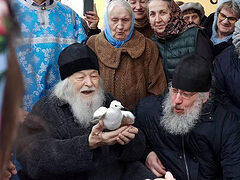
 Elder Tikhon Elder Tikhon did his best to help Fr. Valerian serve and continued hearing the confessions of the numerous believers who flocked to him. Fr. Valerian left this testimony about Elder Tikhon’s ministry:
We were standing there, then batiushka suddenly sternly asked during the Liturgy: “Who’s serving with us?” He pointed to the left side of the altar: “And who’s standing there?” “No one.” “Oh, no one? Alright, that’s fine.” And he bowed his head. That is, apparently he saw an angel…
By his own example, Fr. Tikhon testified to the grace of God, to the grace of the priesthood, which “heals that which is infirm and completes that which is lacking.” He was already advanced in years like Simeon the God-receiver, burdened by the shadow of age, but he had a piercing gaze filled with special power. And of course, he had the greatest humility and incomprehensible patience. He listened to everything, and there was never even a shadow of impatience or indignation in him.
In turn, Archpriest Dmitry Smirnov, who would visit the church in Akulovo, recalled about the elder:
I remember how when he left the church, all the people would buzz around him. And this whole swarm would follow him to the house where he had lunch. It was a sight to behold. And I would play the part of security guard, using my “small stature.” I would push these good people back from the path he took.
He had a very interesting appearance. In Otradnoye there’s an icon of the the Mother of God’s appearance to St. Sergius. It’s a well-known event from the saint’s life. And there on the icon, St. Sergius looks exactly like Fr. Tikhon.
He was such a fragrant person. When he would bless with his trembling hand and you kissed that hand, it was as if you were kissing fragrant relics. That special, most delicate aroma unique to relics... He was the meekest of men—never a cross word to anyone. There were many instances of his clairvoyance... True kindness emanated from him. Whoever spoke with him was always won over by his love. Even thinking about him is a great joy. He was a beacon in our lives, and at the same time a typical manifestation of our Russian spirituality. As the prophet said of Christ, he had neither form nor majesty. He was a living embodiment of humility.
Another visitor to Akulovo had this to say about the elder:
He fully lived up to his name—his life matched it.1 He was so very quiet and peaceful. I’ve met maybe four righteous people in my life, and Fr. Tikhon was one of them. He had a more than modest appearance, and people sometimes gave him alms. He never refused; he always took the money and then lovingly distributed it to the numerous beggars. He was meek and humble.
Archpriest Nikolai Krechetov gives the following details:
Fr. Tikhon entered, slowly shuffling his feet—he walked in these big galoshes—and wanted to venerate the icon on the analogion, but it was rather high. He crossed himself, and at the moment when he began to venerate it, he started rising up from the floor, then lowering again, and so from icon to icon he “rose.”
Archpriest Vladimir Vorobyov, who also knew Fr. Tikhon, once said of him:
Eldership is perfection. The asceticism of eldership is the highest asceticism—the highest and greatest ministry. And Fr. Tikhon showed such amazing perfection in everything. Most of all, we were struck by his meekness, humility, and his amazing joy: He rejoiced in every person, receiving him as family, regardless of who it was. And it was so easy to approach him—you couldn’t feel any distance between yourself and him. He was remarkably open to all and saw infinite value in everyone. For him, everyone was equal, and everyone who came to him felt his remarkable love. The grace of God was quite striking in him.
Before the elder’s repose, he communed every day. Those around him saw that despite his infirmity and forgetfulness, he was always in prayer.
He quietly departed to the Lord on July 17, 1983. He was buried behind the altar of the Holy Protection Church in Akulovo. Many years later, in a conversation with Fr. Nikolai Krechetov, Metropolitan Pitrim (Nechaev) said: “How I miss Fr. Tikhon now! Just to sit in silence with him! It would be so nice!”
May the Lord grant rest to the soul of Archpriest Tikhon in the mansions of the righteous!