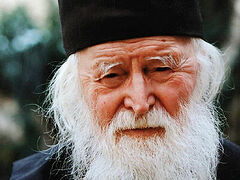
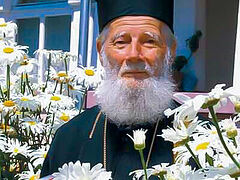
Fr. Serafim (Bădilă) is one of the most revered Romanian confessors of the last twenty years. A humble elder who prays unceasingly, gentle and kindhearted, a strict faster and zealot of the faith, a good shepherd and wise instructor, he transformed the Holy Cross Monastery near the village of Cășiel-Strâmbu, Cluj County, into a wellspring of holiness and a center of pilgrimage. Believers from all across Transylvania travel there to confess to Fr. Serafim and hear his counsel.
 Fr. Serafim (Bădilă) Father is known for his generous spiritual alms (he has nothing material). He cares for the suffering, visiting them in hospitals and the Dej, Gherla, Bistrița, and Zalău prisons, and also instructs the local Orthodox youth. He permanently resides at the Cășiel Convent, serving as confessor for more than thirty nuns and novices, who like bees in a hive compete with each other in work and prayer.
Cășiel Monastery was founded in the seventeenth century by Hieromonk Pahomie (Georgiu), a monk of Putna Monastery, who came from this area. Here, in the vicinity of the village of Cuieșt—in Cășiel, Rugășești, Leurda, Strâmbu, and Sălătruc—there were eight Orthodox monasteries operating at that time, until General von Buccow burned them down. It’s well documented that an Orthodox deanery was located in Cuieșt, and forty believers who refused to convert to Uniatism were shot there.1
The abbess of the monastery, stavrophore nun Barbara (Georgiu), who revived the monastery in 1991, was born in these parts, in the hamlet of Huta, which belongs to Strâmbu parish. Judging by her surname, she’s a distant relative of the monastery’s founder, Hieromonk Pahomie. She took monastic vows in her youth and grew spiritually in the great Râmeț Lavra, where she spent about twenty years.
 Monastic tonsure at Cășiel Monastery. The first sponsor is Abbess Barbara
A disciple of great Romanian confessors of the twentieth century
Fr. Serafim is a wise spiritual father endowed with grace-filled gifts from God. First he studied theology, and then, with the blessing of St. Arsenie (Boca), was tonsured as a monk.
Speaking of St. Arsenie, whose church he used to go to in the village of Drăgănescu, he says that he possessed great gifts of grace. He always remembers him, repeating his counsel, in particular teaching that young people must keep themselves pure until marriage, then have children, and afterwards live in purity again, because children born this way are blessed by God with grace, as happened with Fr. Arsenie.
From St. Cleopa (Ilie), he learned how to apply the canons in Confession so that the person would spiritually change.
Concerning Fr. Justin (Pârvu), he says he was a confessor and martyr, whose prayer and blessing possessed spiritual power like he’d never seen before.
Concerning Archbishop Justinian (Chira), he says he was a holy hierarch. The bishop advised him to dig his grave here, in Cășiel Monastery, where he’s been serving for thirty-three years now.
 The old cemetery church at Cășiel Monasery. Fr. Serafim is hearing confessions at the entrance
Fr. Serafim confessed to St. Dometie (Manolache) of Râmeț, who he says was merciful and preached and sang very beautifully. He also confessed to St. Paisie (Olaru), who possessed the gift of meekness; to Fr. Ioanichie (Balan), who especially valued Fr. Serafim even when he was still young; and to Fr. Ilarion (Argatu), who fasted more strictly than anyone he’s seen since and who had authority over unclean spirits. He learned something from each of them and remembers their soul-profiting words.
Fr. Serafim was born on the feast day of St. Nicholas, December 6, 1948, in the village of Dyal in the commune of Cîlnic, Alba County, and was given the name of the great Wonderworker of Myra in holy Baptism.
Four members of his family became monastics, which testifies to the piety and great love for God of both parents and children. Two of his sisters, Nuns Mina and Pavelida, are abbesses today, of the Holy Cross and Annunciation Monasteries respectively in the city of Oradea. Later, his mother also became a nun, taking the name Michaela. She has since reposed.
The start of his spiritual path
At first, Father worked as a teacher near Râmeț Monastery for twenty whole years. Then, under the influence of Sts. Dometie of Râmeț and Arsenie (Boca), Fr. Serafim discovered his call to serve God in the monastic and priestly ranks.
At the very height of the communist persecution, he taught schoolchildren about God and spirituality, and after 1989 he began studying theology and became a priest and spiritual father at Holy Cross Monastery near the city of Oradea. He fulfilled an important mission there, nurturing hundreds of spiritual children. In 1993, he began to labor in asceticism at Cășiel Monastery, which few people visited at that time. Today, apart from thirty ascetics in Christ and a dozen full-time workers, dozens or hundreds of believers wait every day to see Fr. Serafim.
 Patronal feast at Cășiel Monastery, September 14, 2019
Father greets them, beaming with joy, like St. Seraphim of Sarov, his Heavenly patron in monasticism. I’ve known him for more than a quarter of a century. It’s impossible not to love him. I remember the twelve years when I was an abbot in the Cluj Diocese and the monastic meetings we had. Back then, Fr. Serafim gave our meetings a unique quality with his very presence, his naturalness and warmth, and the depth of his spiritual experience. If I were to describe him in a few words, I’d say that he’s the salt of the earth.
There’s grace in being with Fr. Serafim
His instructions were confirmed by his life experience and that of the great confessors. I confessed to him several times and have greatly benefited each time. We’re connected in heart and mind; we revere and love each other, although we differ in some respects, of course.
Fr. Serafim prays a lot. If you travel with him, you have to be content with silence and prayer offered in the secret of the heart. He is patience, love, and goodness itself, and there’s grace in being with him. It’s greatly edifying when you see how he prays, how he has served the Divine Liturgy every day for decades, how he commemorates thousands of names of the living and reposed (hundreds of which he remembers by heart).
In his presence, the soul is calmed and lifted up in praise to God. Silence reigns around him, and everyone prays quietly. The nuns in the church, the faithful waiting for confession—a hesychastic atmosphere filled with spiritual joy prevails everywhere and among all present.
He doesn’t say much, and only the most important words, but his presence and prayer alone change people. Thanks to him, Romanian spirituality—distinguished by its depth, purity, and sincerity—continues to spread among a people so meek, reverent, and thirsting for God.
While visiting Elder Serafim, I asked him to share with us some spiritual counsels stemming from his spiritual experience.
Sincere confession can make you a different person
—You’ve heard the confessions of very many people who have been coming here for years. What kind of spiritual joy do you find in this ministry? What spiritual experiences have you had?
—As a spiritual father, I’ve noticed that even if people have grievous and numerous sins, through the Sacrament of Confession they’re able to cast off the old man and put on the new. Many people are reborn in Confession when they do it sincerely, with remorse for what they’ve done and the determination not to sin anymore. Confession removes tons of burden from the soul and conscience of a Christian. I’ve experienced this myself. I’ll tell you what happened to me.
 Confession with Elder Serafim
Here, not far from us, is Rohia Monastery, and I went there to confess to Archbishop Justinian. I went with someone, and I asked him not to talk to me: Since I was going for Confession, I wanted to gather my thoughts a little. He understood. On the way there, I reexamined my whole life again, including sins committed in thought, word, and deed, dividing them into three periods: the first from childhood to adolescence; the second from adolescence to the priesthood; and the third, from the day I became a priest and monk till today. And this examination of my life affected me so deeply that when I got there and confessed to the Archbishop, I felt like I was flying. It’s very rare to feel the blessedness and joy I felt then. It happened to me only one other time, when I confessed to Fr. Paisie (Olaru).
—Please tell us more about how you benefited from confessing to different spiritual fathers.
—The Sacrament of Confession can change you. It can make a worldly man into a spiritual man, such that God will take him into His arms and put him on the true path of salvation. But, of course, not everyone benefits from the holy Sacrament of Confession.
—In Confession, we’re reconciled with God, with ourselves, and with each other…
— People who are diligent and don’t give up will find a solution to their problems. Let me tell you about one such case.
A Christian from the city of Cluj came to me whose son and daughter had received a higher education, both had work and housing in Cluj, but couldn’t seem to get married. And this man confessed his sins, adding his heartache: “If only I could see them married! That’s all I want!”
So I told him: “Look, if this pain doesn’t pass, set aside a day and come here, and we’ll go see Fr. Justin (Pârvu), so God might ease your suffering through him.”
I was present for their conversation, and I remember the advice that Fr. Justin from Petru Vodă gave this Christian man. I’ve used this advice myself ever since, and I pass it on.
Fr. Justin told him:
If you want to see your children married, in strong marriages, they have to meet several conditions: They must find active Orthodox Christians to marry; that is, who go to church on Sundays and feast days, and fast during all four fasts, and also on Mondays, Wednesdays, and Fridays; they must have a prayer rule and adhere to Orthodox life and practice; they must labor honestly every day for the good of the family; they have to take an interest in what kind of family they’ll be joining—whether it’s a good Christian family, or whether it has worldly and passionate people, because the apple doesn’t fall far from the tree.
I’ll also add here something that Fr. Arsenie (Boca) told one young man: “You’re not ready for marriage or monasticism.”
Without egotism, life would be Paradise
—That is, you need spiritual preparation in both cases.
—Yes. Some of our spiritual children, although they were active Orthodox people, hardworking, from good families, still got divorced. Why? Because they didn’t fulfill the conditions set by Fr. Arsenie: They weren’t prepared. They all had egotism. The husband, like a dictator, wanted to command everything and impose his opinion everywhere. The woman also had her own egotism: How much can you submit to your husband? She also had her own truth, so in order to live in harmony, peace, and love, you have to know how to make concessions. Peace is four times more important than justice.
 Fr. Serafim hearing a confession
We must cultivate humility, kindness, attention, love, and respect for others. Children should be taught self-denial and self-sacrifice from an early age. But today, selfishness is promoted everywhere. Everything you see on TV or online assumes a lack of love and indifference to others. Of course, there are also Orthodox, spiritual sites—we have to direct our youth to them.
The spirit of humility is the Spirit of Christ. If children weren’t given a Christian upbringing in their father’s house and the parents themselves aren’t religious, then the children grow up alien to the Holy Spirit, the Spirit of Christ, the Spirit of Church, which is a very serious matter, because the youth are the future of the country.
Selfishness leads to strife, disobedience, and passionate addictions. Therefore, the spirit of Antichrist is widespread in society in relation to the Church, icons, religion. Young people with such addictions can’t study; they don’t like work or cleanliness.
—Egotism is a passion that makes itself known even in childhood. How can we deliver ourselves of it?
—The family is the building block of society. If a family starts out correctly, observing the norms of Christian marriage—as Fr. Cleopa says—if they lead a Christian life in humility, if they're abstinent during pregnancies and the fasts, then peace and harmony reign in the family and society. Children are born mentally and physically healthy.
Fr. Arsenie (Boca) says that enmity arises because of sins. We’re all called to change our lives by repentance, like the prodigal son. We have to fast, pray, forgive, read sacred books, and live a truly spiritual life.