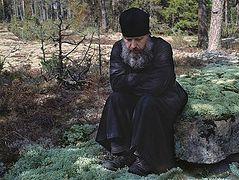
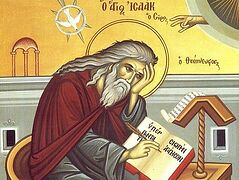
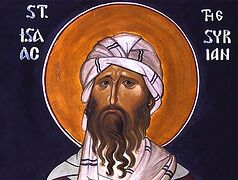
Venerable Ephraim and Isaac, Ascetics of Syria On February 10 according to the new calendar the Holy Church honors the memory of two saints who lived in the Middle East during the first centuries of Christianity. They are known to the faithful as Sts. Ephraim and Isaac. They lived in different centuries and in different parts of the Syrian Desert. The former is known primarily as an exegete, a hymnographer and a teacher of repentance. Every day during Lent we read this saint’s famous prayer.1
The latter was more of a recluse, a contemplative and an ascetic. Despite the different earthly circumstances they struggled in, both of them pleased God with their holy lives. Let us consider in more detail how their examples are important for us, modern Christians, and listen to the wisdom of salvation to which they have guided us.
St. Ephraim the Syrian
 St. Ephraim the Syrian St. Ephraim the Syrian was born around 306 in the city of Nisibis (in what is now Nusaybin in Turkey). At a young age, the future saint retreated into the Syrian Desert, where he struggled under the omophorion of Bishop James of Nisibis, another saint of that era. Having matured in the virtues and been purified by fasting and prayer, he went to Cappadocia, where he met St. Basil the Great. The latter marveled at St. Ephraim’s numerous diverse talents and ordained him deacon, according to some sources of his life. It is known for certain that St. Ephraim remained in this rank all his life, humbly refusing the priesthood. However, this did not prevent him from becoming a renowned preacher and mentor of the Word of God among the inhabitants of Nisibis, where he later returned.
St. Ephraim is famous for his numerous spiritual writings, which were translated into Greek in his lifetime. The most notable of them are exegetical treatises. The saint was also the author of a large number of prayers, poems, hymns, and prose works. St. Ephraim spent the final years of his life in deep repentance. Following the example of St. Basil the Great, he founded a hospital for the needy and lived in absolute poverty. In his testament before his death, the saint wrote humbly: “I made a vow to God to be buried with strangers and wanderers. I am just as much a wanderer as they are. Lay me to rest with them. Bury me in a cemetery where those with contrite hearts are buried.” St. Ephraim reposed in the Lord in about 373.
The Holy Church thus addresses St. Ephraim in the troparion: “By the stream of thy tears thou didst make a desert fertile, and thy deep longing for Good brought forth fruit a hundredfold, and thou wast a beacon to the universe, shining forth miracles, O our father Ephraim! Pray to Christ our God to save our souls.” Let us take a brief look at the treasury of the Divinely inspired wisdom of the “beacon to the universe”, our father Ephraim. In particular, he wrote about God’s love for man:
***
God gave love to His Church so that it could always be adorned with the same love. It becomes an earnest of God in the soul; it is a pillar and a confirmation in the holy soul. The same love sent down to us the Only-Begotten Son. By the same love, Paradise was opened; by the same love, the soul became the bride of the Immortal Bridegroom in order to reflect His beauty and splendor in itself as in a mirror. The passionless and pure Bridegroom suffered out of this love. But if the soul has no love, the Heavenly Master does not favor it. God never forces the soul’s will, therefore, once and for all He gave it the freedom to lead the life it wants.
***
God deplores the death of His image. The soul is much dearer to God than all of His other creations. Grieve for yourself for God’s sake, because He is sorry for you.
***
Desire to be saved, for the Lord loves those who long to be saved and helps them.
***
Beloved, be of good courage and succeed in your God, for His mercy endures forever.
***
 God is good and bestows His blessings on everyone. He is rich and nurtures all men for free. He is full of bounties, and His bounties extend to all. He is Merciful, and His goodness is poured out on everyone. He cures all ailments mercifully without cutting. Instead of powerful and tormenting treatment, which could make one tremble, He uses mercy and a merciful benevolence for all.
God is rich in wise advice: sometimes He shortens and sometimes prolongs the actions of His saving means; sometimes He hurries to us because He loves us; sometimes He moves away from us, again out of compassion for us. He moves away from us in order to increase His love, which flows after Him, and shows that it cannot be far from Him; He hurries to us in order to make it known how unbearable It is for Him to be separated from us… He hurries to us out of His goodness. As He moves away from us for our good, so He hurries to us in order to come upon us and save us.
***
We all come to know Divine Providence and all the gifts that the good God has given us. His grace often visits our hearts at all times, and if it finds rest, then, having entered, it dwells in the soul permanently; unless it finds a pure heart, it immediately draws back. But His bounties prompt it to descend and visit us sinners again.
***
God loves non-possessors who voluntarily for the sake of Christ have subjected themselves to tribulation, to ascetic labors, to vigil, and to much suffering, and have prepared themselves to behold the Immortal Bridegroom in glory. They will inherit the Heavenly Kingdom.
***
 Carl Bloch. Christ the Comforter People, our Lord is meek, easily placated, good, generous, merciful, long-suffering and forgiving of our impious deeds every time we want it. For He calls, forbears and bestows His blessings on all of us in this life and in the life to come, provided that we want it.
Let us plunge ourselves into the sea of God’s bounties. God Himself exhorts and invites everyone, saying, Come unto Me, all ye that labour and are heavy laden, and I will give you rest (Mt. 11:28). Everyone is invited by Him, Who is the Lover of mankind and all-forgiving, Compassionate and Long-suffering, and wants all people to be saved. Not only does He exhort and call His own people, but invites everybody: “Come to Me, all of you, whether rich or poor, for him that cometh to Me I will in no wise cast out (Jn. 6:37).
St. Isaac the Syrian
St. Isaac the Syrian, Bishop of Nineveh, probably lived in the sixth and seventh centuries. Little is known about his life. At the beginning of his monastic path, he struggled in the city of Nineveh in what is now Iraq, namely at the ill-fated Mar Mattai Monastery (in the twenty-first century, this ancient monastery was looted by Islamists). But in the time of St. Isaac, the monastery was a quiet place for prayer and ascetic labors. Desiring strict fasting and the angelic life, the future saint began to live as a recluse in a hermitage cell, where he acquired many Divine gifts. This could not but be noticed by the Christians of Nineveh who wanted him to become their bishop. On becoming a bishop, St. Isaac remained in this see for only five months (due to the corruption of some local residents). After that, he went to perform special monastic feats in a harsh desert area, and later moved to a cenobitic monastery in another part of the Syrian Desert.
 St. Isaac the Syrian St. Isaac spent his life in strict asceticism, prayer, contemplation and abstinence, not even touching boiled food. In his lifetime, the saint was known as a church writer and spiritual mentor to monks. To this day, his Ascetical Homilies continue to inspire those seeking salvific instructions. Thus, in the twentieth century, his teachings were highly appreciated by the holy Elders Joseph the Hesychast and Paisios the Hagiorite. Notably, in Russia St. Isaac was especially venerated by the rock musician and Orthodox actor Pyotr Mamonov (1951–2021), who admired his love for God and dispassion. The troparion to St. Isaac the Syrian reads: “Having served as a good priest in cities, and blossomed in the desert, O Isaac, thou didst appear as a chief of monastics and a teacher of ascetics. Therefore we celebrate thy memory and cry out: Glory to Christ Who glorified thee, glory to Him Who sanctified thee, glory to Him Who gave thee to us, a skilled intercessor.” Let us listen to some instructions by this great “teacher of ascetics”.
***
Do not hate the sinner, because we are all guilty; and if you condemn him for God’s sake, then weep for him. Why do you hate him? Hate his sins and pray for him, so that you may become like Christ Who did not resent sinners, but prayed for them.
***
Without fulfilling the commandments, unless we first follow this path leading to spiritual purity, we should not desire or expect purification of the soul.
***
A chaste body is more precious before God than a pure sacrifice. These two virtues, namely humility and chastity, prepare the earnest of the Trinity in the soul.
***
Every hardship and every sorrow, unless they are accompanied by patience, serve a special torment, because patience averts disasters, whereas faint-heartedness is the mother of torment. Patience is the mother of consolation and a certain power, usually begotten by the breadth of the heart. It is difficult for a Christian to find this power in his sorrows without the Divine gift gained by persistent prayer and shedding tears.
***
Fasting with prudence is a great abode for all goodness. And he who neglects fasting causes all good things to waver, because fasting was a commandment given to our nature in the beginning to guard it from eating food, and the beginning of our creation fell by the violation of fasting.
***
The Tree of Life is the love of God, from which Adam fell away; and thenceforth he had no joy, but he labored and toiled on the earth of thorns. Those who are deprived of the love of God, even if they walk in righteousness, eat the bread of sweat in their work, as Adam was commanded after his fall. As long as we have not acquired love, our work on earth is full of thorns; and although our sowing can be that of righteousness, we sow and reap amid thorns, and we are wounded by them hourly; and whatever we do for our justification, we live by the sweat of our brow. And when we acquire love, we will eat Heavenly Bread and be strengthened without work and labor. For the bread of God is He which cometh down from Heaven, and giveth life unto the world (Jn. 6:33). This is angelic food.
***
The Son of God died, teaching us abundant love and bringing us closer to Himself. God wants us to draw closer to Him with the love of our own hearts.
***
Out of love for the creation, God sent His Son to die on the Cross. For God so loved the world, that He gave His Only-Begotten Son, that whosoever believeth in Him should not perish, but have everlasting life (Jn. 3:16). It is not because He could not redeem us in any other way, but in order thereby to teach us His abundant love and bring us closer to Himself through the death of His Only-Begotten Son. And if He had had something more precious, He would also have given it to us, thereby acquiring our human race.
A prayer that is not accompanied by good behavior is like an eagle with clipped wings.
***
Listen to a true word: As long as you have not acquired humility, you will be tempted by despondency more than anything else. Despondency gives rise to constant reproaches against others, and you see most people sinning against you. If you look at the matter in a fair and appropriate way, then you are to blame for everything.
***
Love is a kingdom; the Lord mysteriously promised the apostles that they would partake of it in His Kingdom. For when it is said, That ye may eat and drink at My table in My kingdom (Lk. 22:30), what else does it mean but love?
Holy Fathers Ephraim and Isaac, pray to God for us!