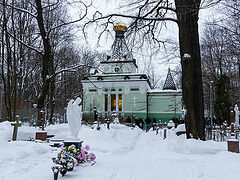
On January 27, the day of complete lifting of the blockade of Leningrad, just as on September 8 when the blockade began, the chapel Church of All Saints Who Shone Forth in the Russian Land on the grounds of the Moskovsky Victory Park in St. Petersburg became too small to accommodate all those who came to pray there. Rector Archimandrite Jerome (Testin) talks about the unique church, its history and parishioners.
 The Church of All Saints Who Shone Forth in the Russian Land in the Moskovsky Victory Park, St. Petersburg. Photo: azbyka.ru
—Tell us about this amazing church.
—Our church is truly unique. It’s a memorial temple, and a memorial building, erected to commemorate the victims of the blockade of Leningrad. From 1931 to 1961, the First brick and pumice factory was located at this spot. Since March 1942, during the siege of Leningrad, the plant was used to cremate the bodies of local residents who died of hunger and shelling, as well as the soldiers who defended the city. According to eyewitnesses, more than six hundred thousand people have been cremated there. Their bodies were burned in the furnaces of the crematorium, because it wasn’t possible to bury them.
 Archimandrite Jerome (Testin)
Unfortunately, we are still unable to build a larger church. I feel ashamed for all of us Russians who cannot build on their own land and in memory of their native Russian hero ancestors a church that would be worthy of such a feat, of such a memory, a tragedy, such depth and significance of the events that had happened here.
Everyone felt as if the souls of hundreds of thousands of victims of the frightful Leningrad blockade were praying invisibly with us
—You have said once that the Victory Park was like antimension, in other words, a place of sacrifice...
—On June 22, 2009, His Eminence Markell (Vetrov), Bishop of Peterhof, held the first open-air Divine Liturgy there, on the site of the future church. It was Bishop Markell who on that day called the Moskovsky Victory Park one great antimension, containing the ashes of the martyrs who died for our sake. Everyone felt that the souls of hundreds of thousands of victims of the frightful blockade of Leningrad were there praying invisibly with us.
On September 8 of the same year, Vladyka served another Liturgy here. Again a tent with a portable altar table became our church, while the entire memorial area of the park where the faithful were praying became a great temple of God invisible to the eye. This area is Europe’s largest burial site; and it is important to preserve the memory of the events of the blockade and the fact that the crematorium furnaces that operated here consumed inside their fiery “bellies” hundreds of thousands of bodies of valiant defenders of Leningrad and its residents.
 His Eminence Markell (Vetrov), Bishop of Peterhof, at the Divine Liturgy at the site of the future church. Photo: hrampobeda.ru
—Could you talk in greater detail about the history of the construction of the memorial church?
—Back then, Archpriest Alexei Isaev and I concelebrated with Vladyka Markell. Fr. Alexei was assigned by the St. Petersburg diocese to oversee the construction of a new memorial church. He also became its first rector, despite also being the rector of the church of the Holy Great Martyr George the Victorious in Kupchino. For several years, the church built during his tenure as its rector was attached to his parish. Its history is replete with challenges. But the Bloodless Sacrifice offered at the Holy Altar in the place held sacred by all St. Petersburg residents seemed to have burned all remaining obstacles that came up during the construction of the memorial church.
On January 9, 2010, the first machinery arrived to Victory Park. On January 11, the construction of the chapel began, and as early as in May—merely four months later— Metropolitan Vladimir of St. Petersburg and Ladoga, together with Bishop Markell, celebrated the Divine Liturgy and consecrated the chapel in honor of All Saints Who Shone Forth in the Russian Land. Its parish life is inextricably linked with the preservation of pious memory of the residents of our city and the soldiers, the defenders of besieged Leningrad.
—How many believers come here to honor the memory of martyrs?
—Russian people always have a tradition to hold sacred the memory of the heroes and the sacred events of our history. Unfortunately, not everyone comes here to honor the memory of those who have lost their lives. Many visitors don’t even give a thought to why our church was built specifically on this place. But it wasn’t built here by chance. The greatest sacrifice, the sacrifice of Love, was made here and; owing to it, we can live today. In the Gospel, Jesus Christ says: This is my commandment, That ye love one another, as I have loved you. Greater love hath no man than this, that a man lay down his life for his friends (John 15:12).
 The Book of Remembrance
A lot of vacationers who stroll around and go boating here having no idea that at the bottom of the pond and under the thickness of lush grass lies hidden the largest mass grave in the world, that the memory of those events is carefully preserved in our church, and that our parishioners keep the Book of Remembrance. Anyone whose loved ones might have been buried in this sacred place can write their names in the Book of Remembrance for eternal commemoration.
Anyone whose loved ones could have been buried in this sacred place can come and write their names in the Book of Remembrance for eternal remembrance
This can be done inside our church and online. Also, at the entrance to the church, we keep an electronic remembrance book. More than six hundred thousand names are displayed one after another on it. We shouldn’t forget about the price our people paid for the Victory over fascism in the Second World War. We shouldn't, but we do forget. So, I have an urge to say: “When you go past it, stop by and read at least a few names and pray for their repose!"
There are many symbolic places in the city that specify the scale and depth of the events that have happened, even though they didn’t happen at exactly the same location. The Moskovsky Victory Park is such place. It is a sacred site for all residents of our city and our country. I don't call it holy. It should become holy as the result of our prayers, but we are still working on it. But it is sacred, because in March 1942, the largest crematorium in Europe was opened here. One German researcher from Hanover called the Moskovsky Victory Park one of the largest military burial places in Europe. As for the crematorium operating here, he considered it the largest not only in relation to the Great Patriotic War, but also the largest in the theater of operations of the World War II.
Gift of St. John the Wonderworker
 The icon of St. John of Shanghai in the Church of All Saints of Russia
—Tell us about the spiritual-educational center dedicated to St. John (Maksimovitch)…
—We named our spiritual-educational center after St. John (Maximovitch), Archbishop of Shanghai and San Francisco—one of the greatest men of the Orthodox Faith in the twentieth century, a great intercessor for everyone who is afflicted and destitute. We constantly prayed to him, and through his prayers not only we have found the building, but also benefactors who paid for its repairs. Before that, our children wandered for ten years through the back streets of the Moscovsky district, because our Sunday school didn’t have a permanent location. Now, thanks to St. John the Wonderworker, who even during his lifetime was revered as a saint and a guardian of children, we have a beautiful Sunday school and everything necessary for an interesting and socially significant parish life.
—Looking at your tiny church, one can’t help but remember how, basically from the ground up, Vladyka John founded the orphanage of Saint Tikhon of Zadonsk in a miserable hut in Shanghai…
—Living in the foreign lands of Serbia, China, the Philippines, Europe and America, Vladyka John would serve the Divine Liturgy in Chinese, Greek, French, Dutch, and English. But he would always appeal for help to the Russian saints, whose names are inumerable. For the holy Vladyka, they were the most precious and cherished, they comforted him on his way of the cross.
Vladyka used to call the patronal feast of the church in Paris “the feast of spiritual sky over Russia.” Living far away from his homeland, he saw this sky stretching wide over what was formerly Holy Russia. The apostle Paul said: We look not at the things which are seen, but at the things which are not seen: for the things which are seen are temporal, but the things which are not seen are eternal (2 Cor. 4:18). According to Vladyka, the host of God-pleasing saints, who shone forth in the Russian Land, represents true power and the glory of Russia. Their life and guidance are commandments of Holy Russia. So today, as in the days of St. John, the spiritual fathers and mothers of the Russian people did not abandon their earthly homeland but became its Spiritual Sky.
—From his childhood, St. John retained a lifelong love for the Russian land, which brought forth a great host of saints for the Russian Church…
—According to him, a great tree of holiness, that is, the Cross of Russian holiness, begins with the Holy Prince Vladimir and Princess Olga, the “roots,” in a way, of all saints who shone forth in the Russian Land. The saints have spiritually descended from other saints, connected with one another like "a golden chain of holiness of the Russian land."
According to Vladyka John, the Russian saints, like great leaders, should always be before our eyes
According to Vladyka John, we should be led in life by Russian saints, who are great leaders. St. John of Shanghai, who received his name from his ancestor St. John of Tobolsk, said that Russia brought everyone together not because of the unity of its borders, but by a spiritual appeal to the holiness of the saints who shone forth in the Russian Land.
—Can you share any stories about modern miracles of St. John?
—We had a visit from Tatyana Erdenko, a citizen of St. Petersburg and the director of the documentary film, “Awakening”. Her daughter became a student at the San Francisco Orthodox lyceum dedicated to Holy Hierarch John. One day, they forgot a bag with her the school uniform on the bus and the girl couldn’t attend her school without it. After they prayed to St. John, to their great surprise they found a bag with the uniform right outside the door of their apartment.
Seven years later, the family decided to return to Moscow, and so they went to venerate the relics of the saint and say goodbye to him, but they were delayed and realized they would be late for their plane. They read the akathist to the saint and another miracle had happened. At the airport, they were told, "We had a call you were about to arrive, so we were waiting for you," even though there was no one who could have placed such call. As for their luggage—despite having a lot of excess weight, it was loaded onto the plane without any complications.
 Form left to right: Theophan Casad from USA and Denmark, Markus Godwin from Great Britain, Tatiana Guseva, Archimandrite Jerome (Testin), Katya Westerhoff from the Netherlands, Priest Vladimir Chebyshev, and Philip Fidelman at the international conference
—The spirit of universal Orthodoxy is felt in the “Victory” center. Tell us about your parishioners from other countries.
—Many years ago, when I was serving in Kostroma, I met Katya Westerhoff, an artist from the Netherlands, whose exhibition of paintings was attended both by the participants of our November conference and visitors of the Alexander Nevsky Lavra, where her works are currently on display. Katya converted to Orthodoxy after seeing icons in the Louvre. Nowadays, she paints icons herself. When she visits Russia, she receives Communion in our church. At the conference, she delivered a paper on St. John’s time in Netherlands.
Another of our parishioners—Theophan Casad—calls himself a “spiritual refugee.” He was born in the United States in 1961, the year St. John arrived to that country. Theophan has been living in our city for two years now. He worked as a lawyer and a musician before. He’s retired now. He loves Russia a lot and doesn’t want to leave it.