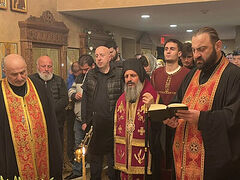
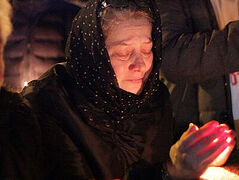
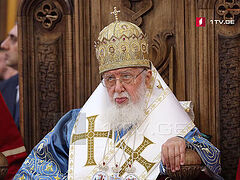
Sometimes in life we encounter the fact that words prove powerless. They cannot contain either the scale of a person, or the depth of their path, or the strength of their influence on people’s hearts. Such a person was Patriarch of Georgia Ilia II; his life cannot be described merely by a list of deeds, his ministry cannot be measured only by historical facts, because it was a personality in whom spiritual depth, fatherly love, and rare inner nobility were united. He became not simply the head of the Church, but a living testimony of how the grace of God acts through a person. His significance extends far beyond the history of the Georgian Church of the twentieth and twenty-first centuries—he belongs to the whole Church, because his heart proved capable of embracing not only his own people, but many others as well, including those who for a long time were on the periphery of church life. And this was not a declaration, but a living experience that people felt.
More than once I had occasion to hear from priests of the Georgian Patriarchate recollections of how, back in the early 2000s, when the construction of the Holy Trinity Cathedral (Sameba) was only beginning, the Patriarch said that services in this church would be conducted in different languages. He mentioned Aramaic, Armenian, Hebrew, and Kurdish. And at that time many could not understand these words, because Kurds in Georgia were to a large extent Muslims, and the majority were Yazidis—conversions to Orthodoxy occurred rarely and almost imperceptibly. It seemed that this future had no foundation in the present, yet he returned to this thought again and again, like a person who already sees what has not yet been revealed to others.
In 2011 I was granted the opportunity to personally meet Patriarch Ilia in the Patriarchate. I spoke with him about the inner calling to serve my people, to engage in translating liturgical texts into the Kurdish language, to receive a theological education, to labor in the field of missionary work. All this lived within me, and I needed support and a blessing. And he received me with remarkable warmth, without formality, as if we had known each other for a very long time. He listened to me in silence, and then blessed my intentions and said: “It is important that a priest appear among your people,” called me to study and blessed me to engage in that to which the Lord calls me. Later I had occasion more than once to be present at the services he celebrated, and each time it was an experience of a special state: a certain sense of protection and peace, when the feeling of alienness disappears and a clear awareness arises that you are not an outsider, that you are accepted, that you are a son, and it was precisely this feeling that revealed the depth of his fatherhood.
In the person of Patriarch Ilia II, the greatness of the Georgian people was fully manifested, because not only did the land of Georgia prove open to Kurds and Yazidis, but the very life of the Georgian Church became a space in which a place was found for my people. This was the inner acceptance of every Orthodox Georgian. The Patriarch treated every people living in Georgia with special attention, and this was evident not only in his deeds, but also in his word. In his festal messages he invariably listed the peoples of the country, addressing each one, and among these names the name of my people, the Yazidis, always sounded as well; and in this there was not merely a mention, but recognition, acceptance, and fatherly care. His fatherhood was especially vividly manifested in his response to the demographic crisis in Georgia, when he called the people to give birth to children and himself took upon himself spiritual responsibility, becoming the godfather for third and subsequent children born in Orthodox families of Georgia. Among these children were also Yazidis who had accepted Christianity, who sought spiritual kinship with the Patriarch and brought their children to Sameba so that it would be precisely he who would become their godfather. I fulfilled his blessing: I entered the Faculty of Theology of the University of Athens and completed it; in 2022 the Patriarch blessed my ordination to the diaconate, and in 2023 my bishop Sava of North America received a blessing from the Patriarch to ordain me to the priesthood. By that time, I had already completed the translation of the Divine Liturgy, and in 2024 I went to Georgia and celebrated the first Divine Liturgy of John Chrysostom in the history of our people in Kurdish-Kurmanji in the Sameba Cathedral, precisely in that church in which the Patriarch had prophesied long before, and what once seemed impossible became a reality.
Similar processes also took place with regard to other peoples. By his blessing and initiative, a priest was ordained for the Orthodox Assyrians. At present the translation of the Liturgy into the Armenian language has been completed. For several years now in Tbilisi there has been a church open where prayer is heard in the English language, and this is a manifestation of his vision of the Church as a home for many peoples. And we, who were engaged in translations and mission, felt and feel ourselves to be children of one father, because through him we sensed the source of grace that unites people of different languages and cultures in the one ecclesial Body of Christ.
For me it is especially valuable that all this became possible through his blessing; his hands blessed millions of people, and these blessings became the beginning of paths, ministries, and changes in human destinies. His mercy and his ability to forgive had no limits; he helped people to find the way and to return to the faith. For us he remains not only the Patriarch of the Georgians—he is a father and Patriarch for Kurds and Yazidis, Armenians and Assyrians, Jews and Azerbaijanis, as well as for many other peoples living on this blessed land. His departure is not a disappearance; his presence continues in hearts, in prayer, and in the living church life which he helped to create and preserve.
I am grateful to God that I was granted to meet the Patriarch, to receive his blessing to become a priest and to serve in the Kurdish language. Through this blessing Orthodoxy has been born and is being strengthened among Kurds and Yazidis, and today we see how many representatives of my people in Georgia are turning to Christ en masse, voluntarily. This has great significance in the formation of Kurds and Yazidis as a Christian people.