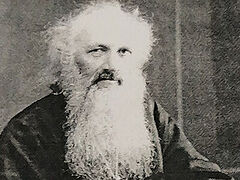
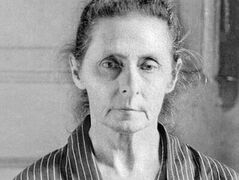
New Martyr Alexander Medem New Martyr Alexander Medem (1877–April 1, 1931) was canonized at the Jubilee Bishops’ Council of the Russian Orthodox Church in 2000. He is commemorated on November 10/23, on the first Sunday after January 25/February 7 (the Synaxis of the New Martyrs and Confessors of Russia), on July 30/August 12 (the Synaxis of the Saints of Samara), and on Sunday closest to August 31/September 13 (the Synaxis of the Saints of Saratov).
New Martyr Alexander—Count Alexander George Ludwig Julius Ottonovich Medem—was born in 1877 in St. Petersburg into the family of Otton Ludwigovich and Alexandra Dmitrievna Medem (nee Naryshkina) and was baptized into Lutheranism. He spent his childhood and most of his life on the homestead settlement of Alexandria of the Khvalynsk district in the Saratov province (now the Saratov region). Otton Ludwigovich bought this estate of approximately 16,200 acres on the banks of the Volga in the 1870s as a wedding gift to his wife Alexandra Dmitrievna Naryshkina, after whom the homestead was named.
The Medems are descendants of an ancient Courland family that lived on the territory of the modern-day Baltic States from the thirteenth century (Konrad von Medem, Herrmeister of the Livonian Order, is considered to be the founder of the capital of Courland, Mitava—now Jelgava, Latvia). It is known that in 1779 Johann Friedrich von Medem’s daughter, Anna Charlotte Dorothea, married Peter Biron, the Duke of Courland. In the same year, Johann Friedrich together with his offspring were elevated to the title of counts of the Holy Roman Empire.
Alexander’s father, Count Otton Ludwigovich, was a highly educated and strong-willed man. He graduated from St. Petersburg University (the Department of Law) and entered the civil service, where he held prominent positions: he was the vice-governor of Voronezh, the governor of Novgorod, and later a senator and a member of the State Council.
 Khvalynsk, 1910s
People had the fondest memories of him. During the Cholera Riot in the town of Khvalynsk in 1892,1 he alone represented the authorities in the city for three days. Hundreds of people died, there was panic, looting, and massacre. Frightened by the rampaging mob, the city authorities hid in the district jail. In the square in front of an Edinoverie church the mob brutally beat and murdered a local physician, A.M. Molchanov, accusing him of “poisoning” patients and forbidding his body to be buried. On learning about this, Otton Ludwigovich arrived in Khvalynsk, hurried to the square. Ignoring the hostile mob accompanying him, he took the unfortunate doctor’s body and moved it to his apartment, where a memorial service for his repose was celebrated. After that he calmly invited everyone gathered outside his house to go to the district council and maintained order in the town until the troops arrived.
Count Medem showed no less courage during the riots in the Novgorod province in 1905. He traveled unaccompanied to the very epicenter, boldly went into the thick of the rioting mob, bowed to the people, took off his peaked cap and started speaking in a low voice. At first there was a lot of noise, but soon the people quieted down and listened to the governor respectfully.
Alexander Medem inherited his strong-willed nature and devotion to his duties from his father. However, after graduating from St. Petersburg University (Department of Law), he did not enter civil service. In 1901, he married Maria Fyodorovna Chertkova and took up his residence on the homestead of Alexandria, having decided on farming.
From childhood Alexander Ottonovich was very attached to land, acquired extensive practical knowledge and did much to sensibly organize of his estate’s prosperity, introducing up-to-date agronomy and technology there. By the standards of that time, the Medems’ estate was among the most progressive and exemplary: there was a stone mill powered by a diesel power unit and a steam engine, a water tower, along with mechanical drinkers and threshing machines on the farm. There were also a cheese dairy, a distillery, a greenhouse, stables, cattle and poultry yards, a blacksmith shop, a coach house, with good barns and other outbuildings.
According to his contemporaries’ recollections, Alexander Medem knew every peasant he hired and selected only the best workers, personally traversed the estate and supervised the progress of work. He was able to win people over. He could eat from the same pot as his workers, and the pay in his farm was one of the highest in the area. The Medems also took care of the peasants’ education—Maria Fyodorovna at her own expense opened a grammar school for children in Alexandria. Thanks to this, the Medems won popular love and respect.
The Medems collected a large library and a portrait gallery in their estate, situated on the bank of a pond, to which led an oak-lined path. Their children—son Fyodor and the daughters Sophia, Elena and Alexandra—were born in Alexandria.
All their children were baptized into Orthodoxy. Alexander Ottonovich did not insist on baptizing their children into Lutheranism, since he had himself grown up in an Orthodox environment, which had played a major role in his spiritual development. His beloved wife, a deeply religious woman, was a great authority for him.
The birth of the middle daughter, Elena, was a difficult ordeal for the Medem family and, at the same time, a step on the path of Alexander Ottonovich’s spiritual growth.
Elenushka,2 as her family called her, was born sick; Maria Fyodorovna fell ill with cholera during her pregnancy, and this affected the child’s health. Elenushka couldn’t speak or control her body. She had seizures, which were a great distress for both the girl and her family. At Maria Fyodorovna’s request, Alexander Ottonovich founded an Orthodox church on the estate in honor of the holy Emperor Constantine and his mother Empress Helen Equal-to-the-Apostles, the latter being his disabled daughter’s Heavenly patroness. And soon he converted to Orthodoxy.
A small single-altar stone church in the Pskov-Novgorod style was built in 1910–1912 and consecrated in 1913 by Archbishop Alexei (Dorodnitsyn) of Saratov and Tsaritsyn.
During the First World War, Count Medem was at the front several times. In 1914, he brought gifts to Poland for the soldiers of the forty-seventh Division, which had once been stationed in Saratov. And in 1915 he went to the front again as the head of the sanitary detachment of the All-Russian Zemstvo Union. He had a heart attack at the front and returned home in 1916.
 Count Alexander Medem. A wartime photograph The Medems spent most of their time in Alexandria, occasionally traveling to Moscow or St. Petersburg. The Count’s family was a remarkable example of Christian love and piety. Count Alexander’s kind attitude towards everybody regardless of their social class and faith so endeared his fellow countrymen that during the tough times of the Revolution, when estates were being burned, and there were rivers of both nobles’ and commoners’ blood, the protesting mob would roar in squares: “Death to landowners!”, adding after that: “Except Medem!” This saved the whole family from certain death.
Nevertheless, the Medems lost their estates. After all private land holdings had been confiscated by the Soviet Government in 1918, the family moved to Khvalynsk where they lived in a rented apartment. In addition to the immediate family, Maria Fyodorovna’s mother Elena Mikhailovna Chertkova, Alexander Ottonovich’s sister Maria Ottonovna Netsvetaeva and her three daughters, as well as the children’s tutor Olga Nikolaevna Kalogeropulo, lived with the Medems. They were also joined by their faithful servants: the housemaids Anastasia Kulyaeva and Agrafena Rubtsova with her daughter Katya. And Alexander Ottonovich took care of this “women’s battalion”, most of whom were either infirm or too young to help him. Leaving Russia with the entire family was out of the question, and as a result only his son Fyodor ended up in emigration. Earlier, Alexander Ottonovich’s father Otton Ludvigovich and his brother Dmitry had emigrated abroad.
The Bolsheviks arrested Alexander Ottonovich more than once on suspicion of “counterrevolutionary activities”, and once they even sentenced him to execution by firing squad. The count’s acquaintances and friends offered to arrange an escape. But he refused, not wanting to put his close ones at risk, as they would have faced an unenviable fate if he had escaped.
The night before his scheduled execution, Alexander Ottonovich was allowed to go home to say goodbye to his family—he was allowed to spend the last night at home. He was released without escort on his own recognizance and on condition that he return in the morning. Alexander Ottonovich and Maria Fyodorovna sat together all night long, and at dawn, when the count was about to return to prison, the government in the town changed. The Bolsheviks were driven out of the town by the Czechoslovakian corps and the verdict was canceled automatically. So the “good count’s” life was saved.
Another time, during his arrest, Maria Fyodorovna was required to pay 10,000 rubles for her husband’s release. She did not have that amount and turned to the mullah of Khvalynsk, who was on friendly terms with the Medems. He provided the necessary amount, and Count Medem was discharged.
In the summer of 1919, he was arrested again and imprisoned in the city of Saratov. When he returned from prison, he said that he had never prayed so well as in jail, where “death knocks on the door at night and you never know whose turn it is”.
In order to survive, Alexander Ottonovich rented several acres of land. They lived modestly. The money, which was mostly borrowed, was barely sufficient to purchase seeds and carry out the most necessary agricultural work. He could get to the plot either on foot or on passing horse-drawn carts. Because of his hard work, several fingers on Alexander Ottonovich’s hands had to be amputated, and his health was impaired
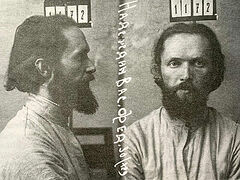
 Photo from criminal case No. 7. 1929
The whole family regularly attended the church of the Holy Trinity Monastery in Khvalynsk, consecrated in honor of the “Life-Giving Spring” Icon of the Mother of God. In the monastery, Count Medem and other believers organized a church council to resist the Renovationist schism. Alexander Ottonovich, who enjoyed indisputable authority, went to Saratov—to one of the most important opponents of the “Living Church” in the province—Bishop Peter (Sokolov), with a request to accept their parish under his omophorion.
In the summer of 1923, the OGPU3 intensified its struggle against the opponents of Renovationism, and Bishop Peter was arrested. Alexander Ottonovich’s activities did not escape the investigators’ attention either, and he was arrested again. He was incarcerated in the city of Saratov in investigative case No. 1200, initiated against the clergy and laypeople of the Saratov province.
Once during the interrogation the investigator asked him how he would organize a livestock farm. Alexander Ottonovich told him, going into all the details. The investigator listened to him with interest and exclaimed: “Oh, I love such people! But, of course, we won’t let you run any farms!” However, the case against Medem collapsed again, and in late October 1923, Alexander Ottonovich was freed and returned to his family.
Arrests, hardships, illnesses, privation and intense labor only tempered his soul and strengthened his faith. He wrote to his son Fyodor in emigration: “One of these days you will turn twenty–one—that is, the age of majority. I will pray for you especially fervently, my boy, that the Lord will help you walk your earthly path worthily and righteously and save your soul; give you happiness, both physical and spiritual strength, courage and boldness, and strong and unshakeable faith. Only the belief that there is a continuation after our earthly life gives us the strength not to cling to our insignificant life at all costs and not to resort to meanness and humiliation in order to preserve it… Only he who is deeply and sincerely religious can be truly free. Dependence on the Lord is the only dependence that does not humiliate you or turn you into a miserable slave, but rather it lifts you up. I am a poor preacher and mentor, but I want to tell you something that I feel acutely and wish for you. Believe firmly and without wavering; always pray fervently, believing that the Lord will hear you; do not be afraid of anything in the world except for the Lord and your conscience guided by Him—do not reckon with anything else; never offend anyone (of course, I mean grave, deeply personal insults that remain forever)—and I think your life will be good. May Christ be with you, my boy, my beloved. Your mother and I keep thinking about you, thanking God for you and praying for you... hugging you tightly, blessing and loving you. May the Lord be with you. Your father.”
Maria Fyodorovna wrote to her son Fyodor as well: “I want to tell you about your father, but I don’t know if you will understand me. We live in such different conditions that many things may seem incomprehensible to you. Over the years, he has grown morally enormously. I have never seen in my life such faith, such peace of mind, such true freedom and fortitude. This is not just my opinion, which may be biased. Everyone sees it. And this is what we live by—by nothing else, because the very fact that we live as such a family by nothing but trust in the Lord proves it.”
Alexander Ottonovich wrote to his son about the situation in the country: “Please do not believe that our life is ostensibly going on full speed ahead, industry is developing, peasant agriculture is being restored, and so on. It’s all just fiction, like everything else that is coming from us. I don’t know a single peasant who has three horses… There is nothing at all. And the prices for what we have are exorbitant, while the products of peasant agriculture are utterly devalued… The pressure on the Church, briefly weakened, is increasing again. Metropolitan Peter is languishing in prison… In the Caucasus the last churches are being taken away from the Orthodox and handed over to the Renovationists—those servants of the antichrist. So far, it’s quiet here—we don’t have any Renovationists. But it will probably reach us, too. In this case, of course, I will suffer first. I’m not afraid of it at all—I’ll even be very happy… May God’s will be done. We are doing our job, and, of course, if our blood is destined to be shed, it will not be wasted... I bless you, my boy, for life. Live simply, honestly, and in a godly way. Never give in to despondency...”
In the winter of 1925, Alexander Ottonovich went through another ordeal: Maria Fyodorovna died of tuberculosis. She passed away, as Alexander Ottonovich wrote to his son Fyodor, “painlessly, blamelessly and peacefully”, in full consciousness and peace of mind, having received the Most Holy Body and Blood of Christ before her repose. Soon after, poor Elenushka also died. After the deaths of his wife and daughter, Alexander Ottonovich went to the cemetery and the monastery church almost every day. Soon the monastery was closed and repurposed as a club of the Horticultural College. Alexander Ottonovich was arrested again and incarcerated in the city of Saratov. After the investigation, he moved to live in the city of Syzran (now in the Samara region), where he earned a living by teaching German.
In the autumn of 1930, Alexander Ottonovich was arrested for the last time. In jail, he showed exceptional greatness of spirit, calmness and courage, and during interrogations he behaved with remarkable patience and dignity, although at that time he was seriously suffering from pulmonary tuberculosis, a disease that tormented him in the final years of his life.
The case never came to an indictment. In early 1931, Alexander Ottonovich’s illness worsened due to prison conditions, and on February 22 he was transferred to the Syzran Prison Hospital, where he fell asleep in the Lord on April 1, 1931 at 12:30 in the afternoon. The funeral service was celebrated for him in absentia at the Cathedral in honor of the Kazan Icon of the city of Syzran.
After the Medems’ estate had been looted, the village of Severny arose on the site of the Alexandria homestead. The church in the former estate was heavily rebuilt and almost destroyed. In 2004, restoration work began here, which was carried out with the active help of Count Medem’s granddaughter Olga Fyodorovna von Lilienfeld-Toal. On November 11, 2007, the church was consecrated in honor of Sts. Constantine and Helen Equal-to-the-Apostles, where prayers are now offered up to the holy New Martyr Alexander Medem.