A saint and our contemporary, Elder Paisios the Hagiorite, said: “If a tree is saturated with linseed oil, it does not rot. If you ‘soak’ children a little bit with reverence and the fear of God, this will help them throughout their lives.”
These words, spoken in the twentieth century, perfectly illustrate the life of Hieroconfessor Sylvester who was born in the nineteenth century and whose life was sanctified from infancy by the Christian piety of adults around him. His spirituality developed under this grace-filled influence. The Lord endowed the future saint with the gifts of meekness, prayerfulness, and reverence. These qualities were revealed in him from a very tender age. The future saint was “saturated with linseed oil” of piety, Gospel truth, and Patristic works, and all this was undoubtedly for the benefit of his developing Christian soul.
On June 1, 1860, a boy was born into the family of Deacon Lev Olshevsky in the village of Kosovka of the Skvira district of the Kiev province. He was named Justin. This was not a mere coincidence; on June 1/14 The Holy Church honors the memory of Martyr Justin the Philosopher. The Life of this saint of the second century of the Christian era tells us about a highly educated young man who at first was tempted by some philosophical schools and participated in various disputes, but suddenly changed his views and wholeheartedly converted to Christ after a conversation with a majestic old man. “Pray that, above all things, the gates of light may be opened to you; for these things cannot be perceived or understood by all, but only by the man to whom God and His Christ have imparted wisdom,” the old man instructed him. Thenceforth Martyr Justin preached the Gospel throughout his life. “I confess, and consider it glory for myself to be, and to try with all my might to prove to be, a real Christian,” the saint asserted. Before his martyrdom, St. Justin told his tormentors: “If I shall suffer these punishments, I hope to receive the reward which is prepared for those who observe the commandments of Christ… There is nothing which we more earnestly desire than to endure torments for the love of our Lord Jesus Christ, and thus attain unto salvation; for this what will enable us to present ourselves with confidence at the tribunal of the Judge before Whom all the world must necessarily appear.”1 Martyr Justin was beheaded in 165 A.D.
There is no doubt that from an early age Justin Olshevsky knew the Life of the saint after whom he was named, and this shaped the Christian qualities of his soul.
The young man studied at the Kiev Theological Seminary. His Life tells us that his parents sent him to this educational institution. Watching their child, after praying to God, a loving father and mother will always try to determine what he is most gifted in. Justin was obedient, meek and submissive to the will of his parents. This is how, in great love and by Divine Providence, his vocation was determined—to devote himself to the service of the Lord. Seminaries prepared students for academies, as was the custom. And the Kiev Theological Seminary was a stepping stone to the Kiev Theological Academy.
 The Kiev Theological Academy. The History Collection / legion-media.ru
Justin studied very diligently at the seminary, was kind to his fellow students, obedient, and amazed everyone with his prayerful spirit. He was recommended as a reader to Professor of the Theological Academy Archimandrite Sylvester (Malevansky; 1828–1908), later Bishop of Kanev, Vicar of the Diocese of Kiev and rector of the Theological Academy. As the saint later said, he was the “eyes and pen” of Archimandrite Sylvester. Justin helped his mentor, who had almost lost his eyesight. He read aloud a huge amount of various spiritual literature to the elderly archimandrite. And he wrote down what his spiritual father dictated to him. It can be said that the first two volumes of Archimandrite Sylvester’s work, Dogmatic Theology, were written by Justin’s hands.
It is a great blessing to be granted from the Lord such a teacher of piety as Archimandrite Sylvester. An apologist, scholar, merciful Christian and strict ascetic, Fr. Sylvester had a great influence on the development of the young Justin Olshevsky’s personality. The future hieroconfessor was being “saturated” with grace-filled “linseed oil”, and this myrrh of piety had a salutary effect on the structure of his soul.
Justin graduated from the Theological Seminary in 1883, and in the same year he entered the Academy, from which he graduated four years later. All this time, his spiritual mentor was Archimandrite Sylvester. Studying at the Academy gave Justin significant meetings in his life. There he met Bishop Hilarion (Yushenov; 1824–1904) of Poltava and Pereyaslav. That acquaintance had an important continuation, but we will return to it later.
A remarkable point: Justin always went home for vacations. The whole area where the young man’s family lived was infected with sectarianism. Justin set about studying various sectarian movements—not out of interest in the essence of sectarian teachings, but in order to understand better how an Orthodox missionary could overcome this plague. At that time, the first direction of his future Christian ministry—missionary work—was already being developed.
 Archimandrite Sylvester (Malevansky) According to the custom of that time, after graduating from the Theological Academy, Justin was appointed teacher of the Law of God at a school. Sectarians were rampant in the province. Justin Lvovich outlined his vision of the situation in a letter to Metropolitan Platon (Gorodetsky; 1803–1891) of Kiev, and on March 7, 1889, he was appointed missionary of the Diocese of Kiev. The result of Justin Olshevsky’s missionary service was the work entitled, Denunciation of the Stundist sect2 in Biblical Texts. Even many years later, this book was used by missionaries as a main reference.
In 1890, Justin Lvovich was invited to teach at the Poltava Theological Seminary. The invitation came from Vladyka Hilarion, whom Olshevsky had first met at the Kiev Theological Academy during his studies there. And Vladyka Hilarion was the head of the See of Poltava at that time. Justin Lvovich’s missionary labors in the Diocese of Poltava lasted over two decades. During this period, several missionary works were born and published.
It is hard to count how many people Justin Lvovich returned to the bosom of the Mother Church from sectarian clutches! His missionary work was highly praised by his contemporaries. “Justin Lvovich Olshevsky and I are the pioneering missionaries. I had embarked on an untrodden missionary path in Kiev a little earlier, and Justin Lvovich a little later. He was the first scholar at the Theological Academy to undertake the academic systematic explanation of the Stundist sect, and his work retains its freshness and high value to this day. His note on missionary work…, published in the Guide for Rural Pastors, opens an era in the history of our internal mission. Until then, it was believed that only priests could be missionaries. And at that time Justin Lvovich and I embarked on that untrodden path… Observing the sectarian movement and its development in the country and among people, Justin Lvovich saw the scope and scale of the threat that sectarianism posed to the Russian nation and the very existence of the state,” wrote the missionary and official of special assignments at the Most Holy Synod V. M. Skvortsov.
In 1891, the Second Missionary Congress was held in Moscow, and Justin Lvovich took part in it. In the 1890s, Justin Olshevsky worked hard as a missionary in villages of the Diocese of Poltava. He was very helpful to parish priests who were discouraged by the horrific scale of sectarianism in their parishes.
 The Missionary Congress in Moscow At the same time, a significant event took place in Justin Lvovich’s life. Bishop Hilarion of Poltava invited him to become a priest. Justin Lvovich was not married. We do not know if he had taken a vow of celibacy in his youth, but this very likely given his lifestyle. He asked Vladyka for permission to be ordained without getting married. He received permission, and on the feast of the Meeting of the Lord of 1892 Bishop Hilarion of Poltava ordained Justin Lvovich a priest. Justin Olshevsky was ordained at the age of thirty-one. He lived like a monk in the world—a pure life wholly devoted to God. “Father Justin is a pastor of a high Christian type of soul and worldview, a pastor of exceptional willpower and character,” the Poltava Diocesan Bulletin wrote about him. After becoming a priest, Fr. Justin continued his missionary activity, enlightening people with the light of Christ’s truth, writing and publishing missionary works. He received many church awards for his labors in the field of enlightening not only his flock but also those who did not yet belong to the Orthodox Church with the light of the Gospel. But he was indifferent to awards and recognition for his work.
His Life tells us that Fr. Justin, not being a monk, led a genuinely monastic life. He prayed much, constantly read the Gospel, devoted himself to pastoral work, and during his summer vacations he made pilgrimages to the Holy Land and holy sites of Russia. On October 15, 1896, Fr. Justin was appointed diocesan supervisor of church schools in the Diocese of Poltava. He had very close and surprisingly touching relations with his subordinates and students. Everyone regarded him as a wise and loving mentor rather than a boss. His visits to every educational institution were perceived as an occasion for celebration. After all the day’s work and evening prayers they would not let Fr. Justin go. They asked him to tell them something, and he would tell them about the shrines he had seen, the ascetics whose relics he had been privileged to venerate, and about Fr. John of Kronstadt, whom he knew personally and with whom he had once celebrated the Liturgy. They would disperse well after midnight. He was a leader for teachers and an example for students. He was loved.
A speech on the occasion of the fifteenth anniversary of the beginning of Fr. Justin’s service in the sphere of education contained the following words: “From the rich treasury of your soul you have generously poured into our school living streams of fragrant prayer and that reverent spirit of churchliness, which is inherent in and inseparable from your personality. And such a profound spiritual influence of yours has been reflected in the entire inner and outer structure of our school life… Your careful, loving attitude towards our school staff has so often boosted their energy, awakened holy impulses, and sometimes warmed completely frozen souls.”
That address was echoed by the Poltava Diocesan Bulletin: “His charming simplicity with others, sincerity and cordial responsiveness—these are the main features of his professional relations… He could not raise his voice, but a gentle, delicate rebuke on his lips (rather than threatening peremptory shouts and accusations) almost always achieved their aim. <…> Father Justin treated children with special tenderness and affection and loved them infinitely. The children felt this instinctively.”
 After ten years of selfless service to the Mother Church and a sublime Christian ascetic life, Fr. Justin was elevated to the rank of archpriest. He was offered the episcopacy many times, but he always declined and agreed only in 1910. By that time, Fr. Justin had already served as a priest for eighteen years and carried out his missionary activity for twenty-one years. On December 23, 1910, Archbishop Nazary tonsured Archpriest Justin into the mantia and named him in honor of St. Sylvester of the Kiev Caves; and on December 25, on Christmas Day, Hieromonk Sylvester was elevated to the rank of Archimandrite. Providentially, his monastic name coincided with the name of the spiritual mentor of his youth—Bishop Sylvester (Malevansky).
On January 15, 1911, in the meeting room of the Holy Synod in St. Petersburg, Archimandrite Sylvester was appointed Bishop of Priluki, Vicar of the Diocese of Poltava. Then Archimandrite Sylvester delivered a speech. He spoke about the spirit of his time, about the terrible struggle for human souls of the dark forces against the radiant Christian truths, and that the dark forces were beneath nothing this struggle. “Archpastoral ministry is hard and frightening nowadays,” Fr. Sylvester concluded.
On January 16, 1911, Archimandrite Sylvester was consecrated Bishop of Priluki, Vicar of the Diocese of Poltava, at the Holy Trinity Cathedral of St. Alexander Nevsky Lavra. St. Sylvester celebrated his first services as bishop at the church of the Convent of St. John of Ryla, where St. John of Kronstadt was buried.
Bishop Sylvester was an amazing man. He was quiet and modest, meek and filled with Christian love for everything and everybody. He always replied to all praises addressed to him that he did not see his own merits in the words, but rather the love of the speakers. “What was good in my activity was from the Lord, and what was imperfect was my own. To the Lord our God be glory and dominion for all things unto the ages and ages. Amen.”
In addition to his diocesan labors, Bishop Sylvester served often in the church of God. People greatly loved his services. When in 1912 there were plans to transfer him, the flock wrote a petition for their bishop to remain in their diocese. The transfer was postponed for two years. Two years later, on November 13, 1914, he was appointed Bishop of Chelyabinsk, Vicar of the Diocese of Orenburg. That was during the First World War.
In his new place of ministry, Vladyka faced a shortage of clergy. At that time, the Diocese of Orenburg was headed by the future hieromartyr, Bishop Methodius (Krasnoperov; †1921; commemorated February 4/17). St. Sylvester appealed to Vladyka Methodius with a request to allow him to invite hieromonks from the Diocese of Poltava. On March 7, 1915, Bishop Sylvester was appointed abbot of the newly founded St. George’s Monastery in the Chelyabinsk district with the right to invite hieromonks and monks from Poltava and other dioceses. Bishop Sylvester organized the spiritual life of the parishes entrusted to him for several months. In June of the same year, he was appointed Bishop of Omsk and Pavlodar.
 The Dormition Cathedral, the main church of White Siberia. Omsk, winter of 1919 Bishop Sylvester gave a speech at his new cathedra: “For the second year now, our beloved fatherland has been enduring an ordeal, allowed by the Lord, in the form of a brutal war with “enlightened” Western European barbarians. The strain of life is terrible, and the losses are great. Many families are mourning the loss of their breadwinners. And our steppe region shares in their sorrows and hardships. Peace is necessary and dear to the suffering heart—the peace of Christ, not the enemy’s.”
It should be noted that in the early twentieth century the Diocese of Omsk suffered greatly from sectarianism. In the work by the vice-rector for student affairs of the Omsk Theological Seminary, Priest Alexander Tkachev, entitled, “Anti-Sectarian Activities in the Diocese of Omsk after the Decree On Strengthening the Principles of Religious Tolerance,” we read: “The Decree on Strengthening the Principles of Religious Tolerance, signed in 1905, resulted in many sectarians moving to the Diocese of Omsk as part of the resettlement movement, which had a negative impact on Orthodox missionary work.” Priest Alexander Rodkin, a graduate student at the Omsk Theological Seminary, noted in his work entitled, “Missionary Activity of the Diocese of Omsk in 1901–1903, that “remnants of ancient beliefs have survived in the diocese. A missionary report mentions shamans, fortune-tellers, soothsayers, and healers who are active in the diocese.” It is not surprising that a well-known missionary with twenty-six years of experience in this field was sent to this center of sectarian plague. Vladyka Sylvester had invaluable experience, which was vital for healing the situation in the diocese.
 Archbishop Sylvester of Omsk and Pavlodar. The only surviving photograph from the Omsk period Revolutions broke out in February and October 1917. Vladyka Sylvester took part in the Local Council, which restored the Patriarchate in Russia with the election of the holy Patriarch Tikhon. Revolutionary changes were sweeping across the country like a muddy stream. Vladyka saw all those terrifying changes, and his soul grieved. It hurt him to see how not only Christian, but even basic moral principles were being trampled on, and the life of the entire society of the once-Christian empire was being disrupted.
Once, Vladyka was traveling on diocesan matters in a shared train car, accompanied by his faithful cell-attendant, Novice Nicholas (Tsikura). Vladyka’s fellow travelers on the train were ordinary soldiers who were returning from the front of the First World War. Incited by the presence of an Orthodox bishop, some of them started blaspheming the Orthodox faith. Vladyka could not endure it: “Brothers, do you recognize freedom for all people? If you recognize the freedom to disbelieve, then recognize the freedom of those who want to believe. Don’t allow non-believers to be mocked, but likewise don’t insult believers. Talk about anything civil and discuss it freely, but do not touch the Lord our God and all that’s holy… If you want to know about religion, ask those who were ordained for this. After all, you ask the doctor about medicine, you ask the lawyer about the court, and you ask priests about religion.”
They rode in the same car for ten days, and over that time Vladyka converted many to Christ. I cannot help but quote Vladyka’s words here, which he painfully told the soldiers because he constantly heard obscene language from them: “My dears! <…> There have been many cases before my eyes when you have been compassionate towards distressed people who have asked you for shelter. You have sheltered them and even fed them. This is a good Gospel trait. I have seen your patience with which you endure the hardships that fall to your lot. And this is good, because there is no salvation without patience. I have seen how sincerely and guilelessly you treat each other. And this is good, because friendship and Christian love grow out of it. Christ can be with us for all these qualities. But beyond that, you have a habit that I cannot speak about without deep sorrow—this is the constant use of foul language… Do you know whom you insult by these words? First of all, you insult the Mother of God, the common spiritual Mother of the Christian race. Then you insult the mother of each one of us, because we are all descended from the same ancestors—Adam and Eve. Lastly, you insult our mother, the earth, because we were taken from the earth, the earth feeds us, and we return to the earth after death… Is it possible to preserve purity of soul this way? Our Savior said that only the pure in heart will see God. Therefore, it is clear that for the Lord Christ to be with us we must give up using foul language forever… Let us persevere in this good intention, and the Lord will help us. May Christ be with you.” When Vladyka finished, all the passengers started singing “It Is Truly Meet.”
In 1918, the Bolsheviks entered Omsk. On February 4, 1918, a grand cross procession was held in Omsk, led by Bishop Sylvester. It was a call to preserve the Orthodox faith and protect the shrines. Further events developed rapidly.
 The cross procession in Omsk in 1918–1919
On the night of February 5–6, an armed punitive squad of sailors arrived at the bishop’s house, attempting to break inside. But Vladyka had given an order in advance not to open the door. No one opened the door to the sailors, so they threatened to blow it up. At the direction of Novice Nicholas (Tsikura), who, in addition to being Vladyka’s cell-attendant, was the steward at the bishop’s house, an alarm bell struck at the cathedral bell-tower, and the sailors scattered. Townspeople began to arrive to the house. At some point it became known that the punishers were robbing the cathedral archpriest’s house, and some of the people went there. Suddenly, the sailors reappeared and this time they succeeded in storming into the bishop’s living quarters.
“Where is the bishop?”
“I am the bishop,” Bishop Sylvester came out calmly and sternly to meet the armed and cursing executioners.
Vladyka was taken away without being allowed to put on his warm clothes (it was February in Siberia).
The leader of the gang stayed to deal with the others. He shot to death Novice Nicholas, who had faithfully served Vladyka Sylvester for many years.
In August 2000, Novice Nicholas (Tsikura) was canonized as a New Martyr at the Jubilee Bishops’ Council of the Russian Orthodox Church. On May 18, 2018, with the blessing of His Holiness Patriarch Kirill and in accordance with the updated information of the Synodal Commission for the Canonization of Saints, Novice Nicholas (Tsikura) began to be officially venerated as a Monk Martyr (commemorated on February 5/18).
Omsk was resounding with bells sounding out the alarm. The alarm went from church to church. Meanwhile, in the building of the Council of Deputies, the sailors were mocking Vladyka Sylvester… A huge throng of people gathered by the building, demanded freedom for Vladyka. The confrontation between the authorities and the people of God lasted for several days. People were scattered by gunfire, and a state of siege was declared in the city. But in the end the authorities surrendered: Vladyka was released on his own recognizance.
On April 22 / May 5, 1918, Bishop Sylvester was elevated to the rank of archbishop.
During the Civil War, Omsk was liberated from the Bolsheviks. In November 1918, the Provisional Higher Church Administration in Siberia was established in Omsk.3 It was headed by Archbishop Sylvester. Everything stolen from the Church was returned to it. Teaching the Law of God resumed in schools. Five theological schools and five theological seminaries were reopened.
It was Vladyka Sylvester who on January 29, 1919, administered the oath of office to Admiral Alexander Kolchak as the Supreme Ruler of Russia.
Vladyka Sylvester restored the institute of regimental priests for pastoring White Army officers and soldiers. In August 1919, at a congress of Cossack troops in Omsk Archbishop Sylvester blessed the soldiers with banners with an image of the cross and the inscription: “By this sign, you shall conquer.”
In November 1919, the Bolsheviks entered Omsk again… Vladyka was kicked out of the bishop’s house and was sheltered by the dean of the Holy Dormition Cathedral, Fr. Theodore Chemagin. It is unclear what the destiny of Archbishop Sylvester would have been, that quiet and meek Christian, strict ascetic, kind and loving pastor, and strong soldier of Christ in the armor of all Christian virtues. The Bolsheviks were furious: Admiral Kolchak was shot without trial and before the investigation was completed. They brutally dealt with everyone they found objectionable.
God sent a rapidly progressing fatal illness to His servant. Vladyka Sylvester was diagnosed with cancer very quickly. The Lord took him to His Heavenly abodes a month after the execution of the Supreme Ruler of Russia—on March 10, 1920.
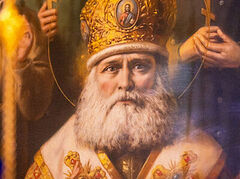
 Archbishop Sylvester. Museum of the Cultural Center of the Directorate of the Ministry of Internal Affairs of Russia in the Omsk region
Vladyka’s body was buried in the crypt of the Holy Dormition Cathedral in Omsk. The cathedral was demolished in 1935, and the Pioneers Public Garden was laid out in its place. In 2005, the government of the Omsk region decided to rebuild the Holy Dormition Cathedral. Excavations began on the site of the destroyed cathedral in the public garden, during which Vladyka Sylvester’s burial place was found. In a secret room beneath St. Nicholas the Wonderworker’s vestibule an icon with a dedicatory inscription to Vladyka, the remains of his vestments, a paraman, as well as fragments of the archbishop’s body were found (their authenticity was confirmed by the results of an examination). The new Holy Dormition Cathedral was solemnly consecrated on July 15, 2007.
On February 25, 2009, a shrine with the relics of hieroconfessor Sylvester (Olshevsky) was permanently installed at the Holy Dormition Cathedral of Omsk. It is situated in the lower aisle of the cathedral—in the cave church where Vladyka’s body had originally been buried.
During his life, Vladyka Sylvester, who witnessed the First World War, three revolutions, and the Civil War, spoke often about peace. But these were not words about peace after war, nor even about peace of mind. Vladyka thought in terms of the Heavenly realm—he spoke about what leads a Christian to salvation. I will conclude with Archbishop Sylvester’s words about peace in the Christian sense as an important value of our existence:
“The peace of Christ is the peace of conscience as moral integrity. The peace of Christ is peace with God as a daring prayer.”