In the name of the Father, and of the Son, and of the Holy Spirit!
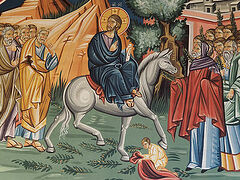
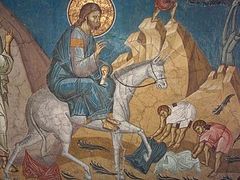
Dear brothers and sisters, greetings to you on this wonderful feast of the Entry of the Lord into Jerusalem—Palm Sunday, a flower-bearing day! Just like representatives of the chosen people 2,000 years ago, today you and I are standing and welcoming Christ our God, Who is coming to fulfill God’s promises from the Old Testament.
This feast is unique in that it merges great joy and exultation with tragedy. Tragedy is what will happen to Christ. In the hymns of this day, we hear: “Today the grace of the Holy Spirit has gathered us together, and we all take up Thy Cross and say: Blessed is He that cometh in the Name of the Lord; Hosanna in the Highest!” Archpriest Alexander Schmeman (1921–1983) says: “In order to feel the joy of this feast, Palm Sunday, every year, we must above all remember that this solemn Entry into Jerusalem was the only obvious triumph before a multitude of people during Christ’s earthly life. He resolutely refused all attempts to glorify Him, and His entire teaching is profoundly centered on humility and meekness. He never sought His own glory and avoided human honor in every possible way.” But suddenly, as if in violation of His former way of life, He accepts the human glory of jubilant Jerusalem.
Practically all of Jerusalem came out to praise Christ. And during the preparation for and observation of the Jewish Passover, Jerusalem was transformed into a city resembling Rome—there was a huge number of people there who were specially flocking as pilgrims from all over the world; so, once a year Jerusalem was like an enormous metropolis. But we know that according to tradition, forty days before His Passion on the Cross, Christ led His disciples to Mount Tabor and showed them Who He really was, so that they could see Him in a transformed state, in the Glory that He had before the beginning of the world. Shortly before, He had already said plainly: I and My Father are one (Jn. 10:30)—that is, “I am God”. He had already put it clearly to them: “I must enter Jerusalem where I will be spat upon, humiliated, insulted, beaten to bleeding, and put to death, in order to fulfill the promise.”
Christ always walked, and only once did He mount a donkey in order to fulfill the famous prophecy of St. Zechariah, who said: Rejoice greatly, O daughter of Zion; shout, O daughter of Jerusalem: behold, thy King cometh unto thee: He is just, and having salvation; lowly, and riding upon an ass, and upon a colt the foal of an ass (Zech. 9:9). All the four evangelists write about this event. However, if the first three write more joyfully, then St. John’s account is more reserved and more tragic. Most likely, Christ’s arrival on a donkey was a symbolic reenactment of the event that took place when Solomon was anointed king—the entry of the true King of Israel into Jerusalem. The laying of garments and palm branches in His path signified the emperor’s entry—that is, the Savior entered Jerusalem like the Roman Emperor, like an emperor of some country, like a king; He was welcomed as a king, but the crowds that greeted Him sought a leader to establish an earthly kingdom.
The Entry of the Lord into Jerusalem is the entry of the Lord into our souls, as theologians say. And, of course, on this day we not only rejoice in this event, but also note that this day was tragic for many people. After all, four days later, the same lips that had shouted: “Hosanna in the Highest!”—those for whom Christ had done a great favor—not just asked, but even demanded in exasperation: “Crucify Him! We demand it and will not leave until we get our way!” Perhaps some of us Christians condemn these people in our hearts: “How could they do that? After all, they had seen the Living Christ, God Incarnate!” Priest Sergei Gankovsky says in his sermon: “For 2,000 years, we Christians have now sought God, now fled from Him. This is how faith in our souls gives way to betrayal. While rejoicing and exulting, we must not forget why our God and Savior is going to Jerusalem. He is going there to die. A colt is carrying the Son of God to Golgotha, to His death. Before that, Christ, surrounded by His disciples, had warned them that the Son of Man would be betrayed and executed.”
While the Savior is talking about death, the disciples are asking Him about their positions in the future “earthly” Kingdom, dividing their “ministerial portfolios”, as it were. Sts. John and James addressed Christ and asked Him, as we would now say, for “cushy spots” in the age to come. “Grand us to sit at Thy right and left hand in Thy glory.” That is, Christ’s words: “I am going to die”, had not influenced them at all.
And St. Nikolai (Velimirovich) of Zica speaks about what is characteristic of each one of us in our weakness. He writes, “The request of James and John for glory without experiencing torments is the request of all descendants of Adam.” Christ’s disciples, like all other people, wanted somehow to “leap over suffering” and “leap into glory”. First of all, you must endure all torments worthily, and only then can you enter into the glory of God. The Heavenly Kingdom is prepared for all those who in this life prove themselves worthy of the Kingdom, regardless of their earthly rank, proximity to Christ or biological kinship, as was the case with these brothers and sons of Zebedee. Humility to the point of self–abasement and suffering to the point of death are the two lessons that the Lord wants to root deeply in the hearts of His disciples before His death, weeding out the “tares” of pride, self-conceit, self-exaltation and vainglory from them.
During our lives, all of us face situations when we must decide what to do, whether to act this way or that way. We say: “Act according to your conscience, and everything will be fine.” I’m going to tell you a frightening thing now: Does it always work? You ask a person: “Why are you doing this? It’s a mean thing to do.” And he replies, “But my conscience prompts me to (My heart prompts me to).” But St. Nikolai (Velimirovich) says these terrifying yet amazing words: “A conscience that is not illuminated by the light of the Gospel is a straight road to hell.” That is, you may think that you are acting according to your conscience—however your “ladder” will not lead you to Heaven but to hell.
In his excellent book, On the Secret Ailments of the Soul, Archimandrite Lazar (Abashidze; 1959–2018) reveals that we tend to believe that our actions are virtuous, but in fact they can turn out to be the terrible, hidden vices of pride, vanity, arrogance and self-satisfaction. And that’s why we need to purify our conscience. Because the conscience is like a tuning fork—it may give us a false tone. And it won’t be the voice of our conscience. Therefore, the most dreadful state, the most terrible sin is the state of a seared conscience. Because you can no longer repent—it doesn’t show you what to repent of. And since you are unable to repent, the Heavenly Kingdom is closed to you.
On this day, while celebrating the feast, let us recall the words of St. Silouan the Athonite: “In this life one man is a cook, another else is a driver, another else is a husbandman, another is a priest, another is a Patriarch, yet another is the head nation a state, a king; but God loves everyone. And who will receive the greatest reward? The one who loves God the most, regardless of his rank, position or title. The greatest reward!” And St. Nikolai (Velimirovich) instructs on this issue: “Neither the royal crown in itself guarantees leadership, nor does wealth and power signify seniority in Christian society. Rank and position remain empty forms unless they are filled with useful service to people in the name of Christ.” And then he continues: “He of you who serves his brethren the most out of love is the first in the eyes of God, and his status will not pass away in this world or in the next. Death has no power over love, nor over what love acquires. Just think deeply about how people would live if they compared and evaluated themselves and each other in terms of service and love, instead of comparing and evaluating themselves and each other in terms of power, wealth, luxury, position and external knowledge?”
This is what the Lord calls us to on this day, since theologians often associate the Entry of the Lord into Jerusalem with God’s entry into our souls. We are on the threshold of Pascha, Holy Week is beginning, and God enters into each of our souls. And what will our soul, our heart, and our conscience answer? Will it follow Christ? It will follow Him provided that it is not attached to the material world. And if it clings to material things, it will exclaim: “Crucify Him!”, or: “Get away from me! You are interfering with my life and preventing me from enjoying earthly benefits!” That is why the Lord says in the Gospel: He that loveth father or mother more than Me is not worthy of Me: and he that loveth son or daughter more than Me is not worthy of Me (Matt. 10:37). Love anything in this life—your brother, your sister, your mother, music, and so on; but love Christ above all else, otherwise your conscience will stumble and won’t provide proper guidance.
So, brothers and sisters, on this joyful and jubilant day, as we stand on the threshold of Holy Pascha—the day of our liberation from original sin, when by the grace of God we are once again adopted as daughters and sons of God—let us not despair, but take our palm branches and exclaim: “Hosanna! Blessed is He that cometh in the Name of the Lord! Lord, help me bear the cross that Thou hast given Me, so that I may always follow Thee with love—both in this life and in the life to come.”
Glory be to our God, always, now and ever, and unto the ages of ages. Amen.