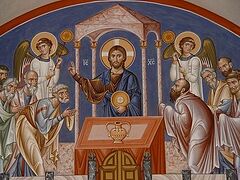
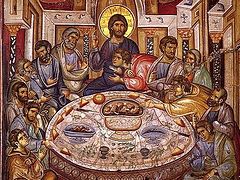
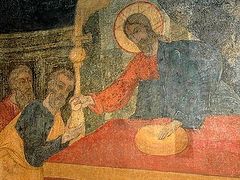
Now when the even was come, he sat down with the twelve. And as they did eat, he said, Verily I say unto you, that one of you shall betray me. And they were exceeding sorrowful, and began every one of them to say unto him, Lord, is it I? And he answered and said, He that dippeth his hand with me in the dish, the same shall betray me. The Son of man goeth as it is written of him: but woe unto that man by whom the Son of man is betrayed! it had been good for that man if he had not been born. Then Judas, which betrayed him, answered and said, Master, is it I? He said unto him, Thou hast said. And as they were eating, Jesus took bread, and blessed it, and brake it, and gave it to the disciples, and said, Take, eat; this is my body. And he took the cup, and gave thanks, and gave it to them, saying, Drink ye all of it; For this is my blood of the new testament, which is shed for many for the remission of sins. But I say unto you, I will not drink henceforth of this fruit of the vine, until that day when I drink it new with you in my Father's kingdom. And when they had sung an hymn, they went out into the mount of Olives. Then saith Jesus unto them, All ye shall be offended because of me this night: for it is written, I will smite the shepherd, and the sheep of the flock shall be scattered abroad. But after I am risen again, I will go before you into Galilee. Peter answered and said unto him, Though all men shall be offended because of thee, yet will I never be offended. Jesus said unto him, Verily I say unto thee, That this night, before the cock crow, thou shalt deny me thrice. Peter said unto him, Though I should die with thee, yet will I not deny thee. Likewise also said all the disciples. Then cometh Jesus with them unto a place called Gethsemane, and saith unto the disciples, Sit ye here, while I go and pray yonder. And he took with him Peter and the two sons of Zebedee, and began to be sorrowful and very heavy. Then saith he unto them, My soul is exceeding sorrowful, even unto death: tarry ye here, and watch with me. And he went a little farther, and fell on his face, and prayed, saying, O my Father, if it be possible, let this cup pass from me: nevertheless not as I will, but as thou wilt (Mt. 26:20–39).

Let there not be a single Judas here, not a single lover of money.
In the day of unleavened bread, when according to the Old Testament law the paschal lamb was to be slain and eaten, and when Jesus knew that his hour was come that he should depart out of this world unto the Father (Jn. 13:1), Jesus Christ, Who came to fulfill the law, sent His disciples Peter and John to Jerusalem to prepare the Passover, the Old Testament prefigurement which He wished to replace with the new Passover—His own Body and Blood. When evening came, the Lord arrived with His twelve disciples in a large upper room, furnished and prepared, belonging to a certain man of Jerusalem (Mk. 14:12–17), and reclined at table. In order to show that in the Kingdom of God—which is not of this world—it is not earthly greatness and glory but love, humility, and purity of spirit that distinguish the true members, the Lord rose from the supper and washed the feet of His disciples. Having washed their feet and reclined again, the Lord said to the disciples: Know ye what I have done to you? Ye call me Master and Lord: and ye say well; for so I am. If I then, your Lord and Master, have washed your feet; ye also ought to wash one another's feet. For I have given you an example, that ye should do as I have done to you (Jn. 13:12–15).
After the washing of the feet, Jesus Christ first celebrated the Passover according to the law of Moses, and then instituted the new Passover—the great Mystery of the Most Holy Eucharist. The institution of the Mystery of Holy Communion is the second event that the Orthodox Church commemorates on Great Thursday.
The Mystery of Holy Communion, instituted by the Lord before His sufferings and death, is performed according to the commandment of Jesus Christ: Do this in remembrance of Me (Lk. 22:19). This has continued from the first times to the present on the many altars of the Universal Church.
At the supper the Lord expressly foretold to the disciples that one of them would betray Him, and that it would be the one to whom He would give the morsel after dipping it in the dish. And having dipped it, He gave it to Judas Iscariot. Satan entered into him after the bread; and the traitor immediately left Christ and His Church. It was already night (Jn. 13:1–30). Having ended the dispute of the apostles about primacy, which should consist not in dominion and possession, but he that is greatest among you, let him be as the younger; and he that is chief, as he that doth serve. And having foretold to the apostles the common temptation, and to Peter the threefold denial of Christ and His appearance to them after the Resurrection in Galilee, the Lord entered with them into the Garden of Gethsemane—on the Mount of Olives (Lk. 22:24–28; Mt. 26:30–35). Here His sufferings began—first the spiritual, and then the bodily. At the beginning of His sufferings, the Lord said to the disciples: Sit here while I go and pray there; and taking with Him Peter, James, and John, who had been witnesses of His glory at the Transfiguration, He began to be sorrowful and deeply distressed. My soul is exceeding sorrowful, even unto death: tarry ye here, and watch with me said the God-Man to His disciples (Mt. 26:38). Going a little farther, He bowed His head and knees and prayed until He sweated blood—as a man, tasting the cup of sufferings and completely surrendering to the will of the Father. An angel from heaven appeared to Jesus Christ and strengthened Him. During His prayer the Lord three times approached His disciples and said to them: Watch and pray, lest you enter into temptation; the spirit indeed is willing, but the flesh is weak. But the disciples could not watch in prayer with the Lord, for their eyes were heavy.
The Gethsemane prayer of Jesus Christ teaches us that in the midst of temptations and sorrows prayer gives us lofty and holy consolation and strengthens the readiness to meet and endure sufferings and death. The power of prayer, which consoles and strengthens, the Lord instructively showed by His own example before His sufferings and death; at the same time He said to the sorrowing apostles: Watch and pray, that ye enter not into temptation: the spirit indeed is willing, but the flesh is weak (Mt. 26:41).
Around midnight the traitor comes into the garden with a multitude of armed people sent by the chief priests and elders. The Lord Himself goes out to meet them and with the words, “It is I,” by which He was making Himself known to them, casts them to the ground and then humbly allows the traitor to kiss Him and take Him for sufferings and death (Mt. 26:36–56; Mk. 14:32–46; Lk. 22:39–53). Thus the Lord, Who throughout His earthly life manifested divine omnipotence and authority over the law of nature, Who cast the traitor and the crowd to the ground with the words “It is I”, Who had legions of Angels at His command and yet came to offer Himself as a sacrifice for the sins of the world, voluntarily and humbly delivers Himself into the hands of sinners!
By tradition all the faithful on this day receive Holy Communion of the Holy Mysteries of Christ.
—Archpriest Gregory Debolsky, Days of Divine Service of the Orthodox Church
Hymns from the service for Great Thursday
When the glorious disciples were enlightened at the washing of their feet at the Supper, then the ungodly Judas was darkened by the disease of avarice, and to the lawless judges he betrayed Thee, the Righteous Judge. Behold, O lover of money, this man who because of money hanged himself! Flee from the insatiable soul that dared such things against the Teacher! O Lord Who art good to all, glory to Thee!
Troparion, tone 8
Of Thy Mystical Supper, O Son of God, accept me today as a communicant; for I will not speak of Thy Mystery to Thine enemies, neither like Judas will I give Thee a kiss; but like the thief will I confess Thee: Remember me, O Lord, in Thy Kingdom.
Troparion, instead of the Cherubic Hymn, tone 6
Explanation of the Gospel of Matthew
As many now say: I would like to see the face of Christ, His image, His garment! Behold, you see Him, you touch Him, you taste Him. You desire to see His garments, yet He gives you Himself—not only to see, but to touch, to taste, and to receive within you. Therefore let no one approach with contempt, no one with faint-heartedness, but all with fervent love, all with a burning heart and zeal.
If the Jews ate the lamb with haste, standing, with sandals on their feet and staves in their hands, then how much more watchful must you be . They were preparing to go to Palestine; you are preparing to go to Heaven. Therefore one must always be watchful—great is the punishment for those who partake unworthily. Think how you are indignant at the traitor and at those who crucified Christ. Therefore beware lest you too become guilty against the Body and Blood of Christ. They slew the all-holy Body; and you receive it with an unclean soul after such great benefactions. Indeed, He was not content merely to become man, to be struck and slain; but He also communicates Himself to us, and not only by faith but in very deed makes us His Body. How pure, then, must be the one who enjoys the Bloodless Sacrifice! How much purer than the rays of the sun must be the hand that divides the Flesh of Christ, the mouth filled with spiritual fire, the tongue reddened by the awesome Blood! Consider what honor you have been counted worthy of, what table you enjoy! At the sight of it the Angels tremble and dare not look without fear because of the radiance proceeding from it—with that we are fed, with that we commune, and we become one body and one flesh with Christ. What shepherd feeds his sheep with his own members? But what am I saying—a shepherd? Often there are mothers who give their newborn infants to other nurses. But Christ did not suffer this; He Himself feeds us with His own Blood, and through this unites us to Himself. Consider that He was born of our nature. But you will say: this does not apply to all. On the contrary, it applies to all.
If He came to our nature, then clearly He came to all; and if to all, then to each one individually. Why then, you ask, did not all receive benefit from it? This depends not on Him Who deigned to do this for all, but on those who did not wish it. With each believer He unites Himself through the Mysteries and Himself feeds those whom He has begotten, and does not entrust them to anyone else; and by this He again assures you that He has taken your flesh. Therefore, having been counted worthy of such love and honor, let us not give ourselves over to negligence. The actions of this Mystery are not accomplished by human power. He Who performed them then, at that supper, performs them now. We occupy the place of servants, but Christ Himself sanctifies and transforms the gifts. Let there not be a single Judas here, not a single lover of money. If anyone is not a disciple of Christ, let him depart; the table does not admit those who are not. This is the very same table that Christ set, and it is in no way inferior to that one. It cannot be said that Christ performed that one and a man performs this one; both are performed by Christ Himself. This place is the very same upper room where He was with the disciples; from here they went out to the Mount of Olives. Let us also go out to where the hands of the poor are stretched out—this is precisely the Mount of Olives. The multitude of the poor are the olive trees planted in the house of God, pouring forth oil that will be useful to us there—which the five virgins had, and which not having taken, the other five perished. Taking this oil, let us enter, so that with burning lamps we may go out to meet the Bridegroom. Taking this oil, let us depart from here. No inhuman person, no cruel or unmerciful person, in a word—no unclean person should approach here.
On Holy Communion
Great Thursday. We have approached the Chalice of the Lord, we have been at the supper with the Lord: Glory to Thee, O God! Glory to Thee, O God! Glory to Thee, O God! This is a great day for the Lord today! A most glorious triumph in Heaven! …How many souls clothed in the white garment of justification have tasted divine life and have been most intimately united with the Lord! The Body of the Lord—the Body of the Church—has been renewed and clothed with its proper glory, hidden from human eyes but visible to the eyes of angels. The Angels worshipped the Firstborn when He was brought into the world in His power, and now they worship Him because the world is again being led back to Him Himself. They worshipped and sang: Thy throne, O God, is for ever and ever: the sceptre of thy kingdom is a sceptre of righteousness. Thou hast loved righteousness, and hated iniquity (Ps. 44:7–8).
The Great God and Ruler of all was not content with having created you in His image and likeness; nor with the fact that when you sinned and offended Him and fell from your dignity, He sent His Only-begotten Son to live thirty-three years on earth in order to seek you out and, having accepted terrible sufferings and a painful death on the Cross, to redeem you and save you from the hands of the devil to whom you had enslaved yourself by sin, and to raise you up again to your former dignity. But besides this, He also instituted the Mystery of the Body and Blood as food for you, for the union with your nature of the whole power of Christ… He Himself is eternal by His divine nature, and eternal is His love for you, by which before all ages He resolved in His counsel to give you His Son in a certain wondrous and incomprehensible manner.
The Lord is in us! Let us take care to hold Him in ourselves forever… In the days that have passed we have been cleansing our hearts for the reception of the Lord… Now let us give Him rest, let us give Him consolation, let us open to Him a pleasing activity in us… Rest consists in the removal of worldly vanity, in the modest satisfaction of the needs of the body, and the cutting off of the action of the passions… Consolation for the Lord consists in pure intentions, in readiness for every good deed… A pleasing activity in us will be opened to Him through our worship and prayer… Prayer will conduct the power of God into all the members of our nature and will give Him free course to act in us… Let us constantly remember that we bear the Lord within ourselves, and then our conscience will not permit anything that could offend Him.
From: Readings For Every Day of Great Lent, Ed. N. Shaposhnikova (Moscow: Danilov Monastery, 2025).