Photo: центрвик.рф
Homily 3: Depart from Your Inner Hell Today
Today, beloved, is the day of the burial of the Lord, a great and sacred day. The seventh day of creation was important, for on that day, as Moses relates, God ended … all His work which He had made over the preceding six days (Gen. 2:2). The present Saturday is yet more significant, for on it, the Son of God rested from His works, having completed all the works of His mission, after the second creation.
The first creation was the work of omnipotence alone: For He spake, and they came into being; He commanded, and they were created (Ps. 32:9). The second creation was, on the other hand, not a work of omnipotence alone, but of all the perfections of God, primarily freedom and love. The first creation cost the Creator nothing, but the second cost the Son of God great effort. And why do I say effort? It cost torments—and the most terrible at that—and death—and the cruelest at that. Great, then, is this present day of rest—the sacred mystery of His repose in the tomb.
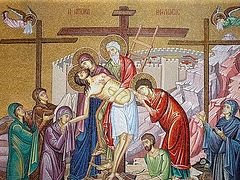
The work of the Son of God seemed to have ceased with His death upon the Cross: His body, like that of other dead men, became soulless, motionless, and senseless—thus was He taken down from the Cross, thus anointed with fragrant spices, thus buried, thus sealed within His tomb. But when everything visibly ceased, at the same time, everything began invisibly. Listen to how the Holy Church depicts this new, unseen, great work of the Lord resting in the tomb: “In the tomb with the body, in hell with the soul as God, in Paradise with the thief, and on the throne with the Father and the Spirit, Thou fillest all things, O boundless Christ.”
This is what He was doing and where He was—He who lay at rest in a small garden and in the yet smaller tomb of Joseph! This day was for Him a day of rest in the flesh, but of the greatest activity in spirit and Divinity. His tormented flesh remained in the tomb, not separating from the Divinity that permeated it. His all-holy soul, also not separated from His Divinity, descended into Hades, to lead up from there everyone who was able to ascend on high. His spirit, filled with Divinity, appeared in Paradise, where the Wise Thief had just scarcely entered before Him. Finally, the Divinity of the Son remained, as always, on the throne “with the Father and the Spirit.” Truly, everyone and everything was filled with the activity and presence of the God-Man.
But, beloved, are our hearts filled with the Lord? Do we have Paradise or hell there? Without the Lord and His grace, even Paradise is not Paradise, but with the Lord and His grace, even hell is not hell. If the trees of Paradise, of virtue and faith, are growing within you, in your soul, then thank Him Who is resting in the tomb. This was His planting, so thank Him and receive Him in your paradise as did Joseph in the garden, and offer Him your heart in place of a burial bed. But if, to your misfortune, you’ve allowed the flame of the passions, the undying worm of self-love and lust, the coldness and Tartarus of avarice and insensibility into your soul, then know that He will visit your inner hell as well, and you will hear from Him—in your conscience—the word of life, calling you up from the abyss in which you dwell.
Don’t neglect the voice of the word of salvation, my beloved, in whatever form you hear it. If there’s ever a fitting time to depart from your inner hell through repentance, it’s this very day, when the Savior leads out of hell even those sinners who were unrepentant in their own time, who resisted the preaching of Noah while God’s long-suffering awaited them before the flood.
Amen.
***
Homily 5: Where Do Our Thoughts Turn Before This Shroud?
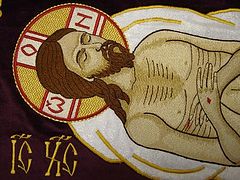
We don’t know, brethren, where your thoughts turn before this Shroud, but ours turn to our own grave. Our life, it seems, will pass as have these Forty Days. And then the great Friday of our death will come for all of us; and after it—the great Saturday of repose in the bosom of the earth; great indeed, by its very duration for us. For the Lord descended into the tomb for but three days, but we will remain beneath the ground for a long, long time. Reflecting upon this is so useful for our souls that some good Christians consider it their duty to have their coffins ready and in plain view. But let us, at least today, turn our thoughts to our coffins, and we’ll see what will happen to us.
And when we’re lying in the tomb, a crown will be placed on our head, for the Church doesn’t deprive even the very last of its sons of this sign of the end of his earthly labors. What would you like this crown to be made of? Roses and lilies from Paradise? Let those who are worthy be adorned with them! As for us, it’s better that this crown, like the crown of the Savior, be woven of thorns—that is, of sorrows and privations borne in His name. So long as we walk in the flesh, these thorns are contrary to our outward man, for they pierce his head; but at the hour of death, they are the finest adornment for the soul! By these sacred thorns upon the head, the angels of God will most readily recognize us as true followers of the Crucified One and will open to us the Paradise won by His Cross.
We will likely have wounds in our grave as well. Oh, if only they came not from the physician’s hand alone, nor merely from the ravages of disease! If only among these wounds there might be found at least some of those marks of which St. Paul once boasted, saying: For I bear in my body the marks of the Lord Jesus (Gal. 6:17). Alas, we will bear many wounds throughout our lives, both physical and spiritual, but they can’t be called the marks of the Lord! For who inflicts them upon us? Either our own flesh with its passions and intemperance, or the world—because of our subservience to its mad rules and whims. Let us not appear before the Lord with such wounds! They must be healed by repentance while we are yet among the living.
There may also appear some Joseph and Nicodemus at our graveside to pay us their last respects. Whoever they may be, let them show their devotion to us and honor our memory not with an abundance of fragrances, nor with needless expense on the adornment of our coffin and grave, but by redoubling the prayers of the Church for our sins and by works of charity. For how does it benefit a soul to have a beautifully decorated gravestone? Before the throne of the all-seeing Judge, it will need not a corruptible covering of gold and silver, with which coffins are covered, but the precious robe of Christ’s merits—the only thing capable of covering our spiritual nakedness.
Finally, our tomb, like that of our Savior, will be sealed. Thank the Lord that for us it won’t be the seal of Caiaphas, but of our mother, the holy Church! But for this sacred seal to retain its full power over us and to keep our remains beyond the reach of the evil spirits of the air, throughout our lives we must preserve unbroken that seal of sanctification with which the Holy Church itself marked us in the baptismal font, and conduct ourselves in all things as true and faithful children of the Church. But if we’re Christians in name only, neglecting the fulfillment of the holy ordinances of the Church, if we don’t have an inner spiritual bond, no filial assistance, and no unity of spirit with this our Mother, then her sacred seal will have no power over our grave—it will fall away, as a seal falls from wax that won’t take the impression.
Such are the thoughts, my brethren, with which we stood before the Shroud this morning, singing the burial hymns of the Author of our salvation. Those who wish may share them with us and carry them further. At the Savior’s tomb, after His death, there’s nothing more fitting or more natural to contemplate than the end of our own lives on earth.
Amen.