Every year we celebrate Pascha, the triumph of the Risen Christ over death. And every year Church calls on us with joy to go to the graves of those dear to our hearts. But with what do we go to their graves?
 Artist: Nikolai Vasilyevich Kharitonov
A Day of Joy, not Sorrow!
Many people (mainly the Slavs) believe that Radonitsa is purely a Church institution. But that’s not quite true. If we turn to the text of the Church Typicon, we will not find the commemoration of the departed on the ninth day after Pascha there. And in modern calendars, not all of the Local Orthodox Churches have a feast called “Radonitsa”.
However, even in ancient times, the Church Fathers called on Christians to rejoice in the Radiant Resurrection of Christ not only with the living, but also with the departed. There is reliable information that from the third century on the faithful visited Christian cemeteries during the days of Paschal joy.
Thus, this pure and joyful Christian tradition has existed for a very long time and is quite natural for believers in Jesus Christ, the Son of God, Who in the future will resurrect all the departed and grant them eternal life. Christians go to the graves of their loved ones to share the joy of the Resurrection of Christ with them, and therefore the joy of the coming universal resurrection, which will be for everyone. Radonitsa is Pascha for the dead.
On the days of Holy Pascha, we greet each other with the words: “Christ is Risen!” It is quite natural to say the same words to the departed, because in them is all our hope for the future renewal of the whole world in this exclamation.
Radonitsa is filled with deep spiritual meaning, as a day of special—joyous—commemoration of the dead. Its service is fundamentally different from the other commemoration services of the Church year—instead of the mournful “I weep and lament when I consider death”, triumphant Paschal hymns full of bright hope are sung. And, as a symbol of joy and renewal rather than mourning and loss, the clergy wear white vestments.
On this day, those who have passed into eternity are commemorated everywhere: in churches, cemeteries, and at the festive table at home…
However, if we dig deeper into the background of this special day of remembrance of the dead, we can see two layers: not only Christian, but also… pagan. And it is deplorable to see that our “progressive” contemporaries do not always distinguish between what meaning the Orthodox Church fills this feast with and what rudiments of pagan rituals have persisted in it. Strictly speaking, many secular and folk customs are connected and intertwined with Christian festivals. The Church has accepted some of them as reasonable and fully compatible with the Christian faith, while categorically rejecting others as superstitions and pagan prejudices that have nothing to do with Orthodoxy.
The Legacy of Pagan Times
“Radunitsa”, or “Naviy den’”—that’s what our ancestors called their custom of commemorating the dead in the spring, and they used to do so long before Christianity came to the Slavic lands. They, too, visited cemeteries for this purpose. The ancient Slavs believed in the afterlife as well, but naturally they imagined it differently from what Christian theology teaches us.
There were beliefs that although the souls of the dead could not leave the afterlife, they were somehow able to influence the realm of the living at special moments and even visit it briefly—for example, during the solstices, equinoxes, and full moons. This powerful, persisting belief is still a foundational element of the religious cults of many peoples in our time; they believe that the departed can supposedly acquire supernatural abilities and influence the lives of those living today—they can cause natural disasters, improve field crop capacity, ensure good weather, and contribute to human and animal health.
And therefore, in order to “appease” the souls of their reposed grandparents and great–grandparents, to earn their favor and help, people would go closer to their remains—to their graves—and performed “trizny” there: ritual feasts with an abundance of food, alcohol, songs and dances. Toasts of praise would be made on the graves, and some contents of the bowl were poured onto the ground. People also left food and treats there, because they believed that the dead would be able to consume it all. In general, they did everything that, by human standards, could please any mortal. Truly, how can you imagine the joys of the spiritual, unearthly realm if, according to the Apostle Paul, Eye hath not seen, nor ear heard, neither have entered into the heart of man, the things which God hath prepared for them that love Him (1 Cor. 2:9).
Centuries passed, the Slavs abandoned their pagan beliefs and were baptized, becoming Christians. But did they unequivocally abandon them? As life shows, the magical, superstitious perception of the world still persists not only among many Christians, but even among atheists who believe in science and technological progress… And many still perform the described pagan rituals in cemeteries—most likely without even realizing their true nature and origin, but simply because their immediate ancestors, parents and grandparents, did so. Or maybe it is simply because they don’t have enough faith and knowledge of the basics of the Christian faith?
So How Should Christians Observe Radonitsa?
If we outline the essence of the Orthodox traditions of observing Radonitsa, which our clergy constantly talk about in churches and write in the media, then it is advisable to start this day by coming to church by the beginning of the service, submitting your intercession list with the names of the departed for commemoration. After the Divine Liturgy it would be good to pray at the memorial service (panikhida) for their repose.
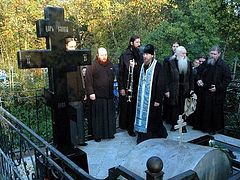
Whether you have managed to pray at the church service or not, when heading for the graves of your loved ones, along with cleaning tools it would not be bad to take the texts of memorial prayers and the Gospels in printed or electronic form to read at the cemetery. And sometimes people have a chance to invite a priest to the cemetery to celebrate a Litiya (a brief memorial service)—then the memorial will become even more solemn and heartfelt. Anyway, whether with a priest’s participation or not, don’t forget to light a candle, an icon lamp and read the prayers yourselves and sing Paschal hymns.
People often make excuses or simply wave their hands, saying that they don’t know any prayers. But you can always pray in your own words—it is not the textual accuracy of the prayer form that matters; it is not a magical spell where you can’t omit or alter anything—what matters is that the words of prayer should come from your heart. God listens to our hearts rather than just words. And you can pray for the most basic yet essential things, but, most importantly, pray with love and compassion: that the Lord will forgive your reposed loved ones all their voluntary and involuntary sins, have mercy on them and grant them the Heavenly Kingdom.
Pouring alcohol on a grave (libations) is unworthy of the title of a Christian, absurd and even barbarous. And drinking alcohol in a cemetery is absolutely inappropriate as well…
“Feeding the dead”, leaving food in the cemetery, is also pure paganism, a rite that has nothing to do with Christianity! The Church has its own traditions that encourage believers to host memorial meals, donate food to the church and provide meals to those in need.
But these actions have a different meaning, not at all the same as in pagan “trizny”. Food can be a form of charity given by the living to the living for the sake of the departed, and not a sacrifice directly to the dead—they no longer need anything in this material world. And the way we do charity is very important—it should make us more generous, merciful, and compassionate. As for leaving food on the grave—where is the mercy here? To whom?
The human soul will always languish and tremble before the mystery of death, because beyond this line is the unknown. But if the memory of those who have passed away is dear to us, then it is best to express our love for them by prayer and the hope that since Christ was raised from the dead, then we will all come back to life, “and we shall behold Christ, the Sun of Righteousness, Who causes life to dawn for all” (from the Paschal Canon, ode 5).