Pyotr Mamonov
The Worst Became the Voice of Conscience for Many
On April 14, the actor and musician Pyotr Nikolaevich Mamonov would have turned seventy-five. He was known in two absolutely different, almost opposite incarnations. For some, he was the front man of the Zvuki Mu Soviet and Russian rock band, whose concerts resembled sessions of “positive madness”; and for others, he was a hermit and “fool-for-Christ,” whose lead role in 2006 Orthodox drama film, The Island, made the audience weep and change their lives.
In Russian cultural tradition, there is a special type of person who cannot be understood by conventional standards. In Russia, such people used to be called “fools for Christ’s sake”, who voluntarily chose the path of feigned madness. A “fool-for-Christ” could tell the Tsar the truth bluntly when the nobles were silent, or expose societal hypocrisy by coming into the square with an inappropriate outward appearance. A “holy fool” could be “the worst of all” to remind everyone else that the last shall be first (Matt. 20:16). The words of those “fools” went straight to the heart. Pyotr Mamonov was such a man. He walked a path from a rocker and alcoholic with scandalous behavior to a hermit. Pyotr Nikolaevich was not a priest, but many people came to him in search of spiritual counsel. For many, his life became a living example of how a person can change beyond recognition if he finds his way to God.
The Path from Antics to Repentance
 Pyotr Mamonov and the Zvuki Mu rock band in 1987. Photo: Wikipedia.org
I first heard the Zvuki Mu band in the second half of the 1980s, and it made a huge impression on me because it was so unlike the typical Soviet rock music. The musicians of that unique band called their style, “Russian folk hallucination”. I saw the Zvuki Mu vocalist and songwriter in 1989 in the Musical Ring TV show broadcast from Leningrad and was really dumbfounded. I had never heard about “holy fools” before, but subconsciously I understood that Mamonov was certainly not a mere buffoon. His antics had some deep meaning.
Mamonov’s life until the age of forty-five was the classic “apophatic” path (path of denial), when a person goes through all the circles of hell to realize that life without God is death.
In a drunken brawl Mamonov was stabbed right in the heart. He experienced clinical death. In the abyss of hell, the truth was revealed to him.
This is what Konstantin Kinchev, the front man of the Alisa rock band,1 said about him:
“Mamonov is neither the stage nor an image. He is a man who came to the edge and then returned to speak about it.”
Pyotr Mamonov himself related:
“I had a total collapse in my life. The turning point came when I was forty-five. I had money, fame, children, and a good wife. I started thinking about the purpose of life… And my great-great-grandfather was an archpriest of St. Basil’s Cathedral in Moscow. I thought: ‘Why not buy a prayer-book and see what they pray about?’”
After experiencing metanoia (a change of mind), he came to the faith as the only purpose of existence. Pyotr Mamonov became a modern-day Russian “fool-for-Christ,” who took on the ascetic labor of “voluntary madness” in order to expose the world in its pride and sin. A “holy fool” pretends to be insane in order to “bring philistines out of a state of their mindless lethargy”—these words of the young Mamonov about his rascally antics surprisingly coincide with the essence of Christian “foolishness for Christ,” which he demonstrated in his public image—from provocative self-abasement in his early career to strict preaching in his mature years. It was a consistent path of “voluntary madness”, where outward absurdity served to expose the world.
From a Monk in The Island to Ivan the Terrible in The Tsar
 A shot from The Island
Mamonov’s collaboration with the film director Pavel Semyonovich Lungin began when the performer was still a “mischievous Moscow reveler.”2 He starred as an avant-garde saxophonist in the “Taxi Blues” drama, after which the Russian movie community realized that a great artistic talent had been born; although Mamonov did not act—he lived on the screen, bringing his hooliganism, alcoholism and other scandals to it.
In the early 2000s, the former frontman of Zvuki Mu underwent a metamorphosis. It was as if he had been reborn. When Lungin invited Mamonov to play Elder Anatoly in The Island, he did not choose a mere actor, but a man who had already been living this way. Mamonov did not act repentance—he lived it on camera.
The actor Viktor Sukhorukov, who played Fr. Philaret in The Island, recalled:
“Mamonov combined childlike spontaneity and the wisdom of an elder. He could be harsh, but there was no malice in it—only pain for people.”
People went to watch the film The Island in cinemas as if they were going to Confession, and then they flocked to Mamonov in the village he lived in for advice and healing—as if to a real elder. The actor himself was horrified by such veneration. He strictly separated himself from his image, saying that he was “too small” for holiness.
Then Mamonov played Ivan the Terrible in Lungin’s film, The Tsar—an extremely religious (to the point of fanaticism) Russian autocrat who killed many people for the sake of the greatness of the State. At first, the Tsar honors Theodore (Kolychev), the Abbot of Solovki Monastery, begging him on his knees to become Metropolitan of Moscow and All Russia, but over time, under the influence of the oprichniki3 whom Metropolitan Philip opposed, he abruptly changes his attitude towards him and exiles him for “disobedience”, while continuously repenting of his sins. Although Ivan the Terrible is tormented by anguish, his pride prevails. Mamonov acted all this with incredible accuracy.
Elder Anatoly and Ivan the Terrible are two diametrically opposite images, but Pyotr Nikolaevich wanted to understand the essence of the sin that he was trying to eradicate from himself by acting as a cruel tyrant.
As the well-known Russian actor, director and former Orthodox priest Ivan Okhlobystin, who played the role of the court jester Vassian in The Tsar film, said:
“Mamonov was a man who did not act faith—he lived in it. And that’s why everything he did was real—sometimes scary, sometimes incomprehensible, but real.”
A Preacher in the World
Pyotr Mamonov “preached” through the secular media, which usually avoid frank conversations about Christ. For eight years, he hosted a program on the Ekho Moskvy (“Echo of Moscow”) Russian talk radio station for free, in order to be able to “hint about Christ gently”—in between CDs of classic rock music he had played.
Pyotr Mamonov:
“I realized that if I lived a day and it didn’t make anyone feel good, then I lived it in vain. Because there will be death, eternity, and a meeting with God. And what am I going to tell Him?”
He was not a priest, but rather an “unpaid Church worker” who went to places that official sermons could not reach—to television talk shows where he spoke about God so bluntly that his interlocutors were lost.
Priest Andrei Chizhenko, a writer:
“His almost epileptic provocativeness in the outward manner of his creative work was akin to ‘foolishness for Christ’. It wasn’t pride or a desire to stand out, but pain for people. There was a great love for man and the search for God behind that.”
Pyotr Mamonov:
“A sin, even a petty one, leaves a lasting effect on my soul. Everything is seemingly fine—I neither drink nor smoke. But still, when I wake up in the morning, I feel melancholy. Why? Because no living place is left. I have left almost nothing in myself to live and love by. Only wounds. And it is very scary and vexing; I did all of this with my own hands.”
Simplicity Bordering on Genius
 Pyotr Nikolaevich Mamonov after receiving the Golden Eagle Award. Photo: vladnews.ru
Mamonov’s “foolishness for Christ” was not demonstrative. It manifested itself in his ability to speak about the most serious things (death, the purpose of life) in a language devoid of any affectedness. Pyotr Nikolaevich went on stage to receive the Golden Eagle Award for his part in The Island in dirty shoes and a grimy sweater to talk about death, repentance, the future of the country, and abortions.
Pyotr Mamonov:
“Why do we kill four million Suvorovs, Ushakovs, Lermontovs, and Pushkins a year? What recklessness! It’s growing into a serious crime!”
Mamonov’s manner of speaking was characterized by simplicity bordering on genius.
Pyotr Mamonov:
“I was recently a winner of the Vladimir Semyonovich Vysotsky4 Prize. I said, ‘Girls, come on, have as many children as possible!…’ And how I rejoiced then! Suddenly three young ladies at the back stood up, all pregnant, and said, ‘Pyotr Nikolaevich, don’t worry, everything is all right with us…’ I replied, ‘Good!’”
He Didn’t Want to Return to Our World after Clinical Death
When asked about the meaning of suffering, Mamonov would answer simply and at the same time with theological precision:
“Sometimes life hits us, but these blows are our medicine. In these trials, we become purer and purer. Gold is purified in fire. So are our souls. The Lord is not an angry man with a stick who sits on a cloud and counts our misdeeds. No! He loves us more than our mothers, more than everyone put together. And if He gives us sorrowful circumstances, it means that our souls need it.”
Mamonov’s “foolishness for Christ” was not a theatrical role that could be turned on and off. It was his way of life in which acting crazy served his humility, and provocation served his preaching. As one article about him says:
“Mamonov was beyond words. He was a man of great stature, not only in art, but also in the quest for truth and God.”
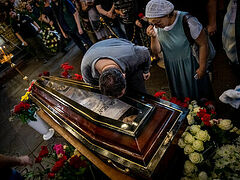
On July 15, 2021, Pyotr Mamonov passed away. Those who knew him in the final years of his life recall that he was burdened by “the need to continue the routine ritual of earthly existence,” and following his apparent death, he felt “disappointed” by his return to earth. He departed from us, leaving us not only his songs and films, but an example of how you can rise from the deepest abyss to the light and be “not of this world”, while remaining in earthly reality.
In Russia, “holy fools” were often regarded as “God’s messengers”. That’s exactly what Pyotr Mamonov was. He told us the truth about God, death, and love—which we feared to tell ourselves.