Olga Stefanova is a documentary filmmaker, the author of several films and a book about Antarctica. Her film about the polar Vostok Station was personally recognized by the president of Russia. Olga spoke about her journeys to the continent and shared the details of life in such extreme conditions.
 Olga Stefanova
— Hello, Olga. You have made several trips to Antarctica. Could you please tell us how your interest in that continent began?
—It is an old story. There were many factors involved. The books I had read, which vividly described the polar world, also played their part. I longed to go there, to witness the human relationships that develop on such expeditions. I wanted to feel connected to those fearless people. Through the prayers of my godmother, many wonderful things happened, thanks to which I finally found myself in Antarctica. After that, it was hard to give it up. One project after another kept emerging. And glory be to God, I was able to bring my plans into being. So far, I have participated in eight expeditions to Antarctica.
—What were your first impressions when you arrived there?
—First and foremost, the people made the strongest impression on me. Of course, also the Antarctic landscape. My very first trip was to the airfield of Novolazarevskaya Station. It is an airfield located on what is called blue ice, a special section of the glacier. The ice there looks almost scaly, and the sun is reflected in every facet. Everything sparkles and dazzles intensely because the sunlight is so bright—you can’t remove your goggles. And I thought, how could anyone film this and look at the camera monitor?
The air was astonishingly fresh, so different from the air in Moscow—it was rich, tangible, almost something you could taste. And of course, I remember the eyes of the people who welcomed us—open, joyful, alive. They had already spent a long winter in Antarctica by that time. They were constantly trying to help us in some way, to bring us joy, always telling us stories with smiles on their faces.
—You spent an entire year at the Russian Bellingshausen Polar Station. What joys and difficulties did you experience there? What did you do during that time?
—I was with the Russian Antarctic Expedition as a documentary film director and worked on making a movie. The station is located on King George Island (Waterloo Island). My task was to make a film about how polar workers spend the winter in Antarctica. Additionally I had duties like everyone else at the station—a duty shift once every two weeks. I was also the steward of the common room, which meant that I welcomed and saw off guests and kept things in order.
Of course, there were difficulties. But honestly, I don’t especially remember much of that now, except perhaps the fierce winds. During storms, the snow falls parallel to the ground. In general, all of my trips there were deeply desired, and therefore joyful—including the year I wintered at Bellingshausen Station. For me, it was the first time I was ever away from my usual environment for so long. Around me were people I had never known before and had not chosen myself. There was complete isolation from the outside world, and my ordinary life was entirely reformatted.
The polar workers themselves live quite ascetically. They have a strict routine. In some ways, it even resembles the life of a monastery. There is nothing there to distract you like there is in everyday life—no cafés, no cinemas where you can go to unwind. I encountered a completely new way of life, a new rhythm. Naturally, it is very quiet there in terms of events, information noise, and bustle. You are never late anywhere, never stuck in traffic, never pushing through a crowded subway. Everything is entirely different.
Completely different opportunities appear—chances to look within yourself, to meet yourself, to see what you have always hidden from yourself. Those discoveries were, of course, difficult. And, you had to live in such a way with the group that wintering would not become hell for anyone. You had to find and apply certain measures, first of all to yourself, so that you could live through that year peacefully with everyone else.
The season of the Antarctic summer arrived, and it became clear that soon the ship Academic Fyodorov would come for us from Cape Town, and we would leave for the mainland. On the one hand, it was probably time—we had lived through so much, and we missed much; I wanted to return home. But on the other hand, the nearer that day came, the more my heart ached, and the less I wanted to leave that place.

And the more I thought: The polar workers would return, rest for a year, and then be able to apply again to the Russian Antarctic Expedition. But what about me? How could I come back here? Those thoughts of returning wouldn’t leave me alone. What could I think up to get here again? Where could I find funding?
—Olga, I know that there’s a church in Antarctica. Please tell us about it.
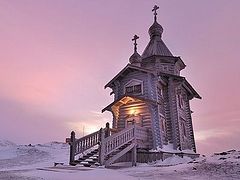
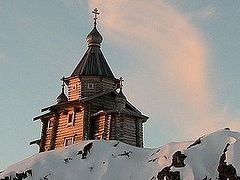
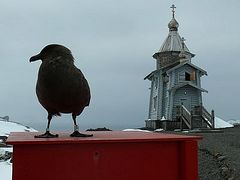
—Yes. It is a dependency of the Holy Trinity-St. Sergius Lavra. The church is dedicated to the Holy Trinity and functions like any ordinary parish church. Services are held on all feast days, as well as on Saturdays and Sundays. Molebens and memorial services are also served. The church itself is small and cozy, assembled log by log from Altai cedar and larch.
—Do foreigners go there as well?
—Yes. Around our station, wintering there are Chileans, Uruguayans, Chinese, South Koreans, and Argentines. It is a tradition of Bellingshausen Station to invite guests for Pascha. And when people come to visit, they always step inside the church. The building is beautiful, unique in the Antarctic landscape, and naturally draws everyone’s attention. Foreigners would even stand through the night Liturgy.
A wedding took place while I was there. A trauma surgeon was wintering at the station, and the station chief allowed his wife to fly to Bellingshausen Station for a week near the end of the wintering season. They were married in that church. Many polar workers came from different stations—those who knew the surgeon, those whom he had treated. He was perhaps the best trauma specialist on the whole continent, and people came from various stations to congratulate him.
Foreigners would often ask to ring the bells. They were allowed to do so, and not only at Pascha.
—Were people baptized there?
—Yes, very many. If it happened in winter, they were usually baptized in the font located beside the diesel power station and bathhouse. In summer, people are baptized directly in the waters of the Southern Ocean from an inflatable boat. There was even a case when a Chilean converted from Catholicism to Orthodoxy right there in Antarctica and received the rite of Chrismation in that church.

—Did you experience any miracles in Antarctica?
—In the sense in which I understand what a miracle is, then yes—without question. Miracles happened to me often. For example, the way a particular person’s attitude would suddenly change in some situation. You need to get somewhere, but someone is standing in the way. You ask your godmother and friends to pray, and you pray yourself as best you can—and that person’s whole view of the matter changes, and you are able to go where you need to go. Many things like that happened, things that simply could not have taken place without God’s help.
In general, it seems that in Antarctica God is somehow especially near to man. There is a feeling of acute attentiveness there. If you turn to the Lord in some extreme situation, you feel as though He’s is standing right beside you and hears you.
—Why do you think that is? Is it because we ourselves change while living in such conditions?
—I think that is part of it, yes. And also because you find yourself in trying situations. You entered them voluntarily. It seems to me that the Lord welcomes that.
—Did that sense that God is near and hears you disappear when you returned to Russia?
—No, it did not disappear. It simply became different.
—Please tell us about your project, Remembering Antarctica.
—It is a project dedicated to all the polar explorers who died in Antarctica. Since the discovery of the sixth continent and the beginning of its exploration, more than four hundred people from different countries, in different expeditions, and under different circumstances have died there.
As part of the project, we began restoring their names and stories, searching for relatives, friends, and colleagues who could tell us who these people were, how they came to Antarctica, what they did there, and how they died. Everything is aimed at preserving their memory. We have an electronic database of fallen polar explorers on the website Remembering Antarctica. Their stories, portraits, recollections, and photographs are published there.
The project began with the restoration of the polar cemetery on Buromsky Island. It is the largest cemetery on the continent. There is no soil there, so polar explorers were buried in metal sarcophagi placed directly on the rocks. The last burial on Buromsky Island took place in 2004. Over time, the sarcophagi had badly rusted and deteriorated.
Our original mission was to restore those graves, to bring them into worthy condition, to cover them with new sarcophagi—beautiful, fresh ones made of stainless steel—and to restore the nameplates. Later, the project grew into the creation of an international memorial database.

To be honest, it is difficult to say exactly how many sarcophagi are there. But on Buromsky Island, forty names have been recorded. What does that mean? Some are buried in shared sarcophagi, while others are in individual ones. For example, one sarcophagus contains six people—the entire crew of an Ilyushin Il-14. Some have symbolic burials; the person was never found, but his memory is marked by a plaque.
A priest flew with us to the island. He served a memorial service, blessed the sarcophagi both before we began the restoration and afterward. A cross has stood there for a long time, though we have not yet managed to install a new one.
—You published a book about Vostok Station. Why did you decide to write specifically about that station? Please tell us more.
—Vostok Station is the cold pole of our planet. It is the coldest place on Earth. The lowest temperature on record of −89.2°C was recorded there. This station is at the forefront of world science. Directly beneath the station lies the largest subglacial lake, also called Lake Vostok, where fascinating scientific research is conducted, including paleoclimate reconstructions based on ice cores.
The Earth’s magnetic field is also studied there, because the planet’s magnetic lines converge in that region. During the first two weeks after arrival, newcomers undergo severe acclimatization—there is not enough oxygen, since Vostok is located at an altitude of 3,800 meters above sea level, and the air is extremely thin.
Nevertheless, I had wanted to go there for a very long time. I first reached Vostok in 2014 while filming Vostok Station. On the Threshold of Life. The film was shown many times on the Russia-1 channel, and it received millions of views online.
And when construction began on the new wintering complex, of course I wanted to follow that process as well. People accomplished a real feat, building a new station over several years in absolutely inhuman conditions. We observed that story literally from beginning to end. As a result, the film Vostok Station. The Russian Heart of Antarctica and the book The New Vostok were released.

—Finally, please tell us about penguins.
—They are very sociable and curious birds. They approach people on their own and watch whatever you’re doing with great interest. They can stand there for a long time, staring attentively. Penguins are always a kind of relief, easing the tension that can arise between people. You go off to a penguin colony, walk around, listen to their bird concert, and your soul feels lighter.
—What advice would you give to people who are searching for their vocation?
—What helps me is my godmother’s advice: ask God who you are, how the Lord created you, what He wants you to become, and what He wants you to do. Pray about this, and the Lord will reveal it.
—Thank you, Olga!