Photo: akcia-antique.ru
Today, the Holy Church remembers those who remained faithful to the end, those who were not stopped by death and whose love blazed up even more strongly after the death of Christ!
The Righteous Nicodemus, a Pharisee and member of the Sanhedrin, became a secret disciple of Christ. It was he who came to Christ in the dead of night to hear the words of Eternal Life about spiritual rebirth. And it was he who fearlessly told the Jews when they viciously sought to accuse the Lord in order to kill Him: Doth our law judge any man, before it hear him, and know what he doeth? (Jn. 7:51). The holy Apostle and Evangelist John the Theologian says that after the body of the Lord had been taken down from the Cross, Nicodemus brought a mixture of myrrh and aloes, about an hundred pound weight (Jn. 19:39).
The Righteous Joseph came from the Palestinian city of Arimathea and was a secret disciple of Christ as well. He was a well-respected member of the Sanhedrin, but did not take part in the trial at which the Jews condemned Jesus Christ to death. Without fear, he dared to approach Pontius Pilate and assumed responsibility for burying the Savior’s body. The Apostle Mark writes: And Pilate marveled if He were already dead: and calling unto him the centurion, he asked him whether He had been any while dead. And when he knew it of the centurion, he gave the body to Joseph (Mk. 15:44-45).
Every day after the Great Entrance at the Divine Liturgy, the priest reads this troparion in the altar: “The noble Joseph, when he had taken down Thy Most Pure Body from the Tree, wrapped it in fine linen and anointed it with spices, and placed it in a new tomb.” Apostle Matthew emphasizes that St. Joseph laid the Lord’s body into a tomb cut out of the rock that he had previously prepared for himself: And when Joseph had taken the body, he wrapped it in a clean linen cloth, and laid it in his own new tomb, which he had hewn out in the rock: and he rolled a great stone to the door of the sepulcher, and departed (Matt. 27:59–60).
According to tradition, some of the Jews came to hate Joseph virulently and vowed to kill the righteous man. He had to leave his native land. Thus he ended up in Britain, a remote corner of the Roman Empire, where he preached the Word of God, and there reposed.
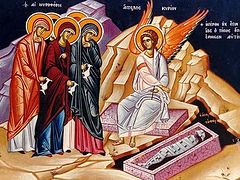
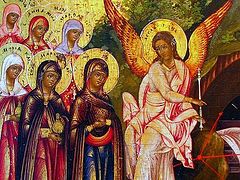
We can find very little about the holy Myrrh-Bearing Women in the Gospel pages. But there are the most important things in this “little”: faithfulness and love. Now there stood by the cross of Jesus His mother, and His mother’s sister, Mary the wife of Cleophas, and Mary Magdalene (Jn. 19:25).
Apostle Matthew testifies: Then all the disciples forsook Him, and fled (Matt. 26:56). The Apostle Peter thrice denied knowing Him, Judas betrayed Him, and the Garden of Gethsemane lapsed into drowsiness… The ultimate, terrible moment came when devotion and love were tested at the Cross!
The Myrrh-Bearing Women stayed at the Cross simply because they LOVED! They did not hide, they did not run away, just as no one runs away from the sun. They did were not fainthearted because in front of them on the Cross was the most important thing—the Truth Itself! “The weaker sex then appeared to be more courageous; everything changed so much!” exclaims St. John Chrysostom.
Christ did not reveal to them, as He revealed to the apostles, the mysteries of His death and His coming Resurrection. But they understood in their hearts that the crucified Truth was on the Cross and that it would soon become an immortal Victory! And then, after the Sabbath, at dawn of the third day, these “weaker vessels”, with vessels of myrrh made their way through the darkness to anoint the body of their Teacher… And it was to them that the Risen Christ appeared first! They were the first to hear from the Lord: “Rejoice!”—a call that has become the essence of the Christian faith. Rejoice evermore. Pray without ceasing. In every thing give thanks (1 Thess. 5:16–18).
And we, people of the twenty-first century, really need this reminder of love, sensitivity, and simple human faithfulness! Humanity desperately lacks these qualities! The holy Elder Sophrony (Sakharov) says that “we are now surrounded by the ‘arctic ocean’ of the prayerless world, and unless we bear within ourselves the power of fire that overcomes the ‘cosmic’ cold, we will inevitably perish along with this world!”
It’s very cold in the world in our days! Therefore, the little icon lamp of the heart of each one of us should never die down. Its flame is love, and its oil and wick are courage and faithfulness! St. Justin (Popovic) of Serbia exclaims: “All that is human is damnation and hell until it is transformed into the Divine-human (theanthropic). Within the God-Man Christ everything human becomes Paradise, Paradise, Paradise. And there is no limit to your joy, O man, because you are man; for only by Him and in Him do you feel that you are a eternal, heavenly, cherubic, and Godlike man. It is a torment, the worst torment, O my mortal brethren and fellow human beings, to be man without the God-Man Christ. But it is a joy, the greatest joy to be man with the God-Man Christ!”
And St. John of Kronstadt reminds us: “With the help of the grace of the Risen Christ, a Christian himself inwardly rises from the dead and becomes a living person in spirit, and receives the gratifying hope of his blessed resurrection on the last day of the world by the Holy Spirit!” These words contain the most important thing, the very essence, the heart of our spiritual work—to rise from the dead inwardly and become living people in spirit, while here on earth. It is very hard to become living: it is easier, more comfortable and practical to be dead—without striving for anything, without desiring any grace—moving from the couch to the TV, from the kitchen to the internet.
Or, on the contrary, to fill your life to the full with invented chores, unnecessary bustle, and chasing earthly fantasies. There’s not a single free second, and it’s all for nothing! St. Nectarius of Optina would tell his visitors: “Man is given life to serve him, not vice versa! Serving his life, a person loses his harmony, works without discernment and comes to a very sad perplexity: He does not even know why he lives!” To serve life means to serve your passions, to live only by earth. It is when someone does not bear Heaven in his heart, but only a joyless, sour, oppressive daily routine! This is when there is no desire to stand by the Crucified Christ and when you do not feel like going to the Risen Savior early in the morning.
Throughout our history, civilizations were born and died. Millions of human lives were swept away by bloody wars. Fashions, tastes, and ideologies changed. But human faithfulness has never lost its value! Devotion to Christ has never been empty words! When Mary poured expensive perfume on Christ’s head in the house of Simon the Leper, the disciples were indignant, viewing it as a wasteful misuse of resources. But the Lord stopped them: Why trouble ye the woman? for she hath wrought a good work upon Me. For ye have the poor always with you; but Me ye have not always. For in that she hath poured this ointment on My body, she did it for My burial. Verily I say unto you, Wheresoever this Gospel shall be preached in the whole world, there shall also this, that this woman hath done, be told for a memorial of her (Matt. 26:10–13).
And each one of us must go in search of Christ not only very early in the morning the first day of the week (Mk. 16:2), but also all our lives! To the Life-Giving Sepulcher! To the Risen Savior of the world! Carrying the “spices” and “aromatic oils” of our hearts!
The Russian “myrrh–bearing women”, often affectionately referred to as “white headscarves”, prayed fervently for the victory of our people in the Great Patriotic War. And when at an international forum after the war journalists asked one of our hierarchs, “What will become of the Russian Church when all these grandmas die out?”, he replied, “Our granmas are immortal!”
Through the twilight of life, when it is hard and almost impossible to bear sorrows and temptations, let us ask God to help us remain faithful and devoted to our Fatherland, to those close and dear to us, to the Church and to Christ! And, as St. Nectarius of Optina used to say, “Let us seek great meaning in everything!”