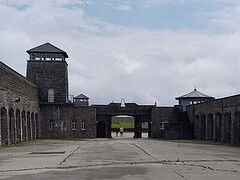
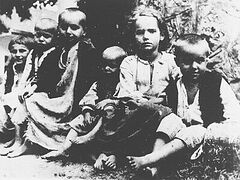
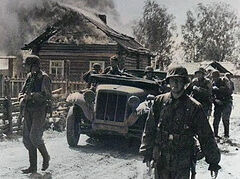
The liberation of Dachau, 1945
I heard the story of the Paschal service in the Dachau concentration camp from Archbishop Longin (Talypin) of Klin, who built an Orthodox chapel dedicated to the Resurrection of Christ on the site of the death camp, and who was a close acquaintance of Gleb Alexandrovich Rar, a Dachau prisoner and participant in that unbelievable Paschal service. I met Vladyka thanks to our common spiritual father, Schema-Archimandrite Vlasiy from the St. Paphnuty-Borov Monastery, where he often came from Germany. He had an amazing fate; he was born to a family of Russian immigrants in Finland, was raised from an early age in the faith, and with his parents often visited New Valaam Monastery, founded by Valaam elders who had fled the godless authorities in Soviet Russia. The spiritual atmosphere in the house of his Christian parents and his association with the Valaam elders, schemamonks, and practicers of mental prayer—all of whom he considered to be saints of our times—had a strong effect on his worldview.
As a youth he studied under well-known professors of theology—Archpriest Liveriy Voronov, Lev Parisskiy, and Nikolai Uspensky—and his fathers-confessors were Nikodim (Rotov) and Metropolitan Anthony of Surouzh. He and the future Patriarch Kirill were subdeacons to Metropolitan Nikodim, and after the services he they often talked, contemplating what to choose as their life’s path. Having both come from believing families, Vladyka Longin’s parents could not even conceive of life without the Church, and His Holiness Kirill’s father was a priest. His family lived in a state where militant atheism was the official ideology, but they both dreamed of dedicating themselves to serving God. This bonded them for their whole lives. When after many years Vladyka Longin’s father died, Archbishop Kirill of Vyborg, the future Patriarch, served his funeral.
Vladyka Longin’s first place of service was the Patriarchal Church of the Protection in Helsinki, where he was appointed rector in 1978. At the time it was the only Orthodox Church of the Moscow Patriarchate in Western Europe where services were celebrated daily, and to which commemoration lists and requests for forty-day commemorations at the Liturgy came from all over the world. As Vladyka told me, they received lists not only from Europe but also from the United States—and in mysterious ways even from believers behind the iron curtain in the Soviet Union.
 Archbishop Longin (Talypin) He ended up in Germany thanks to his Finnish passport, when Bishop Alexis (van der Mensbrugge) of Dusseldorf had retired due to serious illness. The German government strongly opposed the transfer to their country of a priest from “the terrible USSR,” where in their opinion all the priests were KGB agents. He served in Germany all his life, and to his final days he was the rector of the stavropegal Church of the Protection in Dusseldorf.
In the 1990s he set about collecting humanitarian aid for the former Soviet Union, and personally drove a truck all over Germany. “In the morning I prayed to the Theotokos,” Vladyka recalled, “and then—onward!” And the Most Holy Theotokos did not abandon him. They collected around 1500 military trucks of aide, filled with medicines, food products, and clothing. They also filled several large ships and cargo airplanes with humanitarian aid.
Sometimes help came from the most unexpected places. The father of his assistant, Angela Huisen, was a scholarly and believing Christian man who considered himself a friend of Russia. During the Second World War he served in the Wehrmacht forces on the Eastern front, and during one battle he was seriously wounded and taken captive. But instead of showing hatred for the occupying forces, the Russian people treated him and took care of him, as he himself said, literally bringing him back from the brink of death—and from that time on he always felt great gratitude to Russia. He passed on his love for everything Russian to his daughter Angela, who decided to convert from Protestantism to Orthodoxy and then learned iconography from an Athonite monk-iconographer! She was Vladyka Longin’s most faithful assistant, and was engaged in social ministry. Her father worked at the Bundeswehr Military Academy, and through his connections he was able to facilitate the delivery to Russia of humanitarian aid.
In those days, Vladyka Longin became acquainted with the international journalist and Church historian Gleb Alexandrovich Rar—once a prisoner of Dachau. The story of what took place in the death camp and how the prisoners greeted Pascha there shook him to the depths of his soul.
Dachau was one of the most horrifying camps of Fascist Germany, and probably the most terrible, cursed place on earth. It was created for Hitler’s political opponents and enemies. During the Second World War, people whom the Nazis didn’t even think of re-educating were sent there —most of the prisoners were Christians: Protestants, Catholics, and Orthodox. Monstrous and deranged medical experiments were performed on them, under the direction of the Nazi doctor Sigismund Rauch, who was so “successful” at destroying people that he was appointed head of all the concentration camps of the Third Riech. The SS guards killed people under any possible pretext; a person could be shot or sent to the gas chamber for the slightest mistake, even for an incautious glance. These people’s lives were daily martyrdom and confession of the faith. We cannot even imagine what they went through, we can only remember them, revere their unbreakable spirit, and pray.
People in the camps were subjected to the most horrendous tortures: They were hung on hooks through their ribs and left to hang in the sun for several hours, they were crucified, they were stretched out on special racks till the bones broke, they were flayed alive. Human skin was a valuable commodity for German industry—they made lady’s handbags and gloves out of it, and this was very fashionable in German society. Soap was rendered from the corpses of tortured people, and their bones were ground for fertilizer—German frugality turned it all for the benefit of Great Germany. Greasy, suffocating smoke rose over the camp from the crematorium pipes day and night.
 Gleb Alexandrovich Rar Gleb Alexandrovich Rar was brought to the Dachau camp in a freight train from another death camp—Buchenwald. The train cars were packed with sick and dying prisoners, who were given neither food nor water. Out of the 5000 prisoners, just over 1000 made it to their destination. Many were shot, some died of hunger and lack of air, others from typhus. He was taken to barrack No. 27, were those with typhus lived. At night they heard the thunder of the allies’ bombing in Munich, thirty kilometers from their camp. The front rapidly moved closer. Despite the desperate resistance from Hitlers’ forces, the days of Fascist Germany were numbered.
The prisoners were forbidden to leave the barracks under threat of swift execution on the spot. Soon the rat-a-tat of machine guns could be heard, with grenade explosions and shouts right next to the camp. Then the prisoners could see, through the windows and cracks of the barracks, white flags raised on the guard towers.
On April 29, 1945, at six in the evening, the Allies entered Dachau. Colonel Walter Fellenz of the Seventh U.S. Army recalled:
“Several hundred yards inside the main gate, we encountered the concentration camp enclosure. Before us behind an electrically charged barbed-wire fence stood a mass of joyous, hysterical men, women and children shouting and waving with happiness the thought uppermost in their minds: ‘Our liberators have come!’ It was an unbelievable din. Every one of the more than 32,000 persons who could create a sound was yelling with joy. Our hearts wept as we saw the tears of happiness fall from their cheeks.”
To Gleb Alexandrovich Rar’s barrack came the chief translator of the prisoners’ committee, Boris F. He told them that thanks to the help and concern of the Greek and Yugoslav prisoners’ committee, everything had been prepared for the celebration of a real Paschal service! Of course there were no priestly vestments; the prisoners sewed epitrachelions from towels, with red hospital crosses on them. They had no service books, icons, candles, prosphora, or church wine. But they had faith in God’s mercy manifested in that terrible place.
On the day of Pascha, May 6, 1945, in Barrack No. 26, where the English and American prisoners had a chapel in a small room, eighteen Orthodox priests, one deacon, and several faithful laymen entered. The sick Greek Archimandrite Meletius was brought in on a stretcher, and he lay throughout the whole service, having no strength to arise, praying and crossing himself with all the rest. In the chapel there was nothing but a small table and one icon hanging on the wall—of the “Chenstakhova” Mother of God. The original of this image came from Constantinople, from whence it was brought to the city of Belz in Galicia. Later the icon was seized from the Orthodox by the Polish king. When the Russian Army routed Napoleon’s forces from Chenstakhova, the abbot of the Chenstakhova Monastery gifted a copy of the icon to Emperor Alexander I, the “Liberator,” who placed it in the Kazan Cathedral in St. Petersburg upon his return to Russia.
Despite the fact that nearly half of the Dachau prisoners were Russians, only a few were able to participate in the festal services. By that time, the so-called “repatriation officers”—a special division of the “SMERSh”1—had quickly begun setting up new barbed wire fences to isolate the Soviet prisoners from the rest so that they wouldn’t try to stay in the West and not return to the USSR.
Throughout the history of the Orthodox Church there was likely never such a Paschal service as the one on May 6, 1945 in Dachau—the feast day of the great Orthodox saint and warrior, St. George the Trophy-Bearer! Handmade priest’s vestments made of towels with red hospital crosses were worn atop striped prison gowns. They served from memory. The Paschal canon, Paschal stichera—all was sung by heart. After the priest’s proclamations the choir sang hymns in Greek, and then in Church Slavonic. The Gospels were likewise read from memory. A young Athonite monk came out before the fathers, bowed, and with a voice trembling with emotion began reciting the Paschal Homily of St. John Chrysostom by heart. He recited the homily and wept—as did everyone around him. From the very heart of death, from the depths of this veritable hell on earth, carried the words, “Christ is Risen!” And in reply came the shout, “In Truth He is Risen!”
Among the prisoners was also St. Nikolai (Velimirovic) of Serbia, who had been sent there together with Patriarch Gabriel of Serbia on September 14, 1944, and where they remained until the Allies liberated them. It is not known whether St. Nikolai participated in that Paschal service, and Gleb Alexandrovich did not mention his being there. But we do have his Diary of epistles to the Serbian people, Through the Prison Window, which St. Nikolai wrote in Hitler’s dungeons. I will cite one of them:
Day of the Lord
Many do not feel the existence of air until the wind blows. Some have never thought about the existence of light until darkness falls upon them. So also many Christians have not felt the presence of God until the stormy blast of the winds of war have not crashed in on them. They did not think about God for as long as the world was bright and fortune smiled upon them. But when the whirlwind of war arose, when all the forces of evil united and covered all in darkness, people thought of nothing but God, and could think of nothing else.
The Day of the Lord! In Holy Scripture, what is for people night—terrifying night, blood and smoke, fear and horror, blood and torment, fire and destruction, shouts and moans—all of this is called the Day of the Lord. You ask, how is this possible? Why? Because it is in precisely these circumstances that those who are sated and have lost the fulness of God’s image recognize that God is everything, and they are nothing. The self-loving are covered with shame, the arrogant lower their eyes, the rich go with empty pockets, princes wish only that the occupation police might deign to speak with them, formerly careless priests weep bitterly before ruined churches, once-capricious women, dressed in filthy rags, boil dog meat for dinner. And they all think about one thing: about the grandeur of God’s greatness and the nullity of human dust.
This is why that terrible night is called the Day of the Lord. For on this day the Lord manifests Himself. While the peaceful human day went on, man did not remember God; he even exalted himself above God and mocked believers, laughed at those who called them to prayer, to church. When the terrible Day of the Lord arrives, all people return to the Lord, recognize God’s authority, ask about the Church, honor the priesthood, start reading spiritual books, sigh with shame about their past, repent of their sins, give alms, help the sick, fast, and receive Communion—for they understand that their death is close, and close is that world where the Day of the Lord is good, bright, joyful, and eternal.
The Lord says through the lips of Prophet Isaiah, “I will make man more precious than the pure gold of Ophir” (cf. Is. 13:12)—that is, what is most pure and precious. This, brothers, is the meaning of all misfortunes that the Lord allows to befall the world! To make man more valuable and precious than gold. Do you know, brothers, why the Lord of Heaven allowed all these horrors of war into the world in our days, with which only the horrors of hell can be compared? Because the value of man dropped lower than the value of gold. And this contradicts God’s plan for man; and everything that contradicts God’s plan must burst, disappear, die.
And now blessed are we if we have learned to value man above gold, above riches, above glory, above the stars, above the whole universe, which the Creator gave to man. Then all our suffering will not be in vain; then we will be strong and happy, and live in peace and quiet, in love and mutual respect, glorifying God the Father, and the Son, and the Holy Spirit. Amen.
As Vladyka Longin recalled, after Gleb Alexandrovich related the story of Pascha in Dachau, he said that as a believing man he is offended and hurt that although so many people gave their lives in that place for Christ and peace on earth there is still no church on that site where commemorative services could be performed and where prayers could be raised for them. “This was our sacred duty—to build an Orthodox church on the place where thousands of Orthodox Christians suffered!” recalled Vladyka Longin. He came to Patriarch Alexiy II in Moscow and told him about the need to erect a chapel in Dachau. His Holiness fervently supported him and bless him to begin construction. In 1994, a log chapel was prepared by a company in Vladimir province, and then loaded into train cars and brought to Germany, where Russian military engineers of the Western group of forces raised the chapel in the memorial complex at the site of the Dachau death camp.
 The Chapel of the Resurrection of Christ on the territory of the former Dachau concentration camp
On April 29, 1995, the fifty-year anniversary of the liberation of Dachau, the former frontline officer Metropolitan Nikolai of Nizhny Novgorod and Arzamas consecrated the chapel in honor of the Resurrection of Christ, and in autumn of the same year, His Holiness Patriarch Alexiy II served a memorial litya for all Orthodox prisoners who perished on German soil. The world-renowned icon, “The Resurrected Savior frees the prisoners of Dachau concentration camp”, as well as all the other icons in the chapel, were painted by Vladyka Longin’s assistant, the iconographer Angela Hausen, whom I later had the honor of meeting.
All the prisoners who were at the Paschal service of May 6, 1945, as well as all Orthodox Christians “in this place and in other places tortured and killed,” are now eternally commemorated in the Russian memorial chapel of the Resurrection of Christ in Dachau. Eternal Pascha of Christ!