Elder Nectarios was born in 1930 in the Greek city of Piraeus and was named Vasilios at holy Baptism. His parents were pious people who raised seventeen children, of whom the future elder was the sixteenth, the next-to-last. From a young age he was gentle and humble in character, loved the church and the divine services very much, and desired more than anything to become a priest. But in order to earn his daily bread, at the age of fifteen he was forced to begin working in a completely different place—in a barbershop in the port of his native city.
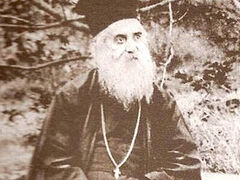
 Elder Nectarios (Vitalis)
At the age of seventeen, Vasilios went on pilgrimage to the island of Aegina, to the Holy Trinity Monastery, to the tomb of the man of God St. Nectarios, who at that time had not yet been glorified among the saints, but was fervently venerated by the people for the abundance of miracles and help he gave to people. Years later Elder Nectarios (Vitalis) recounted this pilgrimage thus: “I approached his tomb and said to myself, ‘If you truly are a saint, let me know about it!’ And when I venerated the tombstone, I clearly heard footsteps beneath it. I was shaken, and said mentally as well, ‘Thank you for giving me a sign! So you are here! You are alive, which means you are a saint! Tell me, will I become a priest, as I dream of doing?’ And I heard a voice from the tomb answer me: ‘Yes, you will become a priest, and you will bear my name!’
That night St. Nectarios appeared to me in a dream and told me a great deal. From that time on he has been my patron.”
I heard a voice from the tomb answer me: ‘Yes, you will become a priest, and you will bear my name!’
In 1950, at the age of twenty, Vasilios Vitalis received the monastic tonsure in the monastery of St. Meletios and was given the name Nectarios. In 1960 he was ordained to the priesthood and began to serve at one of the parishes in the Piraeus district of Athens. But at the age of thirty-five he suffered a stroke, and for the sake of his health he was transferred to the provinces, where the air was cleaner. Thus he found himself in the village of Kamariza in the province of Attica and began to serve there in the church of the holy Equals-to-the-Apostles King Constantine and his mother Queen Helena.
In that same year of 1965, immediately after the move, his heavenly patron St. Nectarios appeared to him and asked him to build a house for him there. Fr. Nectarios had no money at all, and the only valuable thing he possessed was his pectoral cross, but he sold it without hesitation and with the proceeds began to build a chapel at the local cemetery. Having successfully completed it, a year later he decided to erect a new, more spacious house for the saint, which, through the prayers of St. Nectarios of Aegina, came to pass.
However, an enormous obstacle immediately arose. In 1980, after the feasts of the Nativity and Theophany, Fr. Nectarios (Vitalis) fell ill and was forced to turn to the doctors, from whom he heard a terrible diagnosis: advanced lung cancer, with only two and a half months left to live. But it was in no way possible to finish the church in that time! And he began to pray to the holy wonderworker to grant him time to complete the construction and to serve at least one Divine Liturgy there.
 Elder Nectarios (Vitalis) In response to this prayer, St. Nectarios appeared to him in the church under construction in the form of an old monk in a worn-out cassock and said:
—O my child Nectarios! Do not be so downcast! This is only a trial. You will be healed, and the whole world will know about it!
Yet the healing was not instantaneous: he lived through two whole months in terrible torments and was forced to undergo an operation. Here is how the elder recalled it: “I had a severe form of cancer. My chest became one continuous wound, from which blood and pus oozed. From the pain I would tear my shirts. A swift and inevitable death awaited me. I had already prepared my funeral vestments.
“And then, on the morning of March 26, 1980, when I was in the lower church with the iconographer and the nurse who never left my side because of my grave condition, suddenly the door opened and an unfamiliar elder entered. He was short, with a gray beard and receding hairline, and he looked exactly like St. Nectarios in all the well-known photographs. Without saying a word, he took three candles, lit only two, and venerated all the icons in the iconostasis except the icon of St. Nectarios of Aegina. It was as if he had not noticed it. He did not see me. Overcoming the unbearable pain, I headed toward him.
“He stood before the royal doors with his arms crossed over his chest, and gazing into nowhere, asked: ‘Is the rector here?’ The nurse, wishing to shield me from the unknown visitor, hastened to reply, ‘No, no, he is at home; he has the flu.’ ‘That does not matter. I wish you all the best and a happy Pascha.’
“The nurse rushed over to me and said, ‘Father, that elder was the very image of St. Nectarios! It seems to me that it was he! He came to help you!’
“I thanked her, thinking she was saying this only to console me. But then I changed my mind and sent her with the iconographer after him, so that they might catch up with him and bring him back. I myself entered the lower church, approached the crucified Christ, and began to implore Him with tears to heal me. And suddenly I hear:
“‘Father! Rector! Come here!’
“I approached the stranger and wanted to venerate his hand, but out of humility he would not let me do so; instead he instantly bent down and venerated my hand! I asked him:
“‘What is your name, Elder?’
“‘Anastasios, my child.’ He gave the name that had been given to St. Nectarios at Baptism.
“I gestured for him to venerate the holy relics. Out of his pocket he took a pair of eyeglasses in a wire frame with one arm missing. Upon seeing them, we were struck speechless—these were the very eyeglasses of St. Nectarios that stood in the display case next to the holy relics! They had been given to me by the eldress Nectaria from his monastery on the island of Aegina.
“‘Faith is everything!’ he said, placing the eyeglasses upon it.
“And he began to reverently venerate all the holy relics, except the relics of St. Nectarios of Aegina. Paying no attention to them...”
“‘Faith is everything!’ he said, putting his glasses back on.
“And he reverently venerated all the holy relics, except those of St. Nectarius of Aegina. He ignored them and walked past them.
“‘Forgive me, elder!’ I remarked to him. ‘But St. Nectarius is a wonderworker! Why don't you venerate him?’ He turned to me and smiled silently.
“‘And where do you live?’ I asked him.
He pointed up at the ceiling, where we were building a new church, and said, ‘My house is not ready yet, so my soul is not in the right place. I can't live wandering here and there.’
“‘Elder,’ I confessed to him, ‘they told you a lie. I don't have the flu, I have cancer! But I want to recover, beautify the holy altar, finish the church, and then die.
“‘Don't worry,’ he told me. ‘However, I have to go. I'm going to Paros to venerate St. Arseny and visit Fr. Philotheos.’
“And he walked past his big icon without noticing it. I stopped him and touched his face. ‘Oh, my elder, my elder! Why, you have exactly the same face as St. Nectarius, who is revered by our Church!’
“And then tears began to flow from his eyes. He spread his arms and hugged me to his chest. I plucked up the courage to open my arms to hug him too… but my arms closed in emptiness. Then I shuddered and crossed myself. But I said again. “Elder, please, I want to live, I want to celebrate the first Liturgy here. Help me survive…’”
 The Church of St. Peter. The Nectarium of Aegina in Kamariza, built by the elder Nectarius (Vitalis)
On the day appointed for the operation, the saint appeared to him again and comforted him. And then it turned out that the operation was no longer necessary, since the cancerous tumors simply disappeared. This was confirmed in June of the same year at St. Sava's Hospital.
On the day appointed for the operation, the St. appeared to him again and comforted him
The news of this miracle quickly spread everywhere; people flocked to the elder, donations increased, and the church of St. Nectarius the Wonderworker was soon completed. And on June 2, the day on which Elder Nectarius was healed, has since been celebrated in the village of Kamariza as a feast day.
There are other miracles also connected with the name of the elder Nectarius (Vitalis), including the following. In 2015, at the Great Friday divine service, at the most intense moment, when the Savior was being lifted from the Cross and the Burial Shroud was being carried out, the eighty-five-year-old elder fell dead. Doctors pronounced him dead. But it turned out to be merely clinical death; after a mysterious stay in the other world and a conversation with his great patron saint, St. Nectarius of Aegina, the elder was returned to earth by Christ and lived on it for another 3 years.
 The grave of Elder Nectarius (Vitalis)
He reposed in the Lord on February 8, 2018. A video taken on the day of the burial shows how the hand of the lifeless elder continued to move slightly as a sign of blessing. He was buried in the bell tower of the church of St. Nectarius the Wonderworker in Kamariza, which he built. His grave, which has become a place of pilgrimage, is hung with memorial gifts from grateful believers.