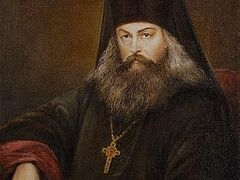
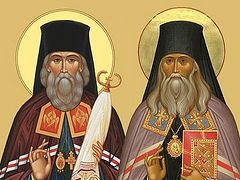
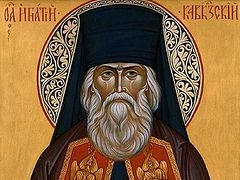
On April 30/May 13 the Holy Church honors the memory of St. Ignatius (Bryanchaninov). St. Ignatius was known to his contemporaries primarily for his ascetical writings. In the nineteenth century, he was a prominent figure in Russian Orthodoxy. The troparion to the saint reads as follows: “Champion of Orthodoxy, outstanding doer and teacher of repentance and prayer, divinely inspired adornment of bishops, and glory and praise of monastics. By thy writings thou hast imbued all of us with purity. O spiritual lute, divinely wise Ignatius, pray to the Word, Christ God, Whom thou didst bear in thy heart, to grant us repentance before the end.” Let’s take a closer look at his life.
 St. Ignatius (Bryanchaninov)
The future saint was born in February 1807 in the Vologda Province of northern Russia into a large noble family. It is known that his mother received him from God after many tearful prayers. The child was named Dimitry. He was the eldest of nine children and distinguished himself by his diligence in study, prayerfulness, and love of solitude. Even in childhood, in addition to three European languages, he acquired a strong knowledge of Latin and Ancient Greek, which later aided him in the study of theology. The boy’s favorite reading was the five-volume work, The School of Piety.
From his youth, the future saint’s soul was drawn toward the spiritual and eternal, but at his father’s insistence he was obliged to pursue a military and government career.
In 1822, Dimitry entered the Main Military Engineering School in St. Petersburg as a cadet. There he became the school’s top student, attracting the attention of Emperor Alexander I of Russia. During his years at the academy, he gained entry into St. Petersburg high society. A brilliant secular career lay open before the young nobleman. Yet the future saint was seeking something entirely different. At that time, he devoted himself to reading the writings of the Holy Fathers and visited the monks of the Alexander Nevsky Lavra, as well as with Hieromonk Leonid Nagolkin, the future renowned elder of the Optina Monastery.
 St. Leonid/Leo (Nagolkin) of Optina After graduating from the school in 1826, Dimitry submitted his resignation, but it was rejected. Yet, by Divine Providence, he retired later that same year due to ill health.
Dimitry then became a novice at the Monastery of the Holy Trinity and St. Alexander of Svir (now located in the village of Staraya Sloboda in the Leningrad Region, south of the border with the Republic of Karelia), where the abbot was Hieromonk Leonid Nagolkin, whom he already knew.
One of the saint’s spiritual children later wrote of this period of his life:
“Brianchaninov’s departure for the monastery quickly became known throughout the circles of St. Petersburg society. Many could not understand how a young and handsome officer, educated in secular learning and possessing influential connections, who enjoyed the patronage of the Emperor himself—an officer who might eventually have become a high-ranking court official or at least the governor of one of Russia’s cities—had suddenly abandoned everything and become a simple novice in a little-known monastery.”
During his novitiate, the future saint’s spiritual gifts began to reveal themselves:
“One day he was assigned to read an instruction from the works of St. Dimitry of Rostov in the refectory. Novice Dimitry’s reading was so moving and spiritually powerful that all the brethren forgot about their meal and listened with deep compunction, while many of them wept.”
But Dimitry did not immediately find inner peace at that monastery, and within the course of a single year, he lived in several different monasteries. Later, the saint himself wrote:
“My health was naturally weak, and it was further undermined by the hardships of life. But the greatest difficulty was spiritual: At first I could not find a monk who would be a living image of the ascetic teaching of the holy fathers of the Orthodox Church.”
In 1831, in the Diocese of Vologda, he was tonsured a monk with the name Ignatius and almost immediately ordained a hieromonk. He wrote to one of his companions:
“It is done! I have been tonsured and ordained a hieromonk. During the tonsure it seemed to me that I had died; during the ordination it seemed that I had risen from the dead. I live a new life. I am profoundly at peace; no desire troubles me. At every Liturgy I feel that I have attained the fulfillment of all my desires and received more than I could ever have wished for. I do not want to describe to you the outward circumstances that accompanied my tonsure and ordination—I assume others will tell you of them. I am telling you what others cannot know about me: I am happy!”
Over the next twenty years, Fr. Ignatius served as abbot of several monasteries, the first being the Pelshema Lopotov Monastery. He later became head of the Holy Trinity-St. Sergius Coastal Monastery near St. Petersburg. His biographers wrote of this period:
“People of every rank visited Archimandrite Ignatius at St. Sergius Monastery, and he found words of instruction for all. His conversations on spiritual matters were marked by profound wisdom drawn from Holy Scripture, the writings of the Fathers, and his own spiritual experience. In discussions on edifying subjects, Father Ignatius found a common language both with ordinary people and with members of high society. His natural simplicity and sincerity helped him with the former, while his brilliant secular education, tact, and keen understanding of human psychology helped him with the latter. No matter who came to Father Ignatius, there was never the slightest trace of self-interest in his words. He did not care what impression he made upon his visitors. His only concern was the benefit of their souls, and for this reason he was always truthful, even when it brought him suffering.”
During his abbacy at the Holy Trinity–St. Sergius Coastal Monastery, he was elevated to the rank of archimandrite. Yet his ministry was far from free of trials. As the Holy Scriptures say: Yea, and all that will live godly in Christ Jesus shall suffer persecution (2 Tim. 3:12). His enemies envied and slandered him, dreaming of having him exiled to some remote diocese.
At the age of forty, Archimandrite Ignatius requested retirement, but his petition was denied. He was, however, permitted to spend a short time at St. Nicholas Babaevsky Monastery in order to recover his health. From there he wrote to one of his correspondents:
“They are writing to me from St. Petersburg and urging me to return soon… To go back to St. Petersburg seems to me a very bitter cup. How happy I would be if the Lord deemed me worthy to end my days in some humble corner among fir trees and pines—I would not object to oaks and other trees as well—laboring for my own salvation and caring for the salvation of those neighbors whom love for God has joined to me.”
Nevertheless, he was obliged to return to St. Petersburg. During this period, he corresponded with the artist Karl Bryullov, the composer Mikhail Glinka, and Admiral Pavel Nakhimov. At the Holy Trinity-St. Sergius Coastal Monastery, he devoted great attention to the spiritual formation of the brethren entrusted to his care, leaving behind a deeply cherished memory.
At the request of Emperor Alexander II of Russia, Archimandrite Ignatius was consecrated Bishop of the Caucasus and the Black Sea in 1857 in recognition of his exceptional merits. The saint arrived in Stavropol and for nearly four years labored in the vineyard of Christ within the Caucasian see. During his tenure, the diocese developed significantly: a new building for the Stavropol Seminary was constructed, and a monastic community was established. It was there that St. Ignatius wrote his famous work, An Offering to Contemporary Monasticism.
At the same time, his already fragile health continued to deteriorate. Once again the saint petitioned for retirement, and this time his request was granted. In 1861, Bishop Ignatius arrived at the St. Nicholas Babaev Monastery in the Diocese of Kostroma (now within the Diocese of Yaroslavl), where he led a secluded life of prayer while devoting himself to literary labors.
 St. Nicholas Babaev Monastery
In 1865, his delightful two-volume book entitled, Ascetic Experiences, was published. We find the following words in the chapter, “Reflections on Death,” in volume 1: “Do you want to remember death? Keep strict moderation in food, clothing, and all household items; make sure that necessities do not turn into luxuries; study the Law of God day and night, or as often as possible, and you will have the remembrance of death. It will be combined with floods of your tears, repentance for your sins, the intention to reform, and many fervent prayers… My death, come to my memory! And the vanity and sensuality that captivate me will flee. I will remove steaming luxurious foods from my meals, take off my splendid clothes, instead put on clothes of mourning, and mourn myself alive—the named dead man from my birth… The remembrance of death, deep and powerful... will strike all my sinful endeavors with deadly blows.” Beyond all doubt, by his ascetic life, the saint acquired the remembrance of death.
St. Ignatius had a premonition of his earthly demise, often mentioning this in conversations with his neighbors. On Pascha 1867, he celebrated his final Liturgy and peacefully departed to the Lord on the Sunday of the Myrrh-Bearing Women. As one of his obituaries reads, “At seven in the morning on the very day of his repose, he had a cup of tea; but when an hour later they entered his room, they found him breathless. He was lying on his bed with an open prayer-book in his hands… So the angel of death came to him when he had no more strength to stand up for prayer, but even on his deathbed he did not want to be separated from the book, unknown to many, which for believers and pious people is an inexhaustible source of spiritual comfort.”
Around 5,000 people gathered for the funeral of St. Ignatius. According to the recollections of those present, the atmosphere was more joyfully solemn than sorrowful. The saint was vested in white liturgical robes, in which he had celebrated his last Liturgy. Soon he appeared in a dream to a religious woman from his circle, revealing how joyfully he had been welcomed in the Heavenly mansions. In 1988, St. Ignatius was canonized by the Russian Orthodox Church. His relics are kept at the Tolga Convent of the Entry of the Most Holy Theotokos into the Temple near the city of Yaroslavl.

On this day, let us partake of at least a single drop from the ocean of spiritual wisdom left to us by this saint, ascetic, and righteous man. One example is his spiritual poem, To an Earthly Wanderer:
O earthly traveler, awaken from your sleep!
Your bag is filled with sins;
You are immersed in carelessness as in a deep slumber.
Cease wasting your life, that priceless gift!
Otherwise death will suddenly come upon you like a thief…
And terrible is that awakening at the gates of eternity!
In many of his writings, the saint gave special attention to thanksgiving toward God. For example, he wrote:
“Make it your rule to thank the Lord every day for your cup—that is, for your illnesses and for all your sorrows… In every thing give thanks: for this is the will of God in Christ Jesus concerning you (1 Thess. 5:18). If not a single event is hidden from God, then God must be glorified for everything that happens. Blessed be God Who provides! Blessed be God Who permits! Nothing can take place apart from His will… With reverent submission, glorify the judgment of God and justify the instruments chosen by Him for your chastisement. Then the peace of Christ will descend into your heart… Through thanksgiving, wondrous peace enters the soul; joy also enters, even while sorrows surround you on every side… ‘Glory be to God!’ These are mighty words! In times of sorrow, when your heart is besieged by thoughts of doubt, fear, displeasure, and murmuring, compel yourself to repeat slowly, attentively, and often the words: ‘Glory be to God!’ Whoever with simplicity of heart accepts this counsel and tests it in practice when needed will perceive the marvelous power of glorifying God. He will rejoice at having acquired such beneficial knowledge and at having received a weapon against spiritual enemies so powerful and so useful.”
The saint also wrote about submission to the will of God:
“Do not be anxious, but in peace of soul surrender yourself to the will of God. God knows what He is doing, and whatever He does, He does according to His infinite goodness and His all-wise and inscrutable judgments. Say to yourself as often as possible: ‘Thy will be done.’ Let your mind and heart be immersed in this peaceful and holy thought. Let them find satisfaction in it. May God bless you and grant you understanding of the truth and submission to His holy will, from which peace of soul blossoms forth… Acknowledge and confess God as the Ruler of the world; with reverence and self-denial submit yourself to His will… From such awareness, from such submission, holy patience will blossom within your soul. You will recognize it by the peace it brings. Every word spoken against the ways of God will freeze upon your lips, and every thought of rebellion will vanish before the greatness of the divine will.”
 Concerning our attitude toward our neighbors, we read in his writings:
“The Lord will judge all our actions toward our neighbor, whether good or evil, as though they had been done to Him directly… Do not be satisfied with merely reading the Gospel fruitlessly; strive to fulfill its commandments and read it through your life itself. It is the Book of Life, and it must be read by life… Do not seek or expect love from people. Rather, seek with all your strength and demand of yourself love and compassion for others.”
There are also these lines from his poetry:
My soul, my soul! Receive this counsel:
There is no salvation outside His paths!
Adorn yourself with fasting and with tears,
With prayer and many sorrows!
Then shall you enter the holy divine dwelling,
The radiant abode of Paradise,
Rejoicing and making merry,
For there God awaits you with a reward!
(From the poem “Advice to My Soul”)
On this day, let us pray to this wondrous saint of Christ in the words of his kontakion:
“Though traversing the path of earthly life, O holy Hierarch Ignatius, thou didst unceasingly contemplate the laws of eternal life, which thou didst teach thy disciples through many words. Therefore, O holy father, pray that we also may follow them.”