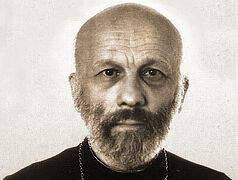
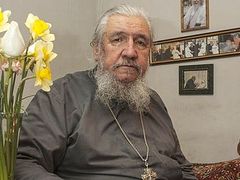
Archimandrite Zosima (Gorshunov) is one of the oldest clerics of the Diocese of Tobolsk and Tyumen. His Church ministry and missionary work began back in the 1980s. He’s the abbot of Holy Trinity Monastery in Tyumen and confessor for the diocese and the Tyumen Spiritual College.
 Hieromonk Zosima (Gorshunov) in a procession
Birth of the Znamenny Parish in Khanty-Mansiysk
The Znamenny parish in Khanty-Mansisky has its own story. Anna Medvedeva and Pelagia Sudeikina came to Tobolsk on pilgrimage. We spoke to them and found out that they really wanted to have a church in their city, so we got the address and went.
On my first trip, with Aquilina Evgenievna, we stayed at Pelagia’s place. Aquilina immediately organized a choir and taught the people to read and sing. She helped me with everything.
We announced on the radio that we had come, that people could be baptized, confess, and commune, and that we could serve other Sacraments and services.
A new day had dawned. I remember, even the chairman of the local Komsomol organization, a lively young man, came. He said he’d been in Poland and Czechoslovakia where people could go to church in peace, and that he didn’t see any problems with faith. I later baptized him and his entire family and blessed their apartment.
That’s how we traveled, founding new parishes or building up those that had already been established.
After consulting with the community, we decided to name the parish in honor of the Znamenny Icon of the Mother of God. Firstly, because according to historical data, before the revolution there was a Znamenny Icon in Samarovo, which in ancient times was brought there by Cossacks and remained there miraculously. It was lost in Soviet times. Secondly, we arrived in the winter of 1989, precisely on the feast of the Novgorod Znamenny Icon, and the Abalak Znamenny Icon, which is the most venerated icon of the Mother of God in Siberia (December 10).
The community was basically led by Anna Vasilievna Medvedeva then. She initiated and pushed through everything that happened in it. She was the organizer and psalmist and directed the order of the services. When there was no priest, she led the community’s liturgical life. She would read Vespers, Matins, Typika, canons, and homilies. She had an amazing gift for serving God and others. She said she had been blessed for this worked in Khanty-Mansiysk by the famous Pskov Caves elder Archimandrite John (Krestiankin).
There were few people in the community at first. There were men too. There were about thirty people altogether. I remember Tatiana Konstantinovna Bazhenova and her husband Vasily, and Valeria, Nadezhda and Sergei Nikonov, Kosygina Nikolaya Zakharovich and her husband. My deepest respect to them and all those whom I didn’t name. There’s a popular saying: “A church isn’t in the logs, but in the ribs.” These very first believers were the very ribs from which the Church in Khanty-Mansiysk was reborn.
In 1990, the Diocese of Tobolsk and Tyumen was established. For the first six months, it was headed by Bishop Anthony (Cheremisov). I remember going to Khanty-Mansiysk with him for the feast of Sts. Peter and Paul. We traveled around the city looking for a place for the future Holy Resurrection Cathedral. Then we went to the city administration where Vladyka proposed the site where the cathedral was later built under Fr. Sergei. He insisted on that spot, as it dominates the area. It offers a wonderful panoramic view of the entire city, at the confluence of the Ob and Irtysh rivers.
At first we gathered at Pelagia’s house, then at Gennady Zakalin’s. After his death, the city administration bought the house from his mother Tatiana and gave it to the Orthodox community. The first Orthodox church in the capital of Yugra was built in this house.
 Center: Metropolitan Dmitry of Tobolsk and Tyumen, L: Hieromonk Zosima (Gorshunov), R: Vladimir Semenovich Semenov
Then in 1991, Vladyka Dmitry (Kapalin) served the full consecration. Today, this building house the trapeza and Sunday school of the Znamenny parish.
There wasn’t much room in the new church. The parish gradually grew. More and more people came. There was an urgent need for another space for the Sunday School. Therefore, practically right after the consecration of the first church, it was decided to build another. Especially since there was a large plot next to the building. The territory was big enough to build a full-fledged church. So that’s what they decided to do.
 Teachers and students of the Znamenny parish Sunday School
Building the Znamenny Church
We took the Church in Uvat as a model. By the will of God, we got our hands on the book, Art of the Russian North, which talks about a church on Zayatsky Island, built out of logs in one day during the times of Peter I. It included a photo of it. We really liked the design of it. Based on this photo, we made a preliminary design and started building. It turned out really well. They used the same design in Khanty-Mansiysk. Considering the northern conditions, the church was prepared with extra insulation.
Since the plot of land was stretched along the road, the church had to depart from the traditional orientation from west to east. So the Znamenny Church altar faces not eastward, but southward. Another difference between the Znamenny Church and the church in Uvat was its larger dimensions and, consequently, greater capacity.
It was built, you might say, by the whole world. Anyone who could, helped—both people and organizations.
Alexander Bykov, a student from the Tobolsk Seminary, who was also a talented iconographer and woodcarver, put a lot of effort into the interior of the church. He made carved icons of the Znamenny Mother of God and of the Savior for the Knanty-Mansiysk community, and also a Crucifix that people still pray before today. For the church in Uvat, he carved wooden icons of the Savior and Elijah the Prophet.
The Znamenny Church was consecrated by Vladyka Dmitry in 1995. I was last there in 2006, at the invitation of the rector Fr. Sergei, for their patronal feast.
Abbacy
I taught at the Tobolsk Seminary from 1993 to 2021. Starting in the late 1990s, I also spent about seven years as the abbot of the reborn Abalak Monastery. I was the second abbot after Fr. Simeon (Mikushin). After me came Igumen Germogen (Sery), who later became Bishop of Michurinsk. All the repairs were carried out and the church was built under him. Now, the abbot of Alabak Monastery is Fr. Seraphim (Krasnov). After the monastery, I served at St. Sophia Cathedral in the Tobolsk Kremlin, where are all the seminary teachers serve.
In 2021, Vladyka blessed me to go to Tyumen, appointing me as abbot of Holy Trinity Monastery.
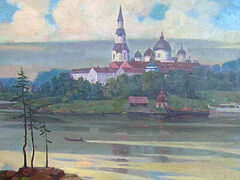
Our monastery was founded in the seventeenth century by St. Philotheus (Leschinsky). The Soviets closed it in 1923 and the brotherhood was repressed. Only in 1995 were the monastery and Holy Trinity Cathedral given to the diocese. In 1997, the Tyumen Theological College was revived. All this was accomplished by the labors and prayers of the first abbot, Hieromonk Tikhon (Bobov), now Bishop of Ishim. The rebirth of the monastery began with him. He had to raise everything up from ruins, restore it, and make an iconostasis.
Before it was reborn, there were various organizations here: the Peter and Paul Museum, the water utility with its facilities. There’s nothing left now. Everything was demolished. After Fr. Tikhon, Fr. Micah (Selyakov) became the abbot. He now serves in Vietnam under Vladyka Pavel. Then there was Fr. Hilarion, who came from Alabak, and after him is me. So I’m the fourth abbot.
We have twenty-five people laboring in our monastery right now: eleven clerics, three monks, and the rest are laborers and novices.
I also teach moral theology at the college and serve as the confessor for the school and the whole Tobolsk-Tyumen Diocese.
A Sign of Faith
The word “Znamenny” means “sign.” The Znamenny Icon, the Znamenny church—what kind of signs are these? I think they’re signs of God’s mercy, His boundless salvific love for us. Most important is to notice, recognize, and follow these signs. Those who pay attention to themselves and delve into the providence and will of God will be benefited by these signs. For that to happen, we have to purify and enlighten ourselves for the sake of meeting and communing with the Lord. We ascend to Him through knowledge of God, communion with God, and theosis. The last is the purpose of human life, which Christ also calls communion with the Kingdom of God.
We should talk about this at every service. If we don’t take heed to ourselves and don’t fulfill the will of God, we won’t attain His Kingdom. After all, what we partake of is what we abide in. If we partake of God, we abide with Him. If we commune with the world, then we perish with the world, having lived our lives in vain. God forbid.