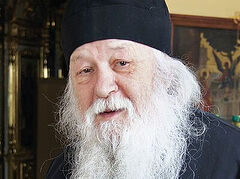
Schema-Archimandrite Mikhail (Krechetov)
November 21 last year, the feast of the Synaxis of the Holy Archangel Michael and the Other Heavenly Bodiless Powers, was the name day of Schema-Archimandrite Mikhail (Krechetov); before receiving the great angelic schema, Archimandrite Seraphim; †11/14/2025). Although this beloved and deeply revered pastor is better known among church people by his name before tonsure: Archpriest Valerian.
For fifty-five years, batiushka was the rector of the Holy Protection Church in the village of Akulovo near Moscow. This church was never closed during the Soviet era, and religious university professors would send their students seeking meaning in life to it, which they referred to as the “embassy of an unearthly civilization”. It was a focal point for everyone who wanted to embrace the Orthodox tradition. “The life of the Church is based on continuity,” Fr. Valerian used to say, and he himself found and learned much—including from people who had lived in the Russian Empire and remembered what it was like.
The father of seven children and grandfather of thirty-five grandchildren, batiushka was always especially happy to communicate with children and young people who visited his church on excursions. We offer our readers some of the elder’s previously unpublished answers to young people’s questions.
The Lord gave, and the Lord hath taken away
—People who are just beginning to read the Gospel cannot understand some of what they believe to be contradictions. For example: why does the Church call the poor blessed, but at the same time glorify people in power? What would you answer, father?
—The Church does not call all the poor blessed and does not glorify all those in power. That’s the whole point. As we read in the funeral service: “Yea, slave and master together stand before Him, king and soldier, rich man and poor man, all accounted of equal rank. For each one, according to his (her) own deeds shall be glorified, or shall be put to shame.” A pauper humbly bearing his cross is one thing. But a pauper who grumbles and envies others is clearly not someone the Church can call blessed. Likewise, for those in authority. If they use their power properly, that’s one thing; but if they abuse it, it’s quite another.
The Church glorifies individuals regardless of their rank and financial standing. Where Divine Providence has placed a person is a separate matter. Besides, the first Beatitude says: Blessed are the poor in spirit (Mt. 5:3). You can be very rich and at the same time poor in spirit. For instance, Righteous Job was rich and at the same time understood that all this was transitory: The Lord gave, and the Lord hath taken away (Job 1:21). And sometimes a poor man can be proud. By the way, neither wealth nor poverty protects us against grumbling if we are always displeased with everything.
It’s better not to wait for death in order to verify the existence of God
—How can you personally verify that God exists?
—Pray, and the Lord will show you. It is very easy to be sure that God exists. Look around you. How could such a complex world appear by itself? There must have been a Creator! Everything is so interconnected! It’s so obvious there is nothing even to verify. Only a fool doesn’t understand it.
Man did not create anything to reproduce. A machine doesn’t give birth to a machine. A Bedouin was once asked: “What makes you think that a camel passed by our tent, and not a man?” He replied, “Because the footprints are those of a camel, not a human being!” Look at the Sun—who created it so that it is neither further from nor closer to the Earth? If it were even a tiny distance further from us, we would freeze; and if it were tiny distance closer, we would burn!
The great Russian surgeon Nikolai Ivanovich Pirogov (1810–1881) said: “I cannot hear without disgust the slightest hint of the absence of a creative plan and creative rationale for the universe, and therefore I consider the existence of a Supreme Mind, and hence a Supreme Creative Will, as a necessary and inevitable fatal requirement of my own mind. So, even if I wanted to deny the existence of God now, I couldn’t do it without going crazy.” It’s rather audacious to test the existence of God. Wait, and you’ll eventually see. When you die, you won’t need any proof.
—And why do we ask God to have His power on earth as it is in Heaven?
—God does have power on earth, but people resist God’s will and want their own way. No one resists in Heaven—there is total obedience there. But on earth we oppose, but then we come to reason, and beg: “Lord, do as Thou willest! May Thy will be done!” More than that, when it was very hard, the Son of God Himself prayed: O My Father, if it be possible, let this cup pass from Me: nevertheless not as I will, but as Thou wilt (Mt. 26:39).
If people don’t seek God’s will
—Father, is it a sin to make a career in a secular society?
—What do we mean when we say, that someone has “made a career”? He had an opportunity, and he used it. In fact, a person cannot “make a career” on his own. This is self-deception. Take the president of a country. There is one president, but there were many candidates. Why did one of them make become president and the others didn’t? Because it’s God’s will—this one should be the head of state, and this one should not. It is known from history when (I don’t remember exactly) a king or a bishop prayed to God: “My God, what is this! How could You make him king?” God replied, “I was looking for a worse one for you, but I didn’t find one.”
 In what sense can it be sinful? When someone is pursuing his aim, while the main thing is to fulfill God’s will! As St. Nikolai (Velimirovic) said, “Your own will is an evil will.” By fulfilling it, you will sin. Because if there it’s God’s will that something happen, it will happen anyway. But if it is not God’s will, yet someone persists in his own will, he will go on sinning.
There are such examples in history. They say that when Hitler came to power, he was initially confused because he had not expected it. So did Lenin. Did they really “make careers”? Vladimir Ilyich was nobody. When I once mentioned Lenin while talking to Fr. Sergei (Orlov; tonsured Hieromonk Seraphim),1 he asked me, “Who is he? What personality?” I explained. “He’s nobody!” This priest, who had witnessed the events of the early twentieth century, cut me short. “I was in the thick of the revolutionary events, and no one had ever heard of him, no one knew him then. He was just some political scribbler... They knew Plekhanov,”2 he replied. Two weeks before the Revolution, Lenin still had no idea that a coup would take place. How can we say that he “made a career”? The Lord simply allowed him to assume power as He couldn’t find anybody worse for our people. There was apostasy in the masses. Godlessness did not infect a significant part of the population just by chance.
—Why is the use of force, by law enforcement officers for example, not a sin?
—Things are not so simple. The guardians of order are given power. But people do not always use power and force appropriately. In the history of both the Old and New Testaments we can find examples when rulers abused their power—take Herod for example. But often a person in authority appears to be powerless to do anything. For example, Pontius Pilate subjected Christ to Crucifixion, although He had made several attempts to release Him.