On May 9/22, we celebrate the Translation of the Relics of St. Nicholas the Wonderworker from Myra in Lycia to Bari. There are truly amazing events behind these words. We offer our readers the details below.
 Ancient neighborhoods of Bari
Bari and St. Nicholas
Let us turn our thoughts to the small city of Bari in southern Italy. We are greeted by picturesque old streets with tubs of fresh flowers. The thick stone walls of massive houses keep the interior invigoratingly cool. The doors are wide open, with snow-white curtains swaying in the openings. Peace and quiet and grace reign there. From the pavements and walls of the houses, you can feel the breath of the history of the ancient port city, which appeared back in the third century before the Birth of Christ.
The people of Bari often repeat the following proverb: “He who has never gone to sea has never prayed to God.” On every family tavern or cafe you can see an image of St. Nicholas in a small boat. Since time immemorial he has been venerated as the patron-saint of sailors, sincerely loved and revered.
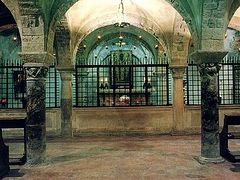
It is enough for a tourist to stop any local on the street and pronounce the words “San Nicolo” (“St. Nicholas”), and the passerby will start gesticulating animatedly, showing you how to get to the world-famous shrine—the Basilica of St. Nicholas. For over nine centuries now, it has been home to a priceless treasure of the Orthodox world—the relics of the illustrious saint and wonderworker—St. Nicholas of Myra.
 St. Nicholas Basilica in Bari
However, they were once in an absolutely different location, and their translation is a fascinating, quasi-detective story.
Translation of St. Nicholas’ Relics to Bari
Bari has not always been a tranquil and peaceful city. In the Middle Ages, wars often raged in this region. The city is conveniently located on the seashore, which means that there had always been many people eager to capture it. The fishing port of Bari had to defend its freedom with weapons, and therefore all the men there were not only fishermen, but also brave soldiers.
The Bari inhabitants were very religious and deeply venerated the patron-saint of sailors—St. Nicholas the Wonderworker. Of course, they wanted his holy relics to be in Bari to protect the city from adversity. However, St. Nicholas’ relics rested in Myra of Lycia—by the church where the holy hierarch served in his lifetime. And they decided on a desperate escapade.
 St. Nicholas Church in Demre (formerly Myra in Lycia)
In 1087, a large merchant ship sailed from the port of Bari; its merchants set off to trade with other countries. However, that voyage was different from the others—in addition to goods, there were many weapons in the holds. Moored in the Lycian city of Myra, the sailors started exploring the city, which was overrun with people. On that day the Turks were burying their military commander, which was why it was so crowded. The Bari people realized that in such an environment their plan was doomed to failure, and traveled on to Antioch.
Soon they returned to Myra, and this time they were lucky. The city was empty; only a handful of monks were at the church where the relics of St. Nicholas were kept. But they were safely hidden.
Today it is hard for us to imagine the morals and manners of that age, but history speaks for itself. The Bari people seized the monks and started “giving them third degree treatment”. One of the monks pointed out the spot on the floor under which the saint’s tomb rested.
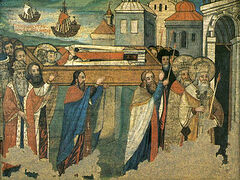
The sailors quickly broke up the floor and found an empty space, from where a subtle fragrance of myrrh emanated. They had to hurry before the townspeople stopped them. And one of them, the sailor Matthew, jumped inside and began to give out the holy remains to his friends. However, he had jumped down carelessly, damaging several bones of St. Nicholas the Wonderworker. The merchant sailors hastily put the relics into a wooden box, took the saint’s icon with them and ran back to their ship.
The commotion had already been noticed by the townspeople who rushed towards the port. The force was on the side of the Bari people, and the locals could only weep bitterly and raise their hands to the heavens. Their grief was so sincere that the sailors relented a little and returned the wonderworking icon of St. Nicholas to the inhabitants of Myra in Lycia. They came back to Bari as heroes.
 Translation of St. Nicholas’ relics from Myra in Lycia to Bari
The Bari residents solemnly welcomed the relics of the wonderworker and enshrined them inside the cathedral. But that was not the end of the story.
Translation of St. Nicholas’s Relics to Venice
Nine years passed. The First Crusade began, and the inhabitants of Venice decided to take part in it. They expressed the hope that they would not only be able to free the Holy Sepulcher, but would also bring the relics of St. Nicholas from Myra in Lycia to Venice. But how is that? After all, everyone knew that the relics had been moved to Bari. What were the Venetians going to look for in Myra?
There was an old legend that said that a portion of St. Nicholas’ relics in a special casket still remained elsewhere in the basilica and the Bari people had not succeeded in finding it. So the Venetians took the initiative.
The Venetian fleet arrived in Myra of Lycia, broke into the basilica and set about searching for the relics, turning everything upside down. The terrified guards assured the knights that the sailors from Bari had taken the relics away a few years earlier, but the Venetians did not believe them and used force. The exhausted guards showed them a place in the old chapel of the basilica.
The knights broke up the floor and found a copper casket with a Greek inscription on it: “The great Bishop Nicholas, famous for his miracles on land and at sea, rests here.” When it was opened, the whole space was filled with a subtle fragrance.
 Church of San Nicolo on the island of Lido, where a portion of St. Nicholas’ relics is kept
Overjoyed, the Venetians took the relics to the church on the island of Lido in Venice. They are still there.
Modern Examination
Now let us travel back to the twentieth century. In 1953, the bishop of Bari decided to prove that it was there that the saint’s relics were kept, since Venice disputed this honor with Bari. He invited Luigi Martino, professor of human anatomy at the University of Bari, as an expert.
The results of the study amazed the entire scientific world. First, myrrh-streaming was established. The thin bones were covered with fragrant moisture. In addition, it was officially confirmed that these are the authentic relics of St. Nicholas, and the very remains that the Bari people had stolen from Myra in the eleventh century. Do you remember the unlucky sailor Matthew who jumped into the tomb in a hurry? The professor confirmed historical sources, proving that many bones were damaged owing to that jump.
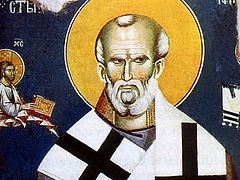
 Icon of St. Nicholas, painted by students of the Russian School of Icon-Painting
Luigi Martino carefully laid out all the remains and found out that many parts were missing. Everyone immediately remembered how the Venetians claimed that St. Nicholas’ relics were in their possession. But that set of relics was not examined until 1992. The same professor confirmed that the Venetian remains perfectly complement those in Bari. So, everything secret became known.
Now it is hard for us to give a moral assessment of the events that took place over nine centuries ago, and there is no need to do so. In fairness, it should be noted that the territory of modern Turkey, including the former Myra in Lycia, was subsequently captured by the Seljuk Turks, and many Christian shrines were in danger. Perhaps the Italians saved the holy relics from destruction.
A great deal has changed since then. Powerful empires have since disappeared, new countries have appeared, and many generations have changed. But to this day, the ancient Italian cities of Bari and Venice share their patron-saint, and multitudes of pilgrims flock to the unique shrines of St. Nicholas every day, asking for his help. Let us ask for it too!
Holy Father Nicholas, pray to God for us!