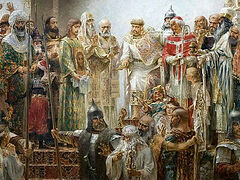
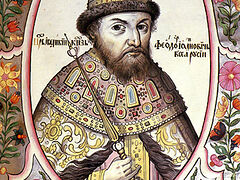
The baptism of the Kiev people by Metropolitan Michael I. The Illustrated Chronicle of Tsar Fyodor III, 1682 The era of the beginning of Christianity in Russia is an indisputable watershed in the life of our Fatherland—the time when, in fact, Russian history began. What was before is the Slavic pagan past, and what came after is the Russian Orthodox present. It was then, in the second half of the tenth century, that a new Ancient Russian State was born out of the Polovtsians and the Drevlyans, the Krivichi and the Vyatichi, the Slavs and the Varangians—no longer bound by politics, force, self-interest and fear, but by faith—the true faith.
Everything that is dear to us now, what we call “our native” and “Russian”, was either born of Christianity, or transformed by it in the most profound way. It is impossible to imagine a Russian house without the “holy corner”;1 the Russian kosovorotka (the traditional side-button, stand-up collar shirt) was specially invented for wearing the cross comfortably;2 Russian cuisine owes its wealth to the vibrant variety of the Orthodox calendar (the alternation of non-fasting and fasting periods); and any Russian city, town or village is unthinkable without the silhouette of an Orthodox church… It is often much easier for us than for representatives of many other nations to come to God—even now, after the era of Soviet atheism—because the road to the Orthodox Church had been trodden by many generations of our ancestors.
But for us to have all this happiness now, hundreds of years ago our forefathers had to take a much more difficult step. They could not rely on the power of custom, they were not warmed by the memories of their believing grandparents, and they were not returning to the Church, but were stepping into the unknown for the first time. They needed to abandon not only their personal weaknesses and passions, but also many of the customs of their ancestors, and to realize that the God they were being called to was not “foreign” or “Greek”, but their own loving Father. They had to choose between their world, so close and dear to them, and the Truth. And they chose the Truth.
The process of this transformation of an entire country was certainly not easy and by no means instantaneous; and, beyond all doubt, the main figure here was the holy Grand Prince Vladimir Svyatoslavich, Equal-to-the-Apostles (ruled 980–1015). It was he who chose Orthodoxy both for himself and for his state, and it was he who was able to implement such an epoch-making reform of the life of the whole nation, which was then divided into tribes, and do it in such a way that a large-scale pagan reaction did not sweep through Russia, as often happened in history. That is why Prince Vladimir the Great has enjoyed well-deserved love in his country for a millennium; all Russian people know him and his deeds. But what is surprising is that there are hardly any people who know anything about who actually baptized the Russians in those days, who consecrated the first Russian churches, and who was the first archpastor of all Russia. More than that, we cannot even be quite sure that we have the correct information about him or even his name. Scholars still argue over this question: who was the first Metropolitan of Kiev? However, Church consciousness confidently preserves the tradition of our first archpastor, and at every Vigil during the Litia the name of St. Michael, the first Metropolitan of Kiev, is proclaimed. However, this title does not necessarily mean that St. Michael was bishop under the holy Prince Vladimir; it may have been earlier, during the so-called “Photian Baptism of Russia”.3
This is what the holy Patriarch Photius of Constantinople wrote in his encyclical letter, written in 867, 120 years before the Baptism of Prince Vladimir:
“Even the so-called Rus’ people…, who were notorious and outstripped everyone in their ferocity and bloodshed, have exchanged the pagan and godless faith in which they had previously lived for the pure and genuine faith of Christians…, received a bishop and a pastor, and with great zeal and diligence celebrate Christian rites.”4
To all appearances, it was the Baptism of the Kievan people on the initiative of their famous Varangian Princes Askold and Dir, who, having previously come to fight against Byzantium, converted to Christ by a miracle of God. Another Byzantine source (by Emperor Constantine VII Porphyrogenitus) even recorded a vivid episode of those days: an Orthodox archpastor who had recently arrived in Russia was invited by noble Russians who wondered what he wanted to teach them. The hierarch opened the Gospel and began to tell them about the Lord Jesus Christ, His life on earth, and His teachings and miracles, and mentioned some of the great things that God performed in the Old Testament. After listening to him, the Russians replied:
“Unless we see something like this, especially something like, as you say, that which happened to the Three Children in the Fiery Furnace, we don’t want to believe it.”5
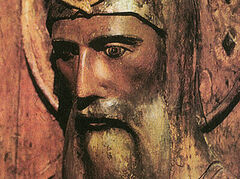
 St. Michael, Metropolitan of Kiev. A Menologion icon. The State Hermitage Museum In some sense, we can understand those nobles: they were being told about events that had taken place a long time before—at least 1000 years before them; it was as far away as those ancient Russians are to us today… “It doesn’t matter whether it happened or not, because now everything is different, it is the contemporary era, and there is no place for those miracles in it. Why should we need that?”
But the bishop from the faraway Byzantine Empire knew what his listeners did not know: that Jesus Christ the same yesterday, and to day, and for ever (Heb. 13:8). That both external miracles and the miracle of changing the human heart is not about the semi-legendary past, but always about us living here and now. He understood that the Russians were asking for the impossible, but he wholeheartedly believed in the One Whom he preached. He replied:
“Although we must not tempt the Lord, if you have sincerely decided to convert to Him, ask for what you want, and He will fulfill everything according to your faith, no matter how insignificant we are before His greatness.”6
The Russians asked that a large bonfire be made, and that the Gospel that the bishop was holding in his hands be placed into it. If the Book did not burn, they would be baptized. The bishop agreed. A bonfire was made; raising his hands, the archpastor exclaimed:
“Lord Jesus Christ, our God! Glorify Thy holy name now in the sight of these people!”7 and he threw the Gospel into the fire.
Several hours passed. The flames burned everything in the bonfire, and finally went out; and the Gospel lay absolutely intact on the ashes. Even the ribbons that fastened it were whole. Astounded, the Russians fulfilled their promise and were baptized at once.
The Rudder8 and some other sources refer to this hierarch as St. Michael, and a number of researchers believe that this may have been the very first archpastor of Kiev.9
However, the most popular (although not historically ideal in all respects) is another version, which has become the traditional Life of the saint and dates his life to the reign of Prince Vladimir Svyatoslavich; the problem lies in the fact that the name of St. Michael as hierarch under Prince Vladimir cannot be found in the oldest sources and appears only in texts of the fifteenth century. However, since this version has not been completely rejected by historians, has been accepted by Church consciousness and is reflected in liturgical texts (see the Canon to St. Michael, the First Metropolitan of Kiev), let us consider it.
The thirteenth-century Chronicler of the Russian Tsars (also known as The Chronicler of Pereyaslavl-Suzdal) and some other historical sources, followed by the Life of St. Michael of Kiev by St. Dimitry of Rostov (1651–1709),10 say that he came with Princess Anna Porphyrogenita from Byzantium to Chersonesos (also known as Korsun), where Prince Vladimir Svyatoslavich was waiting for them. As we know, St. Vladimir provided great military assistance to the Byzantine Empire in exchange for the hand of the Byzantine princess, but the co-emperor brothers Basil II and Constantine VIII were disinclined to give their imperial sister in marriage to a “barbarian” ruler. The offended Vladimir Svyatoslavich seized the Byzantine colony of Chersonesos in order to demand the promised princess in exchange for it. Young Anna had to go to a foreign country to marry a man whom we know as the holy Baptizer of Russia, but she knew him as a cruel pagan. St. Michael traveled with her—away from his homeland, but in the name of Christ. He baptized Prince Vladimir in Chersonesos, instructed him in the faith, went to Kiev with the prince and Princess Anna and baptized Vladimir Svyatoslavich’s children, and after that he set about evangelizing the country entrusted to him. It was he who headed the Baptism of the Kievan people in the waters of the Dnieper River; with his blessing, Prince Vladimir built the first churches—in particular, the famous Tithe Church in Kiev, “the cathedral church of the Most Holy Theotokos”,11 baptized people, smashed pagan idols, and traveled to Novgorod and Rostov, enlightening the people entrusted to him. The Lord ordained St. Michael to perform his ministry in Russia for four years (the saint reposed in 992), but he accomplished very much in such a short span of time. St. Michael was buried at the Tithe Church, which was then still unfinished, and later his relics were translated to the Kiev Caves Monastery.
That’s virtually all we can say about the man who was the first to stand at the helm of our Church. Of course, we would like to say, What a pity that it is so little! Yes, it’s a pity… But the main thing we know for sure: Without sparing himself, he sowed the seeds of the faith of Christ into the yet unfertilized and wild soil of the Russian land. And his labors yielded fruits that can hardly be completely described or even fully imagined. And we believe that now at the throne of God he prays for the Russian Orthodox land and his countlessly multiplied spiritual children.